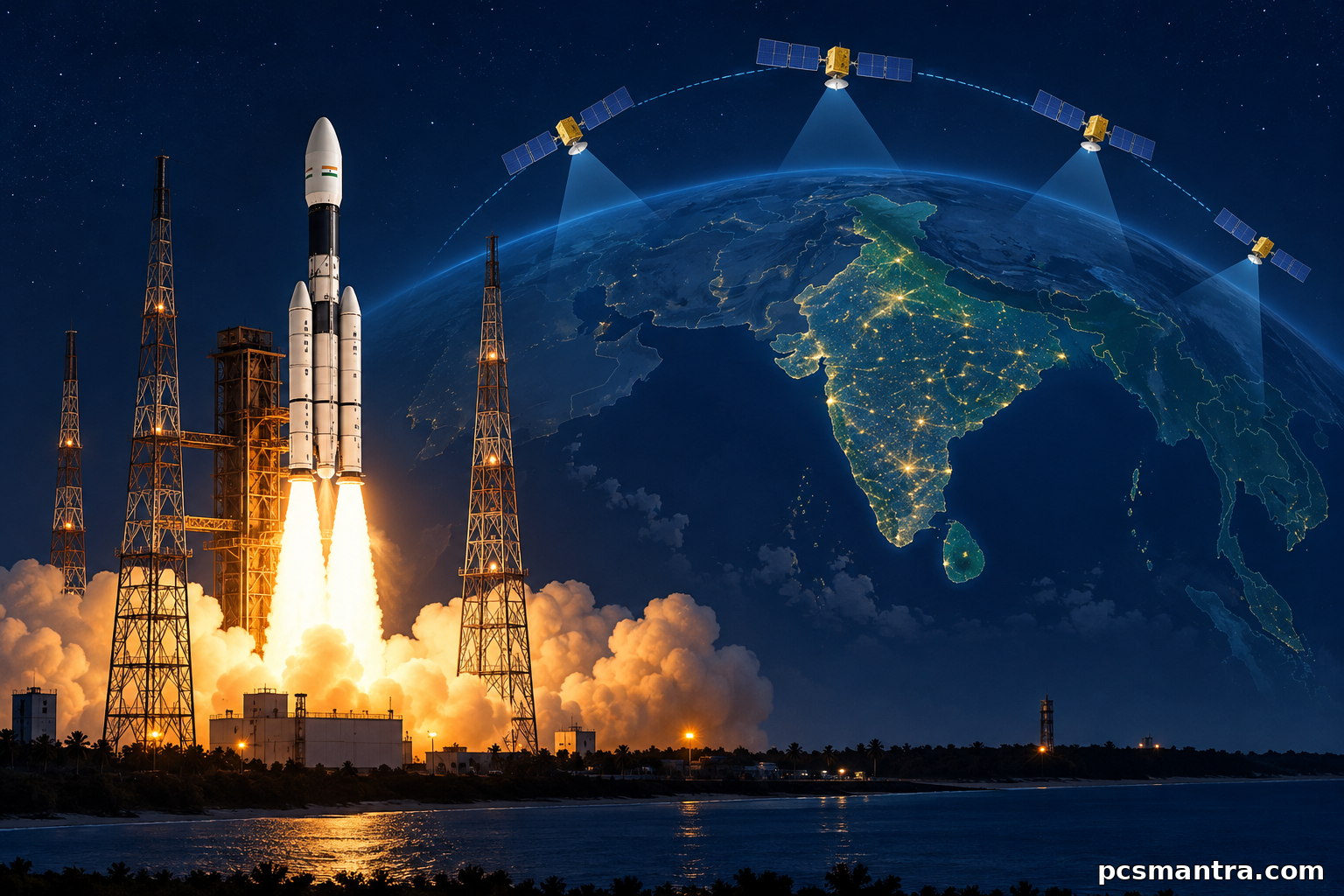
NVS-03 Healthy: Service Status Will Be Decided Only After In-Orbit Tests
Event: 5 November 2026 | Update published: 7 November 2026
On 5 November 2026, ISRO Chairman V. Narayanan said that the NVS-03 satellite, launched on 30 October, is healthy. He referred to engine operations beyond the initial orbit and the satellite's good condition. He said the payload and other systems are yet to be tested in orbit.
ISRO's official mission update of 4 November gives details of the completion of four orbit manoeuvres, a cumulative LAM engine burn of 6,164 seconds and reaching a geosynchronous orbit of 35,765 x 36,196 km. The official page describes the satellite's health as normal. For the precise orbit and engine duration, this dated mission page is the basis, rather than the oral details given in the news.
Launch, orbit-raising and service are three stages: the successful launch of a satellite by a rocket is one stage. Reaching the intended orbit is the second stage. Testing of the payload and induction into service is a separate, further stage. So it would be hasty to assume that a 'healthy satellite' or successful orbit operations mean all NavIC services are fully restored.
The earlier article had the details of the first orbit manoeuvre of 31 October and of the operations to follow. That was the position at that time; the 5 November statement takes that progress forward. The satellite was launched on 30 October 2026.
Meaning for the examination: in indigenous navigation, not only the number of satellites but also healthy clocks, a reliable signal, orbital position and continuous service capacity matter. Claims of operational success should be tied to the correct stage of the mission.
Sources for This Update
Why in the News
At 23:51 on the night of 30 October 2026, ISRO successfully launched the 2,250 kg navigation satellite NVS-03 aboard the GSLV-F18 rocket from the second launch pad of the Satish Dhawan Space Centre, Sriharikota. On 31 October, the satellite's first orbit manoeuvre also succeeded and the satellite is healthy. According to ISRO Chairman Dr. V. Narayanan, the constellation has returned to its minimum operational configuration (four satellites) with this; full restoration of services will be decided only after the satellite's final orbital placement and commissioning. But ISRO's own launch list also shows a harsher picture: by 2 November 2026 there had been only three orbital launches in 2026, of which PSLV-C62 (12 January 2026) failed and only GSLV-F17 (4 September) and GSLV-F18 (30 October) succeeded; before that, PSLV-C61 (18 May 2025) had also failed. That is, two PSLV failures in a year and a half, and only two successful launches in the first ten months of the year. Measured against the announced plans for human spaceflight, a space station and a reusable rocket, this gap is the centre of the discussion about ISRO's capacity.
Position of the Launch and the Satellite (as of 2 November)
According to ISRO's mission page, GSLV-F18 was the 20th flight of the Geosynchronous Satellite Launch Vehicle (GSLV). The rocket placed NVS-03 into a geosynchronous transfer orbit (GTO) of 170.3 km x 38,080 km. According to ISRO, the first orbit manoeuvre was completed on 31 October at 16:48 with an LAM engine burn of 2,174.8 seconds, after which the orbit stood at 5,477.6 km x 37,833.4 km. That was the position as of 31 October; under the plan at that time, further manoeuvres were to take the satellite to its GSO slot at 111.75 degrees East. On 4 November, ISRO confirmed the completion of all four orbit manoeuvres; the latest details are in the update section above.
NVS-03 is the third satellite of the second-generation navigation satellite series, built for the continuity of the IRNSS series' navigation services. It carries an indigenous atomic clock alongside imported ones and an L1 signal in addition to the existing L5 and S band signals; coverage is the Indian landmass and an area about 1,500 km beyond its borders. The mission life is 12 years.
Background: A Weakened NavIC
NavIC is India's independent regional navigation system, providing position, navigation and timing (PNT) services in India and the surrounding region. Repeated failures of the imported atomic clocks of the first-generation IRNSS satellites weakened the constellation; in March 2026, IRNSS-1F's last working clock also stopped. In addition, the replacement satellite NVS-02 could not reach its designated orbit. The result: the constellation remained one working satellite short for at least six months and was unable to fulfil the main purpose of an independent positioning service. In the Parliamentary Standing Committee's 410th report (March 2026), the department stated that 12 satellites have been launched so far, eight are operational, but only four are providing continuous PNT service; four satellites (IRNSS-1A, 1C, 1E, 1G) cannot provide PNT service because of clock failure and are used only for one-way message broadcasting, IRNSS-1D has been decommissioned, IRNSS-1H was a failure, and NVS-02 is on limited service in an elliptical orbit. The department admitted that the failed clocks had been bought from foreign vendors; indigenous clocks have been demonstrated on NVS-01 and NVS-02, and the committee has recommended a full indigenous switchover and time-bound replacement. According to the ISRO Chairman, with NVS-03's replacement the constellation has returned to the minimum operational configuration of four satellites.
Capacity Constraints: The Picture in Numbers
According to ISRO's official launch list, there were three orbital missions in 2026: PSLV-C62/EOS-N1 (12 January - the satellites did not reach their designated orbit due to an anomaly in the third stage), GSLV-F17/EOS-05 (4 September) and GSLV-F18/NVS-03 (30 October). PSLV-C61/EOS-09 (18 May 2025) had also failed. That is, between two consecutive PSLV failures, the vehicle considered the country's most reliable remained out of service for nearly a year and a half, and by the end of October 2026 only two successful orbital launches had taken place in all.
On the resources side, the main evidence is the figures in the 410th report (Demands for Grants of the Department of Space, 2026-27) presented on 25 March 2026 by the Parliamentary Standing Committee (on Science and Technology, Environment, Forests and Climate Change): the department had sought an outlay of Rs 15,604.80 crore from the Ministry of Finance, while the approval was Rs 13,705.63 crore (87.82% of the outlay sought). The committee noted that the 2025-26 allocation had come down from the budget estimate of Rs 13,416.20 crore to a revised estimate of Rs 12,448.60 crore, and that expenditure by 31 January 2026 was only Rs 9,739.72 crore; the committee recommended improving the rate of budget utilisation and additional funds for IN-SPACe and INSAT systems at the revised-estimate stage. In the same report, the committee recorded that scientific missions such as Chandrayaan-4 and the Venus Orbiter Mission were held up by the availability of special components, vendor readiness and long-lead items, pushing procurement programmes into the next financial year; the committee also noted that ISRO depends on foreign vendors for certain important components and technologies, and recommended supporting start-ups with funding, technology transfer and market access to reduce foreign dependence.
On the reform side, an editorial proposes adapting the Electronics Component Manufacturing Scheme and the modernisation of the Semiconductor Laboratory for space components, an allocation of about Rs 17,000 crore for the Department of Space in the 2027-28 budget, a dedicated operator for NavIC, and a national space law covering private participation and liability. To be clear, the Rs 17,000 crore figure is only that editorial's proposal, not any government announcement.
Examination Perspective
Mains (GS-III): space capacity, navigation self-reliance and institutional reform: the combination of launch-vehicle reliability, component procurement, budget and law.
Prelims: GSLV-F18 (20th flight), the NVS series (indigenous atomic clock, L1/L5/S signals, 1,500 km coverage), NavIC's minimum operational configuration.
Prelims Practice Questions
Question 1. Which statement is correct with reference to NVS-03?
(a) It is the third replacement satellite of the first-generation IRNSS series
(b) It is the third satellite of the second-generation navigation series, with an L1 signal alongside the indigenous atomic clock
(c) It carries only imported atomic clocks
(d) Its mission life is fixed at 7 years
Answer and Explanation
Answer: (b). NVS-03 is the third satellite of the second-generation navigation series (NVS); it carries an indigenous atomic clock alongside imported ones and includes the L1 signal in addition to L5/S. The mission life is 12 years.
Question 2. Which statement is correct with reference to the GSLV-F18 mission?
(a) It was the 20th flight of the GSLV vehicle
(b) It placed NVS-03 directly into geostationary orbit
(c) The launch took place from the first launch pad
(d) It is an advanced version of the PSLV vehicle
Answer and Explanation
Answer: (a). According to ISRO, GSLV-F18 was the vehicle's 20th flight; it placed NVS-03 into a geosynchronous transfer orbit (GTO), from where orbit manoeuvres took it to the GSO slot.
Mains Practice Question
"Despite the success of GSLV-F18/NVS-03, ISRO's capacity constraints are a major challenge before India's space goals." Review this statement. (Answer in 250 words. 15 marks)
Answer Outline
Introduction: The successful launch of NVS-03 by GSLV-F18 on 30 October 2026 and the restoration of NavIC's four-satellite minimum configuration, as stated by the ISRO Chairman, are a relief, but the launch list shows only two successful orbital launches in 2026 so far.
Main Body: Constraints: the successive failures of PSLV-C61 (May 2025) and PSLV-C62 (January 2026) and pressure on vehicle reliability; NavIC short of one satellite for six months because of clock failures and NVS-02's failure; budget constraints recorded in the committee's 410th report (87.82% allocation, slow spending, IN-SPACe/INSAT cuts) and the constraints of special-component availability, vendor readiness and dependence on foreign vendors. Reform directions: use of the component-manufacturing scheme and the Semiconductor Laboratory, increased resources, a dedicated operator for NavIC, a national space law.
Conclusion: For the plans of human spaceflight, a space station and a reusable vehicle, not mission-by-mission improvisation but a combination of resources, institutions and law is necessary.
Way Forward
NVS-03's orbit manoeuvres were completed on 4 November; NavIC's service restoration will be considered final only after in-orbit testing of the payload and other systems and commissioning. Next, the 2027-28 budget allocation, component-procurement reform and the progress of a space law will bear watching.
Sources
- ISRO: GSLV-F18/NVS-03 mission page – 20th flight, placement in GTO (October 2026)
- ISRO: orbit manoeuvring of NVS-03 – first LAM burn 31 October 2026, target 111.75°E GSO slot
- ISRO: launch missions list – three missions in 2026; PSLV-C61 "Not accomplished"
- NSIL: PSLV-C62/EOS-N1 failure message – third-stage anomaly (12 January 2026)
- The Hindu: GSLV-F18 places NVS-03 in orbit; NavIC restored to four satellites (30 October 2026)
- The Hindu editorial: Slow recovery – procurement constraints, the Rs 17,000 crore proposal (2 November 2026)
- Budget 2026-27, Demand 95: Department of Space – Rs 13,705.63 crore (indiabudget.gov.in)
- Standing Committee: 410th report, Demands for Grants 2026-27 (sansad.in, 25 March 2026)
Note: launch, satellite and mission figures are verified from ISRO's official pages, the C62 failure from NSIL's message, and the figures on the budget, NavIC constellation status, clock purchases and vendor dependence from the Parliamentary Standing Committee's 410th report; the Rs 17,000 crore figure is only The Hindu editorial's proposal; the constellation restoration is based on the ISRO Chairman's statement of 30 October.
Download This Article: PDF

PCSMANTRA Editorial Team
Research and Editing
We prepare current affairs analysis, exam updates and study material in Hindi and English for UPSC, State PCS, PCS-J and other competitive examinations. Every article is verified against official sources before publication; sources are listed at the end of each article.
Read our editorial policy