
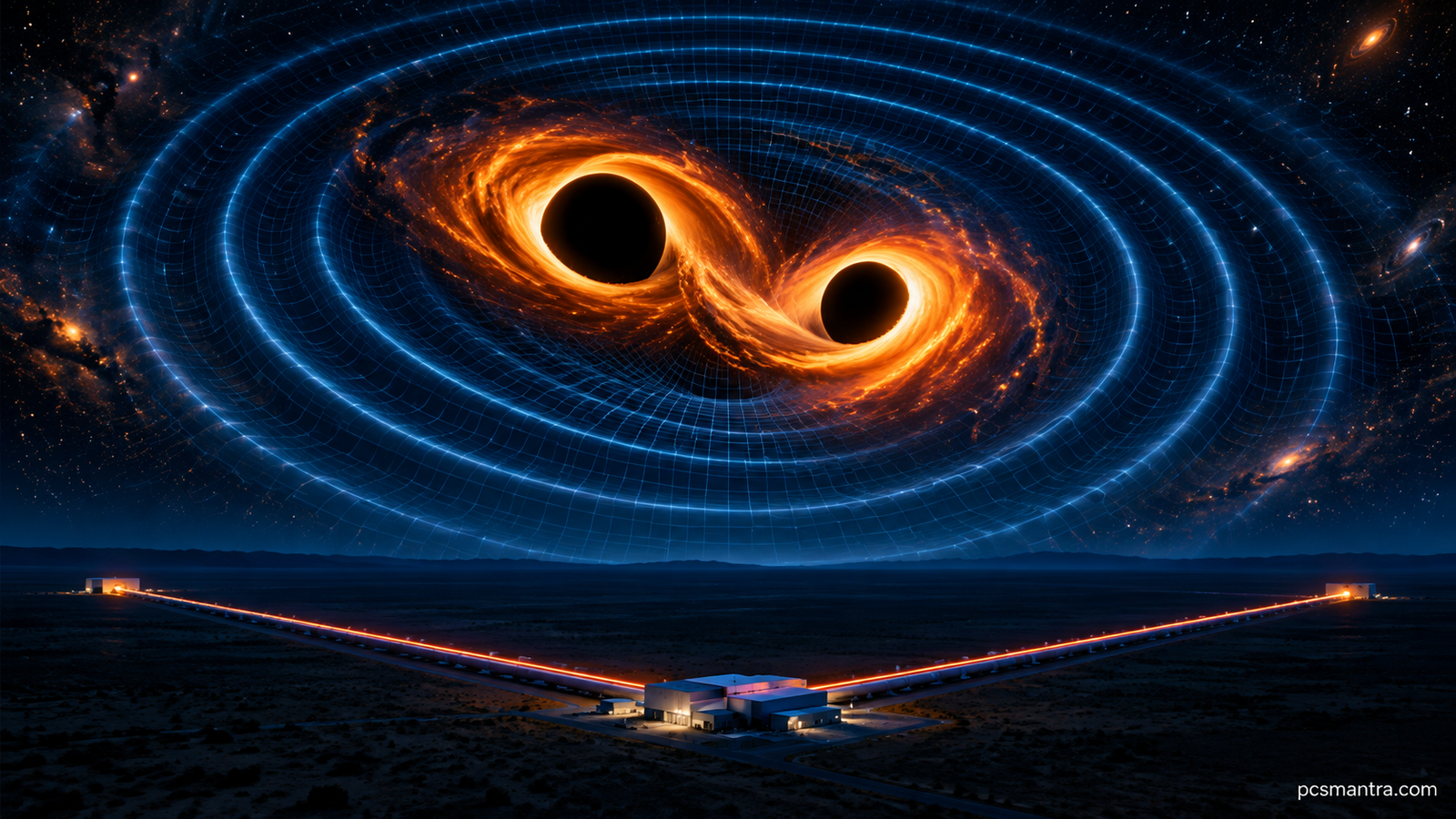
12 November 2026: Gravitational-wave astronomy is entering its "statistical era", The Hindu reports. The latest milestone in this journey is GW250114 - the clearest gravitational-wave signal recorded so far, picked up on 14 January 2025 by the twin LIGO observatories in the United States.
What is GW250114?
- Date and place: Recorded on 14 January 2025 by the twin LIGO (Laser Interferometer Gravitational-Wave Observatory) detectors - Hanford (Washington) and Livingston (Louisiana) in the US. Italy's Virgo and Japan's KAGRA detectors were not operating at the time.
- The event: Two black holes - one about 34 times (33.6) and the other about 32 times (32.2) the mass of the Sun - merged roughly 1.3 billion light-years from Earth.
- Resulting black hole: The merged black hole has a mass of about 62.7 solar masses; the remaining energy was radiated as gravitational waves.
- Clearest signal so far: The signal-to-noise ratio (SNR) was about 80 - the highest ever; the previous record was about 42. This clarity is what makes it special for scientific tests.
Hawking's area theorem verified
- The LIGO, Virgo and KAGRA collaborations published the analysis in Physical Review Letters on 10 September 2025.
- Stephen Hawking's 1971 black hole area theorem (the second law of black hole mechanics) states that when two black holes merge, the total surface area of the final black hole cannot be smaller than the sum of the two original areas.
- By measuring the ringdown phase (the final black hole vibrating like a struck bell after the merger): the two original black holes had a combined surface area of about 240,000 square kilometres (roughly the size of the United Kingdom), while the final black hole's area was about 400,000 square kilometres (roughly the size of Sweden) - the most precise experimental confirmation of the theorem.
- The analysis also tested the final black hole's Kerr nature (a black hole defined only by mass and spin) - the results were consistent with Einstein's general theory of relativity.
Gravitational waves: a brief background
- Gravitational waves are ripples in spacetime produced when extremely heavy objects such as black holes or neutron stars accelerate rapidly.
- Scientists first detected gravitational waves in 2015 (signal GW150914, 14 September 2015) - the discovery completed ten years in September 2025.
- After a decade of detector improvements, scientists can now study hundreds of black hole mergers and answer questions about how black holes form, their mass distribution, and whether general relativity always holds.
LIGO-India: India's role
- The Union Cabinet approved the LIGO-India project in April 2023 at an estimated cost of about Rs 2,600 crore; construction is expected to be completed by 2030.
- Site: Hingoli district, Maharashtra (Aundha area) - about 174 acres of land acquired.
- Project: built by the Department of Atomic Energy (DAE) and the Department of Science and Technology (DST), with a memorandum of understanding with the US National Science Foundation; the US will provide key components worth about Rs 560 crore.
- It will be the world's third advanced LIGO observatory, working in tandem with the two US LIGO detectors and helping locate sources in the sky more precisely.
Introduction: from the UPSC-PCS exam perspective
- Syllabus link: General Studies - Science and Technology (space, fundamental physics, international scientific cooperation).
- Key: GW250114 = signal of 14 January 2025; first gravitational-wave detection 2015; LIGO-India = Hingoli, Maharashtra (2030 target).
- Likely confusion: GW250114 is itself a 2025 signal - it is the subject of a 12 November 2026 review report, not a new discovery.
Quiz: test your knowledge
Question 1: When was the GW250114 gravitational-wave signal recorded?
(a) 14 September 2015
(b) 14 January 2025
(c) 10 September 2025
(d) 12 November 2026
Answer and explanation: (b) The twin LIGO detectors recorded GW250114 on 14 January 2025; 14 September 2015 is the date of the first gravitational-wave detection (GW150914) and the analysis paper was published on 10 September 2025.
Question 2: The analysis of GW250114 provided the most precise confirmation of which theorem?
(a) Planck's quantum theory
(b) Hubble's law of cosmic expansion
(c) Hawking's black hole area theorem
(d) Pauli's exclusion principle
Answer and explanation: (c) Hawking's 1971 area theorem says the total area of black holes cannot decrease in a merger; in GW250114 the area grew from about 240,000 to about 400,000 square kilometres.
Question 3: Where is the LIGO-India observatory being set up?
(a) Leh, Ladakh
(b) Hingoli, Maharashtra
(c) Sriharikota, Andhra Pradesh
(d) Mausam, Uttarakhand
Answer and explanation: (b) The Union Cabinet approved the roughly Rs 2,600 crore project in April 2023; it is expected to be built in Hingoli district, Maharashtra by 2030.
Sources:
- The Hindu - Gravitational-wave astronomy is entering its statistical era
- INFN - LIGO-Virgo-KAGRA confirm Stephen Hawking's black hole area theorem
- The Hindu - Cabinet approves LIGO-India, gravitational-wave detector to be built in Maharashtra
Download this article: PDF