
Background and Context
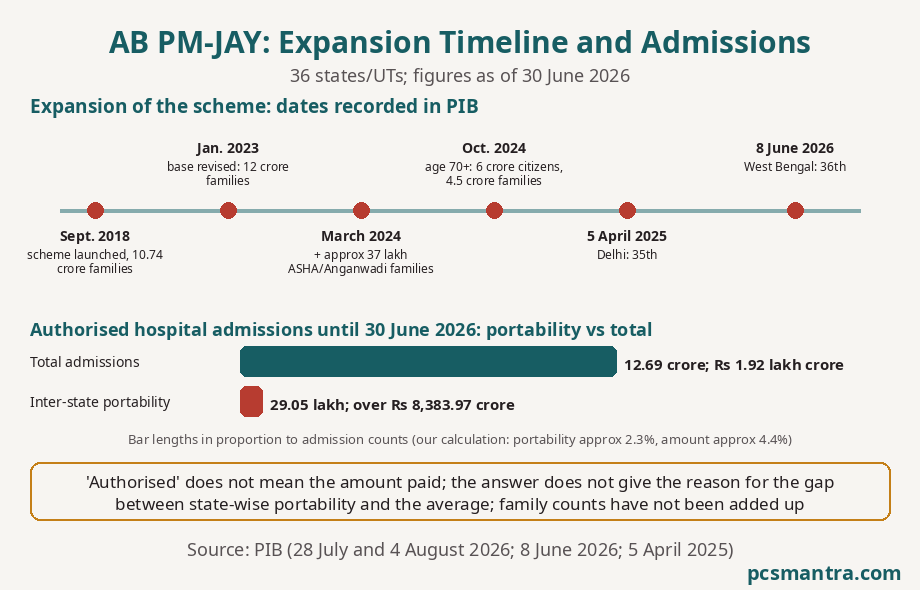
The Ayushman Bharat Pradhan Mantri Jan Arogya Yojana (AB PM-JAY) was launched in September 2018. It provides secondary and tertiary hospital-treatment cover of up to Rs 5 lakh per family per year. According to PIB, at launch it had 10.74 crore families chosen from the 2011 Socio-Economic Caste Census. In January 2023 this base was revised to 12 crore families, in March 2024 about 37 lakh ASHA, anganwadi worker and helper families were added, and in October 2024, 6 crore senior citizens aged 70 and above (4.5 crore families) were included. Delhi became the 35th state/Union Territory on 5 April 2025, and West Bengal the 36th on 8 June 2026.
Why in the News
According to PIB's release of 28 July 2026, Minister of State for Health Prataprao Jadhav gave a written answer in the Rajya Sabha. It said the scheme is now operational in all 36 states/Union Territories. By 30 June 2026, 29.05 lakh hospital admissions under inter-state portability, amounting to over Rs 8,383.97 crore, had been authorised under the scheme. Subsequently, a PIB release of 4 August 2026 stated that up to the same date, a total of 12.69 crore hospital admissions, amounting to Rs 1.92 lakh crore, had been authorised through a network of 37,413 hospitals.
Key Facts and Figures
| Portability (PIB, 28 July 2026) | By 30 June 2026, 29.05 lakh inter-state admissions authorised, amounting to over Rs 8,383.97 crore. Cashless treatment at hospitals outside one's state. |
|---|---|
| Total admissions (PIB, 4 August 2026; Lok Sabha Unstarred Question 1100, 24 July 2026) | By 30 June 2026, a total of 12.69 crore admissions and Rs 1.92 lakh crore authorised; 37,413 empanelled hospitals. |
| Beneficiary base | 12 crore families (revised from 10.74 crore in January 2023), about 37 lakh ASHA/anganwadi families (March 2024), 6 crore senior citizens aged 70+, 4.5 crore families (October 2024). Several states have expanded the base by linking their own schemes. |
| Dates of expansion (PIB) | Delhi: 5 April 2025, 35th; West Bengal: 8 June 2026, 36th. According to statements recorded in PIB, about 6.54 lakh families in Delhi (Delhi's Chief Minister) and about 1.43 crore families in West Bengal (Bengal's Chief Minister; including ASHAs, anganwadi workers and senior citizens) will benefit. |
Checking the Figures: What Matches and What Is Not Comparable
What matches (our calculation): Both figures are up to the same date (30 June 2026) and are of "authorised" amounts, so the basis of comparison is the same. 29.05 lakh ÷ 12.69 crore ≈ 2.3%. Amount: Rs 8,383.97 crore ÷ Rs 1.92 lakh crore ≈ 4.4%. Average per admission: portability ≈ Rs 28,860, overall ≈ Rs 15,100 (our calculation; Rs 1.92 lakh crore and 12.69 crore are rounded figures and Rs 8,383.97 crore is "over" that amount). The answer does not give the reason for the difference in averages, so we do not assume one.
What appears different in the sources: The beneficiary-base figures cannot be added. Adding 12 crore and 37 lakh families makes about 12.37 crore (our calculation), but how many of the 4.5 crore families of those aged 70+ are already in these groups is not stated, so we do not compute a total number of families. The 28 July release does not have the date of the senior-citizen expansion; the 4 August release has October 2024.
What is unstated: The answer does not give state-wise portability, how many admissions from which state, the type of treatment, rejected claims or the amount paid out. "Operational in 36" does not tell how much card distribution and hospital empanelment has happened in each state. According to the Lok Sabha answer, the permitted period for settling portability claims is 30 days, and 15 days within the state; no figure for actual settlement time is given.
Significance: Access, Portability and Coverage
The claim of access and the figure of use: Being operational in all 36 states/Union Territories states the span of coverage, not use. The figures of use (12.69 crore admissions) are separate and have not been given state-wise.
Migrant workers and portability: According to PIB, Pradhan Mantri Arogya Mitras help with identification, verification and cashless admission in hospitals, and portability was described as useful for migrant workers. Portability's share in total admissions is about 2.3% (our calculation), which gives no conclusion about this facility's limited or expected use, because the number of eligible migrant beneficiaries is not available.
The difference between cover and base: The scheme covers not all families but identified groups: the bottom 40% of families (12 crore), some service-worker families and citizens aged 70+. The cover is Rs 5 lakh per family per year and is for secondary-tertiary treatment.
Challenges and What We Did Not Read
The nature of a government answer: These are the ministry's written answers in the Rajya Sabha and the Lok Sabha; they do not contain independent evaluation, state-wise figures or grievance-redressal outcomes. The "authorised" amount is not the amount paid out.
Out-of-pocket expenditure figures: Different releases use different wording for the base year and percentage of out-of-pocket expenditure, so we have not taken them into this article and have not read them as the scheme's effect.
What we did not read: We read in full the PIB release of 28 July 2026 and the PIB release of 4 August 2026, and read the answer to Lok Sabha Question 1100 (24 July 2026). The PIB releases on West Bengal (8 June 2026) and Delhi (5 April 2025) were read for background dates. We did not read the original text of the 28 July Rajya Sabha question, the NHA dashboard, state-wise MoUs or the annual report.
Way Forward
Treat this as dated government information of 28 July 2026 and 4 August 2026. Figures after 30 June 2026 are not in this article.
Distinctions Within the Concept
Keep four things apart: (1) a scheme being operational in a state and its actual use; (2) the authorised amount and the amount paid out; (3) the number of families and the number of individuals; (4) PIB's figure and our calculation.
Mains Perspective
GS-II: health, welfare schemes and Centre-state relations; GS-III: inclusive development.
Answer Outline
Introduction: the scheme and the Rs 5 lakh cover; expansion of the beneficiary base (2023, 2024) and spread to 36 states; portability and migrant workers; figures up to 30 June 2026; authorised versus paid; the limit of adding the base; the absence of state-wise figures; conclusion.
Sources
- PIB, update on AB PM-JAY (Rajya Sabha, 28 July 2026)
- PIB, update on AB PM-JAY (Rajya Sabha, 4 August 2026)
- Lok Sabha Unstarred Question 1100 and answer, 24.07.2026 (Parliament's official PDF)
- PIB, NHA agreement for AB PM-JAY in West Bengal (8 June 2026)
- PIB, Delhi the 35th state/Union Territory to implement AB PM-JAY (5 April 2025)
Sources: The PIB releases of 28 July and 4 August 2026 and the Lok Sabha's official answer were read in full. Two other PIB releases of 2026 and 2025 were read for the background of dates. State-wise figures and the NHA dashboard were not read.
Remember: According to PIB, AB PM-JAY is operational in 36 states/Union Territories and 12.69 crore admissions were authorised by 30 June 2026, of which 29.05 lakh are of inter-state portability (our calculation: about 2.3%). But "authorised" is not payment, the total number of beneficiary families cannot be added up, and there is no state-wise figure or one on the reasons for portability.
Download This Article: PDF