
Research paper: Monthly Notices of the Royal Astronomical Society (MNRAS) vol 545, issue 4; online 29 November 2025, print issue 5 January 2026 (Crossref) • News: The Hindu, 25 May 2026 (based on information from the Department of Science and Technology)
Prelims • Science and Technology: Astronomy and space science
Why in the News
According to The Hindu (25 May 2026), astronomers of the Indian Institute of Astrophysics (IIA), the Aryabhatta Research Institute of Observational Sciences (ARIES), Gauhati University and the INAF-Catania Observatory of Italy have made the world's first confirmed discovery (press statement): a blue straggler star with a sub-stellar (likely brown dwarf) companion orbiting in a very compact binary system. The orbital period is only about 5.6 hours and the companion is the lightest known companion of a blue straggler so far.
The Key Point to Remember:
The discovery was made by the radial velocity method; the system is in the open star cluster NGC 2243. The mass of the companion is about 0.056 solar mass - below the hydrogen-burning limit, that is, neither a star nor a planet: a likely brown dwarf (paper summary: "likely").
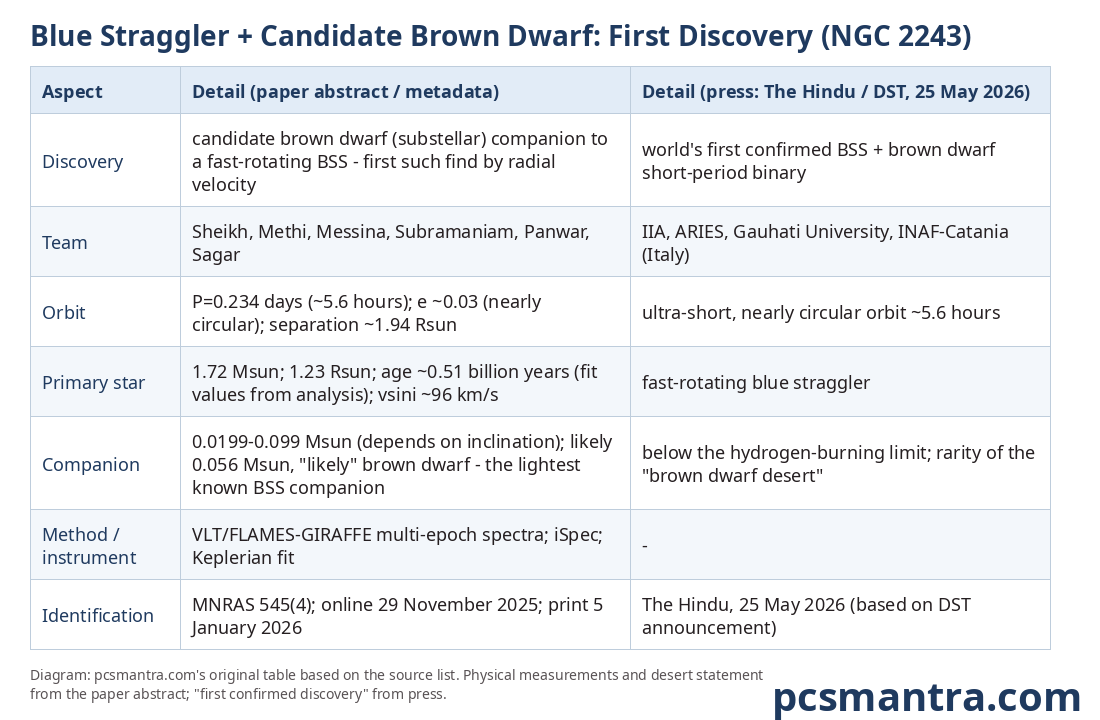
Blue straggler + likely brown dwarf (NGC 2243)
MNRAS 545(4); news: The Hindu 25 May 2026
Discovery
First discovery of a sub-stellar companion with a fast-rotating blue straggler by radial velocity; press: the world's first confirmed BSS + brown dwarf compact binary
Orbit
P = 0.234 day (~5.6 hours); e = 0.03 (nearly circular); separation ~1.94 R☉
Primary star / companion
1.72 M☉, ~96 km/s; companion 0.0199-0.099 M☉ (depending on inclination), likely 0.056 M☉ - the lightest known companion of a BSS
Method
VLT/FLAMES-GIRAFFE multi-epoch spectra; ispec; Keplerian fit
Diagram: original table based on the source list.
BSS + likely brown dwarf: first discovery (NGC 2243)
MNRAS 545(4); news: The Hindu 25 May 2026
System
Orbital period ~5.6 hours; nearly circular orbit (e = 0.03)
Primary star
Mass 1.72 M☉; fast rotation (~96 km/s)
Companion
~0.056 M☉; below the hydrogen-burning limit; the lightest known companion of a BSS
Method
Radial velocity; VLT/FLAMES-GIRAFFE spectra
Diagram: original table; detailed data in the source list.
What Are Blue Stragglers?
According to the Department of Science and Technology, all stars of a cluster are considered to be of about the same age, yet blue stragglers look brighter and bluer than the main-sequence turn-off point - against standard stellar evolution theory. This puzzle has kept them interesting for decades; the main explanations include mass transfer between stars or collisions (press).
What the Study Found (Paper Abstract)
According to the abstract of the paper, the team carried out a multi-epoch radial velocity study of a fast-rotating blue straggler in NGC 2243: spectra taken with the FLAMES-GIRAFFE of the VLT were analysed with ispec. A Keplerian fit gave a nearly circular orbit (e = 0.03) and a period of 0.234 day (~5.6 hours). The mass of the primary star is 1.72 solar masses and the age value from the analysis is about 0.51 billion years. The mass of the companion, depending on the orbital inclination, can be from 0.0199 to 0.099 solar mass; the system is probably tidally synchronized, which gives an inclination of ~21 degrees and a companion mass of 0.056 solar mass - the lightest companion of a blue straggler so far. According to the abstract, it is the shortest-period known binary in the so-called "brown dwarf desert" for main-sequence stars (where such companions are considered extremely rare).
What Is a Brown Dwarf?
A brown dwarf is a sub-stellar body: more massive than a planet, but so low in mass that stable hydrogen fusion cannot start in its core; that is why it is also called a "failed star". In this discovery the likely mass of the companion stayed below the hydrogen-burning limit (press).
Why Is This Important?
According to the Department, the results improve the theoretical models of stellar evolution, binary interaction and sub-stellar bodies, which are used in interpreting data from ground-based observatories and space missions.
Keep the Dates Separate
The paper was published online on 29 November 2025 and came in the print issue of January 2026 (Crossref metadata); the news discussion took place in May 2026 with the departmental announcement. In exam preparation remember the research date and the news date separately. (The press writes the journal as "MNRAS: Letters"; according to Crossref it is MNRAS vol 545, issue 4 - the metadata is valid.)
Points to Note for the Exam
Stellar evolution, brown dwarfs, the radial velocity method and Indian astronomy institutes (IIA, ARIES) connect to the science and technology section of Prelims. The questions below are original practice, not actual PYQs.
Prelims Style: Practice Questions
1. On the basis of this discovery, consider the following statements:
Statement 1: The orbital period of this binary system is about 5.6 hours.
Statement 2: The mass of the companion body is above the hydrogen-burning limit.
Statement 3: The discovery is based on radial velocity measurements.
Which of the statements given above is/are correct?
(a) Only Statement 1
(b) Only Statements 2 and 3
(c) Only Statements 1 and 3
(d) All three statements
See answer and reason
Answer: (c) Only Statements 1 and 3. Statement 2 is wrong: the companion (~0.056 solar mass) is below the hydrogen-burning limit, which is why it is a likely brown dwarf.
2. In which star cluster was this system found?
(a) NGC 2243
(b) M 67
(c) 47 Tucanae
(d) Omega Centauri
See answer and reason
Answer: (a). According to the abstract of the paper the system is in the open star cluster NGC 2243.
3. What is the puzzle of blue straggler stars?
(a) Even in a cluster of the same age they look brighter and bluer than the main-sequence turn-off
(b) They are found only alone, outside any cluster
(c) They do not emit light and are seen only by radio waves
(d) Their age has been measured as more than the age of the universe
See answer and reason
Answer: (a). According to the press (DST), although all stars of a cluster are of the same age, blue stragglers look brighter and bluer, which does not match standard stellar evolution.
Sources:
MNRAS 545(4): research paper (abstract/metadata) • The Hindu, 25 May 2026.
Download This Article: PDF