
Background and Context
The biggest obstacle for small enterprises in taking bank credit is the lack of collateral (property that can be pledged). For this, the Central Government runs the Credit Guarantee Scheme (CGS): member lending institutions (banks, NBFCs) give collateral-free loans to micro and small enterprises, and if there is a default, the Credit Guarantee Fund Trust (CGTMSE) bears a fixed share. A guarantee does not mean loan waiver - the borrower's repayment responsibility remains; the guarantee merely reduces the bank's risk and makes lending easier.
Why in the News
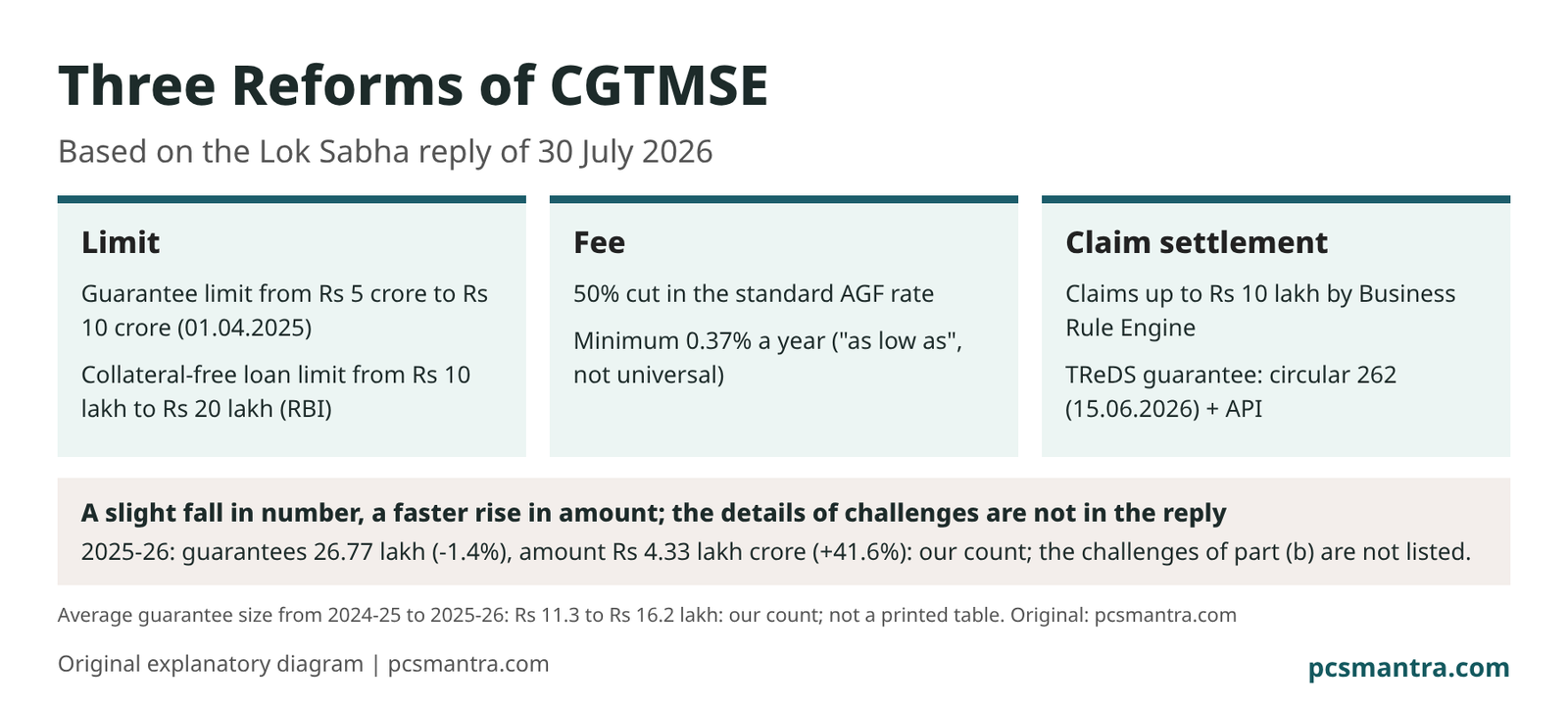
On 30 July 2026, in reply to Lok Sabha Unstarred Question 1899 (Shri Tejasvi Surya), the Minister of State for MSME, Ms Shobha Karandlaje, listed steps to strengthen CGTMSE: guarantee ceiling raised from ₹5 crore to ₹10 crore from 01.04.2025; a 50% cut in the standard rate of the Annual Guarantee Fee (AGF), which can bring the rate as low as 0.37% per annum ("as low as" - this is the minimum rate, not a uniform rate for all guarantees); arrangement to settle claims up to ₹10 lakh without intervention through a Business Rule Engine; Circular 262 (15.06.2026) and an API ready for invoice discounting on TReDS; collateral-free loan limit raised from ₹10 lakh to ₹20 lakh through the RBI Master Direction (09.02.2026); and an advisory to decide loans up to ₹25 lakh within 14 working days. State-wise guarantee data for three years and the current year were also given along with it.
Key Facts and Figures
| Guarantee ceiling and fee | Under CGS, the loan guarantee ceiling raised from ₹5 crore to ₹10 crore from 01.04.2025. AGF structure revised - 50% cut in the standard rate, rate as low as 0.37% per annum ("as low as"). In the reply's words this is the lowest possible rate; do not say that every guarantee is now at 0.37%. |
|---|---|
| Claim settlement and TReDS | Pending claims up to ₹10 lakh are settled by the system-based Business Rule Engine without manual intervention; claims above ₹10 lakh are also in an online process on the CGTMSE portal. Circular 262 (15.06.2026) issued for guarantee of invoice discounting on the TReDS platform; an API has also been developed for implementation. |
| Total guarantees (from the reply's annexure) | Number of guarantees: 17,24,073 (2023-24), 27,15,275 (2024-25), 26,76,789 (2025-26), 5,18,587 (2026-27, up to 30.06.2026). Amount: ₹2,02,807 crore, ₹3,05,507 crore, ₹4,32,547 crore and ₹1,01,687 crore. By our calculation the average guarantee size: about ₹11.8 lakh, ₹11.3 lakh, ₹16.2 lakh and ₹19.6 lakh - rising. |
| State-wise spread and Bengaluru | Top states by amount in 2025-26 (our calculation): Maharashtra ₹59,178 crore, Uttar Pradesh ₹46,876, Gujarat ₹40,110, Tamil Nadu ₹30,072, Karnataka ₹28,673 - total ₹2,04,909 crore, about 47% of the printed total. At the other end, Lakshadweep has only 51 guarantees. In Bengaluru in 2025-26: 47,900 guarantees, ₹15,821 crore - about 32% of Karnataka's number and about 55% of its amount (our calculation). |
How Does the System Work?
The mechanism of the guarantee: Member lending institutions lend to new and existing MSEs; on default, CGTMSE bears a fixed share. With the bank's risk reduced, lending without collateral becomes possible. This is not a grant or a rebate - the borrower has to repay the full loan; government expenditure comes only in the case of default.
Seven steps listed in the reply: guarantee ceiling ₹10 crore; cut in AGF; BRE-based claim settlement; TReDS Circular 262 and API; advice to banks to streamline MSE loan policy (additional working capital, mid-term review, fixed decision time); collateral-free loan limit ₹20 lakh (RBI Master Direction 09.02.2026); advice to decide loans up to ₹25 lakh within 14 working days.
Advisory versus binding: Note: the 14-working-day limit is printed for banks as an "advisory" (advised); for loans above ₹25 lakh the time limit is left to board-approved norms. That is, the time guarantee is not a rule applying to all loans.
Reading the Figures Correctly
Number versus amount: In 2025-26 the number of guarantees fell (-1.4%, our calculation) and the amount rose (+41.6%). The average guarantee size went from ₹11.3 lakh to ₹16.2 lakh. This does not prove that small or first-time units got more credit - that breakdown is not in the reply.
Our check of the totals: Sum of the 36 state/union territory rows: all four columns of the guarantee numbers match the printed totals exactly. In the amount, 2025-26 matches exactly; the sum for 2023-24 comes to ₹2 crore more than the printed total, 2024-25 comes to ₹2 crore less and 2026-27 (Q1) comes to ₹3 crore less. The reply does not give the reason for these small differences; we have recorded them as they are, not corrected them.
Printing of the Dadra and Nagar Haveli row: In the annexure, serial number 32 (Dadra and Nagar Haveli and Daman and Diu) has its 2023-24 number "1039" and amount "277" printed without thousands comma - a printing style different from the other rows. This was confirmed from the page image; in the sum we took 1,039 and 277 only.
Which Conclusions Should Be Avoided?
A list of steps = an answer on challenges: no. Part (b) of the question asked for implementation challenges - guarantee coverage, lender participation, regional disparity. The reply has no detail of challenges; only steps were listed. Regional disparity shows only from our calculation - in 2025-26 Uttar Pradesh 5,46,792 guarantees versus Lakshadweep 51.
Amount is not disbursement or reach: The annexure figures are of "guarantees approved" - approved guarantees, not actual loan disbursement or outstanding. A rise in average size shows growth of bigger guarantees, but does not tell which size of units the guarantee reached.
Minimum rate is not a universal rate: "As low as 0.37%" is the minimum possible rate of AGF. The actual rate on any guarantee will depend on its category; the reply does not give a full slab-wise rate table.
Limit of reading: We read all three pages (text and image) of the question-answer in full. CGTMSE's annual report, data on the actual settlement time of claims, usage data of TReDS integration and the original RBI Master Direction were not read; comment on them is outside the scope of this article.
Way Forward
Our policy suggestion is that direct questions like part (b) be given a direct answer: a recorded analysis of the challenges of guarantee coverage and lender participation should be made public. CGTMSE should publish lender-wise and unit-size-wise breakdown of guarantees, so that it is known whether the rising amount is reaching small and new units or not. The actual time of claim settlement (average and median days) and usage data of TReDS guarantees should be given regularly. There should be target-based outreach on state-wise disparity.
Difference in Concepts
Guarantee ≠ grant or loan waiver. Approved guarantee ≠ actual loan disbursement. "As low as 0.37%" ≠ the rate of all guarantees. Sum of rows ≠ printed total (a difference of ₹2-3 crore in three columns of amount, reason not in the reply). The 14-working-day advisory ≠ a binding time limit on all loans.
Mains Perspective
GS-III: Economy, MSME and financial inclusion. In the answer, keep all three: the mechanism (guarantee = risk sharing), the reforms (ceiling, fee, BRE, TReDS, RBI advisory) and the limit (the unanswered part on challenges, disparity, amount versus reach).
Answer Outline
Introduction: The guarantee mechanism.
Main Body: The list of reforms; number versus amount (our calculation); check of the totals; the unanswered part (b) on challenges and regional disparity; suggestions.
Conclusion: Do not treat the rising guarantee amount as proof of reach to more units; from the figures of unit size, lenders, states and claim settlement, judge the benefit to small and new units and regional inequality.
Sources
The figures are taken from the Lok Sabha reply of 30 July 2026 and its annexure. The columns of the number of guarantees match the printed totals exactly (our calculation); in the three columns of amount there is a difference of ₹2-3 crore between the sum of the rows and the printed total - the reply does not give the reason, we have recorded the difference as it is. "0.37%" is printed as the minimum possible rate of AGF. The average size, percentage change, top-state share and Bengaluru ratio are our calculation. The challenges of part (b) are not recorded in the reply; this gap is recorded as it is.
Remember: The guarantee system is improving - ceiling doubled, fee cut, claims faster - but the answer to "reach to whom and at what pace" will come not from the list of reforms but from broken-down data; a recorded account of the challenges is also part of public accountability.
Download This Article: PDF