
News Reference:
According to PIB's release of 14 July 2026, the 49th session of the Codex Alimentarius Commission adopted seven standards and guidelines developed under India's chairmanship or co-chairmanship. The session was held in Geneva on 6-10 July.
The standards for dried coriander seed and fresh curry leaves had been developed under India's chairmanship. The other five texts include provisions relating to vanilla, large cardamom, the safe use and reuse of water in food production, the control of Campylobacter and Salmonella in chicken, and the combined presentation/multipack labelling of packaged foods.
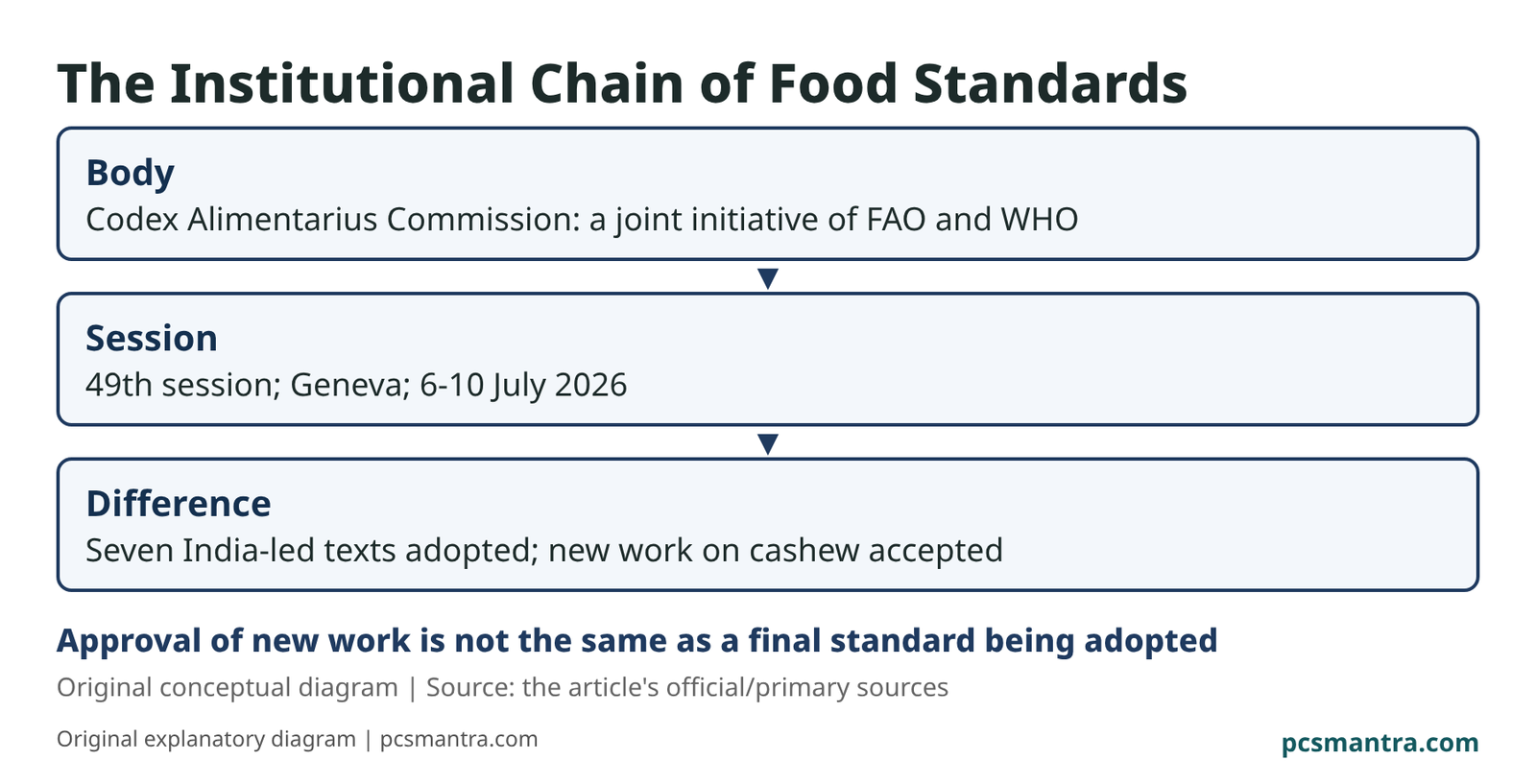
Body: Codex Alimentarius Commission: a joint initiative of FAO and WHO
Session: 49th session; Geneva; 6-10 July 2026
Difference: seven India-led texts adopted; new work on cashew approved
Approval of new work is not the same as a final standard being adopted
Codex's Role:
According to the WHO, the Commission is a joint initiative of FAO and WHO. Its purpose is to protect consumer health and promote fair practices in food trade. It works on international standards of food safety and quality.
Do not take the seven texts as standards for seven spices. Along with commodity-specific standards, they include texts related to water, food hygiene and labelling.
The Decision on Cashew:
The Commission approved India's proposal to start new work to develop a standard for cashew kernels. This work will be under the Codex Committee on Processed Fruits and Vegetables (CCPFV).
The approval of new work is the start of a process, not the announcement of a complete standard being adopted. Improved market access or export growth may be intended outcomes; the release does not prove any measured increase in exports.
Prelims: Practice Questions
Question 1. The Codex Alimentarius Commission is a joint initiative of whom?
(a) WTO and IMF
(b) UNESCO and UNICEF
(c) FAO and WHO
(d) ILO and UNDP
See Answer and Reason
Answer: (c). The WHO describes the Commission as a joint initiative of FAO and WHO.
Question 2. Statement-I: CAC49 adopted seven India-led standards/guidelines.
Statement-II: All these seven were standards only for spices.
Choose the correct option.
(a) Both correct
(b) Only I correct
(c) Only II correct
(d) Both wrong
See Answer and Reason
Answer: (b). The seven texts also included texts related to water, chicken hygiene and labelling.
Question 3. What was the decision on cashew kernels at CAC49?
(a) A final global standard was adopted
(b) A ban was placed on the cashew trade
(c) New work to develop a standard was approved
(d) Cashew was removed from the food list
See Answer and Reason
Answer: (c). According to PIB, the proposal to start new work was approved, not a final standard.
Sources:
PIB: India's contribution at CAC49, 14 July 2026
WHO: the 49th Codex session and standards
Download This Article: PDF