
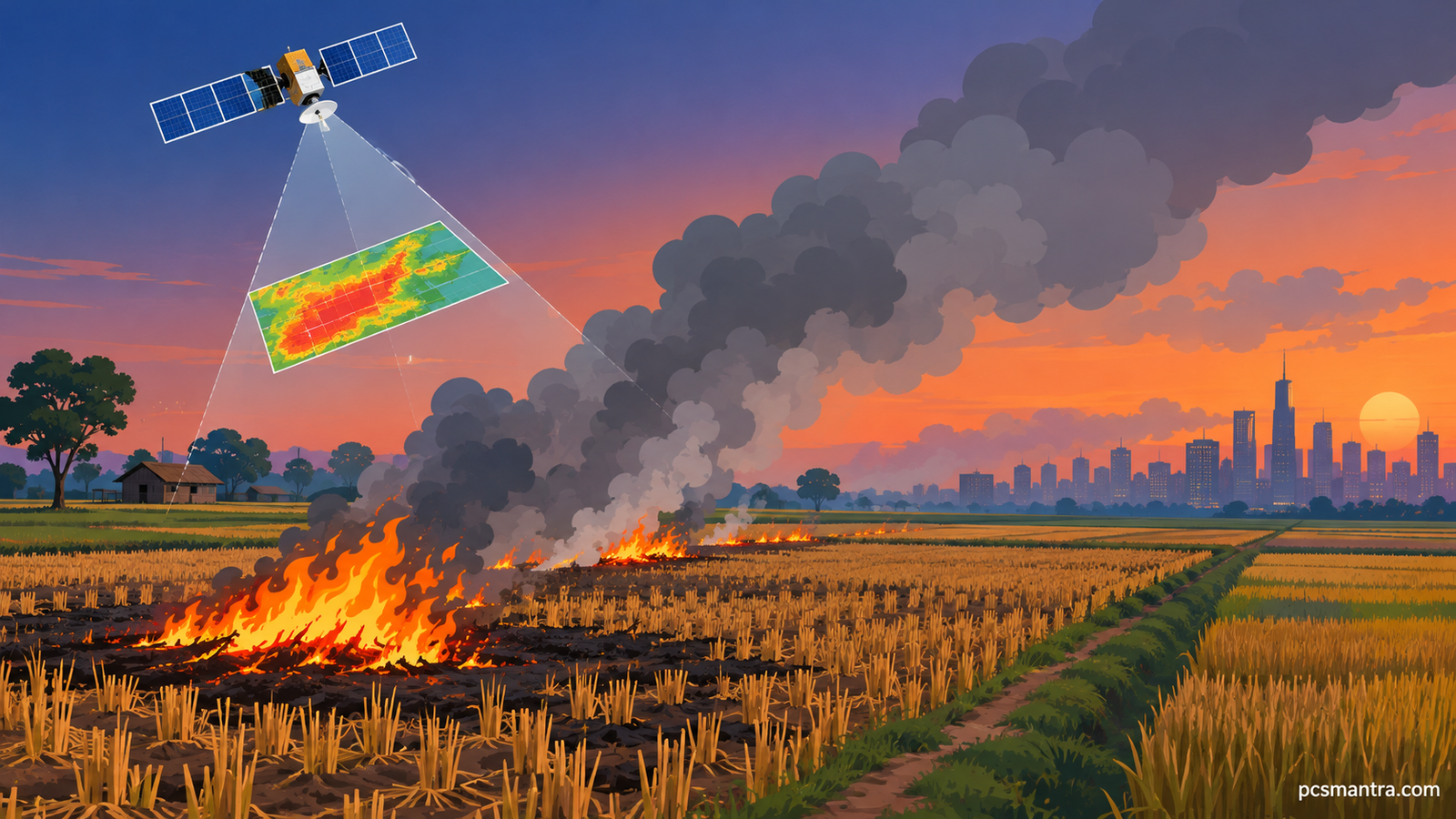
Why in the news
Even two years after the Supreme Court flagged it, the country has no final protocol to measure the actual 'burnt area' of farm fires. The court had said that merely counting 'fire counts' is not enough - the area of burnt land is what gives an accurate assessment of the pollution load.
The root of the issue: counts versus area
- Current method: Satellites (such as VIIRS/MODIS, and geostationary satellites) count fire points based on 'thermal anomalies'.
- The court's objection: A single point can represent a large field or a small fragment - so the area of burnt land cannot be derived from the count of incidents; a burnt-area protocol is essential.
- Latest status: The CAQM (Commission for Air Quality Management) has directed district administrations to physically verify the burnt area of paddy stubble; a review of the protocol has also been proposed after discrepancies were found between satellite and ground-level data.
Why it matters
- Policy base: A reliable assessment of stubble smoke's share in Delhi-NCR's winter pollution (percentages in DSS estimates) depends on accurate burnt-area data.
- Accountability: Without correct measurement, both comparison of districts and penalties/incentives can be misleading.
- Scientific standard: Satellite resolution, cloud cover and crop cycles affect protocol design.
Challenges and the way forward
- Technical: Limits of satellite detection over small, fragmented fields; coordination between geostationary and polar-orbit satellites.
- Institutional: Data integration among CAQM, CPCB, ISRO and state agriculture departments.
- Alternative solutions: Linking stubble-management machinery (CRM), bio-decomposers and ex-situ use with measurement improvement.
Exam relevance
- Key facts: The SC's observation (two years ago); CAQM's verification directions; the difference between fire counts and burnt area; DSS share estimates.
- Analytical angle: The relationship between data quality and environmental governance; the test of 'what is not measured is not managed'.
Mains practice question
"Reliable measurement is the first condition of policy success in tackling air pollution." Evaluate this statement in the context of the ongoing debate on the 'burnt area' protocol for stubble burning. (250 words, 15 marks)
Answer outline:
In the introduction: The SC's warning and the absence of a protocol even after two years.
In the body: Limits of fire counts; the scientific basis of burnt area; links with DSS/GRAP decisions; CAQM's verification directions and the satellite-ground data discrepancy; suggestions for technical-institutional improvement.
In the conclusion: Without a standardised, transparent measurement protocol, assessment of interventions will remain incomplete.
Prelims practice questions
In the ongoing debate on measuring stubble burning, 'burnt area' means:
(a) The total number of fire incidents
(b) The area of land actually burnt by fire
(c) A list of polluted cities
(d) The total number of satellites
Answer and explanation
Answer: (b)
The court had pointed to the need to measure the area of burnt land (burnt area) instead of counting incidents.
CAQM's remit is:
(a) Forest-fire monitoring across India
(b) Air quality management in Delhi-NCR and adjoining areas
(c) Industrial water pollution control
(d) Nuclear safety
Answer and explanation
Answer: (b)
CAQM (Commission for Air Quality Management) is the statutory commission for air quality in Delhi-NCR and adjoining areas.
Sources
Indian Express - CAQM directs districts to verify burnt area of stubble fires
Download this article: PDF