
Background and Context
In human spaceflight, every stage carries the same question: if this stage fails, what happens to the crew? That is why such programmes test small, separate sub-systems on the ground again and again before a big launch. In Gaganyaan, the decisive moment just before re-entry is when the capsule carrying the crew separates from the service vehicle. This article explains the concept of that separation test and states what ground tests prove and what they do not.
Why in the News
ISRO stated on 16 October 2026 that a series of separation tests of the Crew Module (CM) and the Service Module (SM) for the Gaganyaan missions has been successfully completed. The tests were done in the facility of the Vikram Sarabhai Space Centre, Thiruvananthapuram. According to ISRO, these give the confidence necessary for the separation system of the first uncrewed Gaganyaan mission (G1), whose launch is targeted in 2026.
This article is based on ISRO's release. The number of tests, dates and pass/fail criteria are not in the public release, so they are not given here either. "Successful" is ISRO's word, not the conclusion of an independent review.
The Main Concept: Orbital Module, Umbilicals and Sequenced Separation
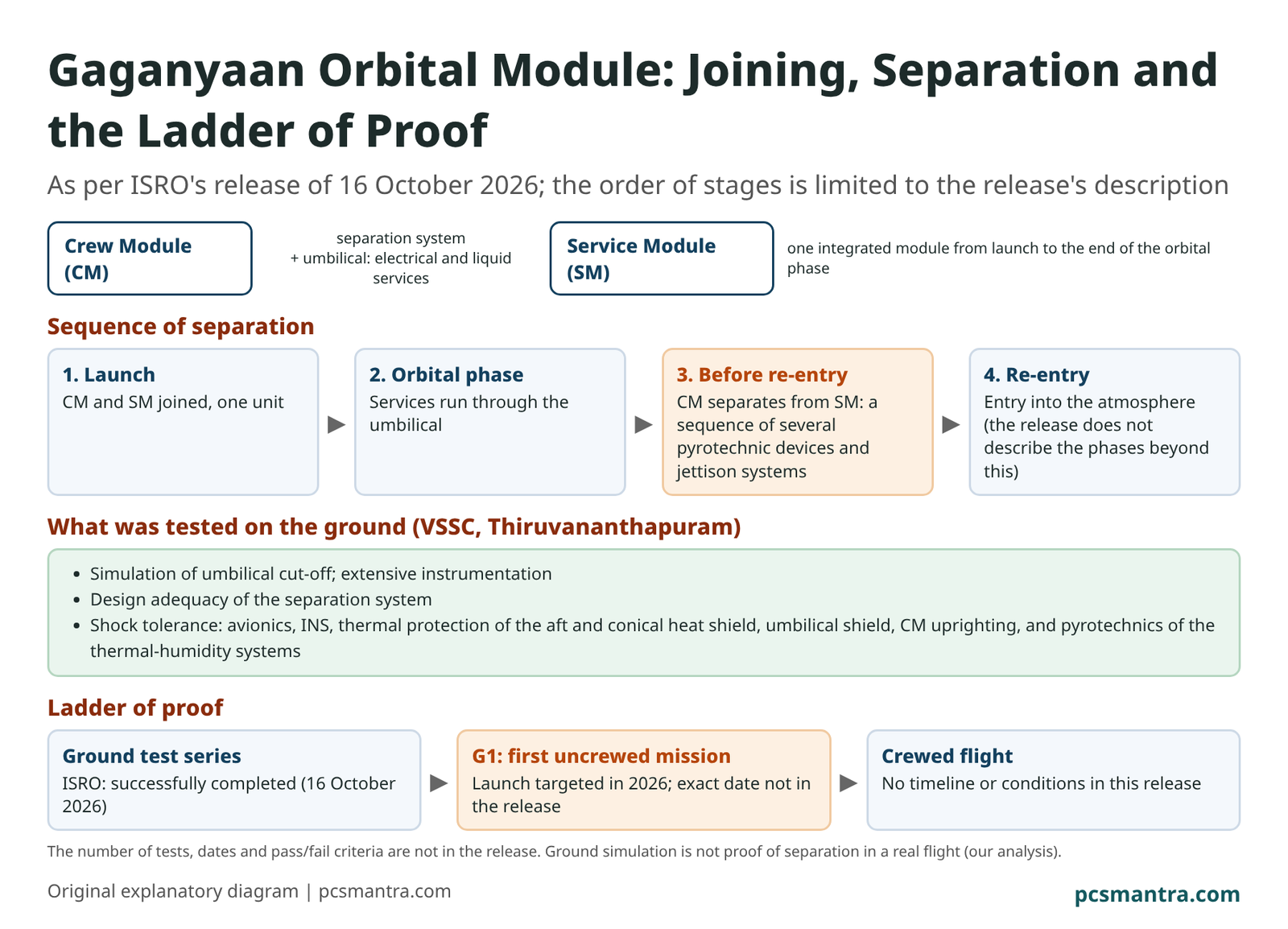
One unit, two parts: According to ISRO, the orbital module has the Crew Module and the Service Module. From launch to the end of the orbital phase they work like one integrated module. Power and fluid supplies run between them through umbilical connections (pipe-like links).
The moment of separation: Before re-entry begins, the CM has to separate from the SM. Several events happen in a fixed sequence, involving pyrotechnic devices and jettison systems. If the sequence goes wrong, the separation can be incomplete or incorrect; that is why the test checks not only "it separated" but also the sequence and surviving the shock. (This reasoning is ours; ISRO has not described failure scenarios in the available text.)
The role of ground tests: In the tests, the condition of the umbilicals being cut was simulated and, ISRO says, the avionics, the inertial navigation system, the thermal protection of the heat shields, the umbilical hood and two pyrotechnic systems remained safe in the shock. This builds confidence in the design; but it is not proof of separation in flight.
Main Facts and Figures
| Source and date | ISRO's press release (isro.gov.in), 16 October 2026, read in full. The Times of India (16 October 2026) repeated the same release and carries ISRO quotations; we found no separate new fact in it. |
|---|---|
| What was completed | According to ISRO, "a series of separation tests" of the Crew Module (CM) and the Service Module (SM) for the Gaganyaan missions was successfully completed. The release does not give the number of tests, dates or pass criteria. |
| Where and how | In a test facility built at the Vikram Sarabhai Space Centre (VSSC), Thiruvananthapuram, which simulates the whole CM-SM combination and is fitted with extensive instrumentation. The tests simulated the condition of several umbilical connections between the CM and SM being cut. |
| The structure | According to ISRO, the Gaganyaan orbital module has the CM and SM, joined by a separation system. Electrical and fluid services run between them through umbilical connections. The two are joined before launch and work like one integrated module from launch to the end of the mission's orbital phase. |
| When and how separation happens | Before starting re-entry into the Earth's atmosphere, the CM separates from the SM. According to ISRO, this separation involves several precisely sequenced events linked to pyrotechnic devices and jettison systems. |
| What was tested | The tests examined the overall design adequacy of the separation system and showed the strength and shock-survivability of several important sub-systems of the CM: avionics systems, inertial navigation systems (INS), the thermal protection system of the aft and conical heat shields, the CM's deployable umbilical hood, and the pyrotechnic devices of the CM uprighting system and the thermal and humidity control system. |
| ISRO's conclusion | According to ISRO, this gives the "necessary confidence" in the working of the separation system applicable to the upcoming first uncrewed Gaganyaan mission (G1). G1 is targeted for launch in 2026. The release has no exact date for G1. |
Analysis: Three Questions from Ground Test to Flight
(This is our analysis, not ISRO's statement.)
1. What was proven? The adequacy of the design in the simulation of the separation system and the shock-survivability of sub-systems. According to ISRO, this is the basis of confidence for G1.
2. What was not proven? The release has no proof of separation in flight conditions (return from orbit), nor the criteria of the tests. So read "successful" only in the sense of ground validation.
3. What will the further proof be? ISRO has stated G1 as targeted in 2026. The result of that flight will be this system's real flight proof, but the date and details are not in the release.
Significance: Staged Testing and Risk Control
In a human space programme, every important stage is tested first at the sub-system level, then at the integrated level, then in an uncrewed flight and then in a crewed flight. This ladder can become a question in the exam: stating the nature of the test (simulation versus flight) clearly makes the answer credible. This is also an example of the programme's technical self-reliance and accountable communication, but not without stating the limits of the release.
Challenges and What the Release Does Not Have
- The number of tests, dates, pass/fail criteria and data are not public.
- No exact date of G1 has been given, only "targeted in 2026".
- The timeline of the crewed mission is not in this release.
- Nothing is said about the fate of the SM after separation or about other tests (parachute, re-entry). We have not read ISRO's other Gaganyaan pages for this article.
Way Forward
- Proof of separation in flight conditions from an uncrewed flight such as G1.
- A suitably transparent disclosure of test criteria and learnings, so that the meaning of "successful" stays clear.
- A public outline of additional validation steps after integrated ground tests and before the crewed flight.
The Difference in Concepts
| Point | Difference |
|---|---|
| Crew Module (CM) versus Service Module (SM) | According to ISRO's release, the crew stays in the CM (ISRO's description quoted in TOI) and the SM supports the vehicle during the mission. The CM separates before re-entry; the release says nothing about the SM's later fate. |
| Ground test versus flight proof | These tests were simulations in VSSC's ground facility. They give proof of design adequacy and shock-survivability, but not flight proof of separation in the return from orbit. This is our analysis. |
| Design adequacy versus shock-survivability | The first means that the separation system's design is capable of completing the necessary sequence; the second means that the CM's instruments and structures keep working in the shock of separation. ISRO has said both things. |
| Pyrotechnic devices versus jettison systems | Pyrotechnic devices are explosive-based tools that cause instant actions such as cutting links; jettison systems throw a part away. ISRO has mentioned both. This general definition is ours, not a sentence of the release. |
| G1 versus the crewed mission | The release talks of confidence only for the first uncrewed mission G1. The date or conditions of a crewed flight are not in it. |
The Mains View
GS-III: science and technology, the space programme, self-reliance in technology; GS-IV: the ethics of risk, safety and accountability (transparency in tests linked to human life).
UPSC CSE Mains Style: Original Practice Question
In the context of the recent separation tests of Gaganyaan's Crew Module and Service Module, explain what role ground simulation tests play in the safety of human spaceflight and what their limits are. State the relevance of a staged testing arrangement.
(Answer in 150 words) | 10 marks
Answer Outline
Introduction: ISRO's announcement of 16 October 2026, the significance of CM-SM separation (before re-entry).
Main Body: The role of ground tests: design adequacy, shock-survivability, validation of sub-systems (avionics, INS, heat shields, pyrotechnics); limits: simulation versus flight, criteria not public; the staged ladder: sub-system, integrated, uncrewed G1 (targeted in 2026), then crewed; suggestion: transparency, additional validation.
Conclusion: Ground simulation gives confidence on design and shock-survivability, not a guarantee of full flight safety; keep staged uncrewed validation and transparency of test criteria as the basis for judging a crewed flight.
Sources
- ISRO's press release: Crew Module-Service Module Separation Tests for Gaganyaan Programme, 16 October 2026
- News report, for comparison: The Times of India, 16 October 2026
Note: The main source is ISRO's release, which was read in full. ISRO's other Gaganyaan pages, the technical documents of the tests and the programme's timeline were not read. The general definitions and analysis in "The Difference in Concepts" are ours, not the release's.
Download This Article: PDF