
Background and context
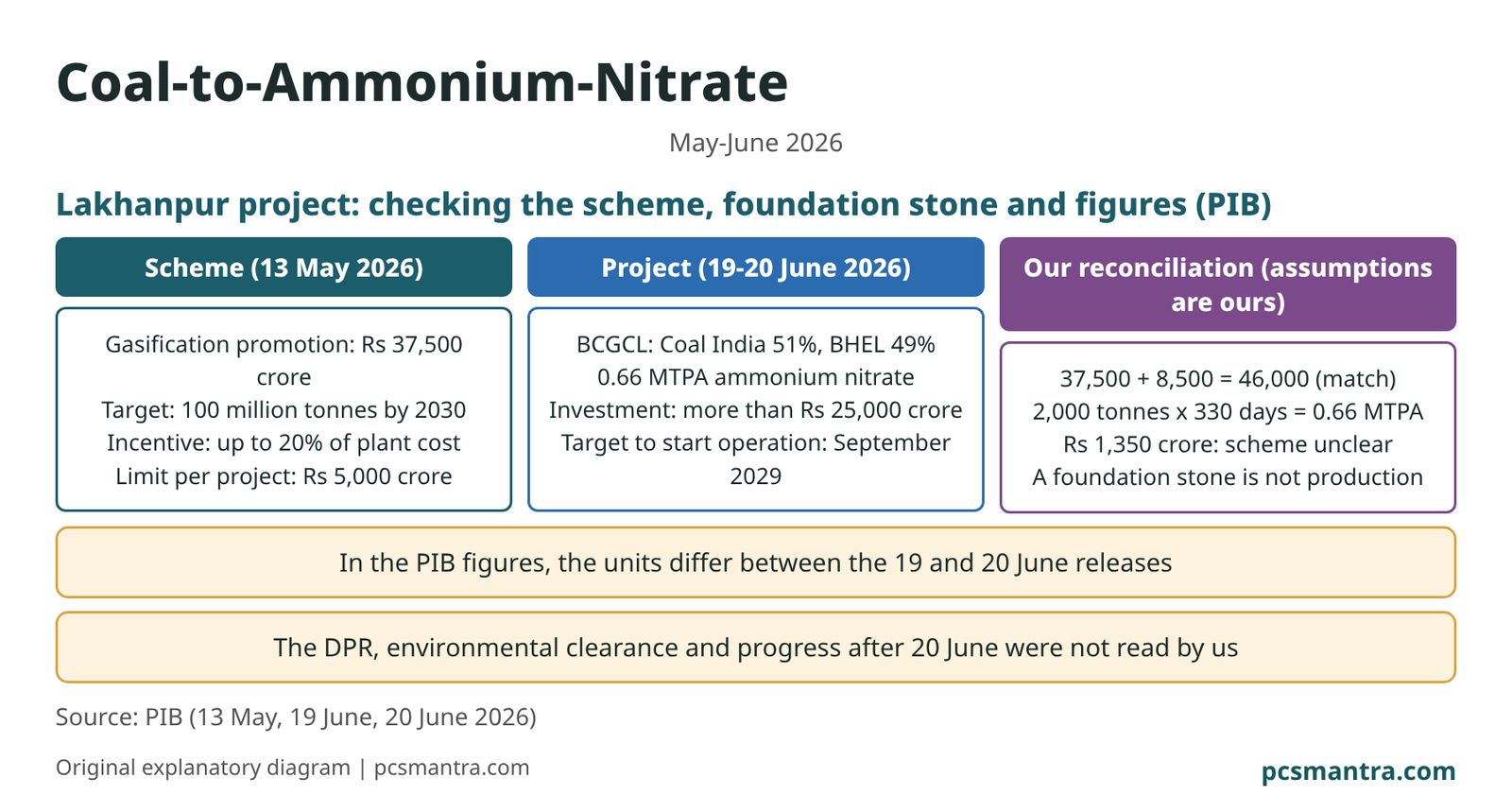
Coal gasification turns coal into syngas (synthesis gas), from which products such as methanol, urea, ammonium nitrate and synthetic natural gas can be made. According to PIB (13 May 2026), the Union Cabinet approved a ₹37,500 crore scheme to promote surface coal/lignite gasification projects. Its target is the gasification of 100 million tonnes of coal by 2030. Under the scheme, selection happens through competitive bidding on a benchmark of project cost, and the incentive is up to a maximum of 20 percent of the cost of plant and machinery.
Why in the News
According to PIB's release of 20 June 2026, the President and the Prime Minister remotely laid the foundation stone of Bharat Coal Gasification and Chemicals Limited's (BCGCL) coal-to-ammonium-nitrate project at Lakhanpur in Odisha's Jharsuguda district. A day earlier, on 19 June, PIB had called it India's first project of this kind "at commercial scale".
Key facts and figures
| The nature of the project (PIB, 20 June) | According to PIB, the project targets the production of about 0.66 million tonnes per annum (MTPA) of technical-grade ammonium nitrate. Mahanadi Coalfields will provide about 350 acres of land and will supply 0.79 MTY of washed coal and 1.19 MTY of reject coal from the Ib Valley washery. The project has received single-window approval from Odisha's High-Level Clearance Authority (HLCA) and lump-sum turnkey execution packages have been awarded. |
|---|---|
| The release of 19 June | According to PIB (19 June), the project is of ₹25,016 crore and will make 2,000 tonnes of ammonium nitrate per day. The land-lease agreement took place in April between BCGCL and Mahanadi Coalfields. The ministry has permitted such use of coal-sector land. |
| The scheme's limits (Cabinet, 13 May) | According to PIB, the limit of the incentive for any one project is ₹5,000 crore, and ₹9,000 crore for one product (except synthetic natural gas and urea). The incentive is tied to project stages in four equal instalments. The scheme is technology-neutral and encourages indigenous technology. |
| The import-dependence argument | According to PIB (Cabinet, 13 May), more than 50 percent of LNG, about 20 percent of urea, about 100 percent of ammonia and about 80-90 percent of methanol are imported. These are the government's figures. |
How to check the match and mismatch of PIB's figures
₹46,000 crore versus ₹37,500 crore: the 19 June release says the cumulative outlay of the incentive schemes is up to ₹46,000 crore. In the 13 May release, the new scheme is of ₹37,500 crore and there is mention of the old scheme of ₹8,500 crore of January 2024. Our addition is 37,500 + 8,500 = 46,000. This matches, but the 19 June release does not make clear that ₹46,000 crore is the sum of these very two.
2,000 tonnes per day versus 0.66 MTPA: the 19 June release says 2,000 tonnes per day and the 20 June release about 0.66 million tonnes per year. Our calculation: 2,000 x 330 days = 6.6 lakh tonnes, that is about 0.66 MTPA. This matches only if the plant runs about 330 days a year. This assumption is ours and is not given in the releases.
₹1,350 crore from which scheme: according to PIB, the Ministry of Coal has given an incentive of ₹1,350 crore. The releases do not say whether it is from the ₹8,500 crore scheme of 2024 or the new ₹37,500 crore scheme. So we do not tie it to any one scheme.
Importance: the chemical use of coal
Import substitution: according to PIB, India imports about ₹2.7 lakh crore of end-use and intermediate chemical products every year (19 June), while the Cabinet's release has an import bill of about ₹2.77 lakh crore for substitutable products in financial year 2025 (13 May). The product groups of the two are described differently and we have not merged them.
Indigenous technology: according to PIB, the project will be built with BHEL's indigenous PFBG technology and will be a "model" for future projects. This is the government's statement. The technology's commercial-scale test will happen only when the project is commissioned.
Challenges and what we did not read
The distance to commissioning: according to PIB, the target is September 2029. The time from foundation laying to production, cost escalation and technical risks are not discussed in PIB.
Environment and coal consumption: the releases say nothing on the project's environmental impact, emissions or water use. PIB only speaks of "all major statutory and environmental approvals" being in place. We have not read the documents of the approvals.
What we did not read: we read PIB's three releases (13 May, 19 June, 20 June 2026) in full. The project's DPR, the environmental clearance, demand-supply figures for ammonium nitrate and progress after 20 June were not read by us.
The government's side: the releases carry no discussion of any objection or risk. All these figures and benefits are the government's statements.
Way Forward
Read this article as the position of the PIB releases of 19-20 June 2026. The assessment will change as the progress of construction, cost and production come in.
Distinction in the concept
Keep four things separate: (1) approval of the scheme (13 May) and a project's foundation laying (20 June); (2) foundation laying and production; (3) PIB's figures and our matching calculations; (4) what we did not read.
Mains perspective
GS-III: energy security, infrastructure, industrial policy, environment; GS-II: public-sector partnership. In an answer, state the risks along with the benefits.
Answer Outline
Introduction: gasification and syngas.
Main Body: the scheme and the project - incentives, limits; the benefits - import substitution, indigenous technology; the challenges - technical risk, environment, time frame; measures.
Conclusion: Keep the foundation-laying, incentives and targeted production separate from production in operation; evaluate the possibility of import substitution together with technical risk, the environment and the project's timeline.
Sources
- PIB, foundation laying of the coal-to-ammonium-nitrate project tomorrow (19 June 2026)
- PIB, the President and the Prime Minister laid the foundation of the BCGCL project (20 June 2026)
- PIB, Cabinet: the ₹37,500 crore surface coal/lignite gasification scheme (13 May 2026, background)
Source: all three PIB releases were read in full. The DPR, the environmental clearance and progress after 20 June were not read.
Remember: according to PIB, the foundation of BCGCL's coal-to-ammonium-nitrate project at Lakhanpur was laid on 20 June 2026. Investment of more than ₹25,000 crore and a commissioning target of September 2029 have been stated. A foundation laying is not production. Our matching of the figures of ₹46,000 crore and 2,000 tonnes per day rests on assumptions.
Download This Article: PDF