
Background and Context
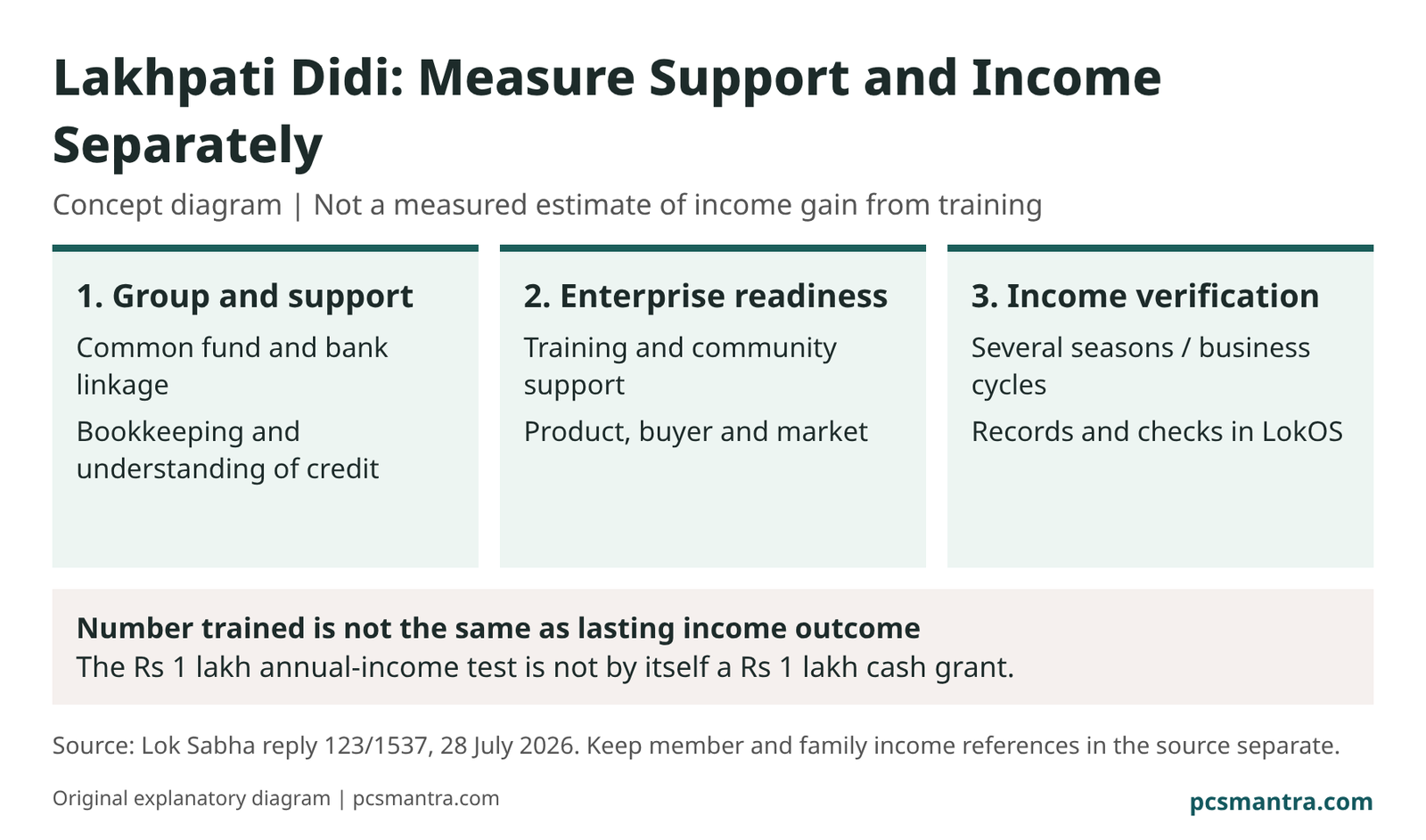
Joining a woman to a self-help group, giving her enterprise training, and her income rising for a long time are separate stages. Deendayal Antyodaya Yojana-National Rural Livelihoods Mission (DAY-NRLM) builds the foundation of social and financial inclusion by organising rural poor families into groups. The Lakhpati Didi initiative is this mission's result-based effort. Its essence is not merely giving a loan or distributing a training certificate, but making an income-generating activity durable.
Why in the News
In Lok Sabha Starred Question 123 of 28 July 2026, the Ministry of Rural Development described the process of recording and verifying, through LokOS, the state-wise number of Lakhpati Didis as of 31 March 2026, the training of the entrepreneurship campaign, and income information. The same day, the answer to Unstarred Question 1537 clarified the initiative's income-related definition and the measures of credit, training and market access.
The Meaning of the Rs 1 Lakh Threshold
The answer to Question 1537 speaks of making self-help group (SHG) women capable of earning at least Rs 1 lakh of annual income on a durable basis, over at least four agricultural seasons and/or business cycles. Do not take this as the government's promise of giving every woman Rs 1 lakh in cash. Question 123 has the description of recording the household's income information through LokOS. This link of a member's status with the household's income is in the sources; these answers do not establish a detailed method of measuring only the woman's separate individual net income.
Key Facts and Figures
| Detail | Description |
|---|---|
| Number of Lakhpati Didis | Annexure-III: 3,46,49,448 as of 31 March 2026. Our sum of all 34 state/UT rows matches the printed total. Do not treat this as a fresh count of 28 July or October. |
| Resources giving entrepreneurship training | Annexure-I: 66,390 CRP-EPs and BDSPs; the sum of 32 rows matches the printed total. These are resources giving/supporting training, not the number of all trained SHG members. |
| Trained SHG members | The printed total in Annexure-II is 41,38,229; our count of 29 rows is 41,38,230, that is, one more. The answer gives no reason for the difference; the printed total has not been changed. The table does not print a separate fixed status date; the main answer calls it the position at that time. |
| Target and achievement are separate | The main answer speaks of a total target of 6 crore and an additional target of 4.10 crore allocated to states/UTs. Their mutual basis has not been fully accounted for; 3.46 and 4.10 have not been added to make a new total target. |
| Maharashtra's two descriptions | Main answer: 49.62 lakh verified Lakhpati Didis; Annexure-III: 49,66,617 (31 March 2026). The two are not exactly the same number; the answer does not give the reason for the difference. |
How Support Connects from the Group to the Enterprise?
Community resources and training: a Community Resource Person for Enterprise Promotion (CRP-EP) is a community resource person for growing enterprises; a Business Development Service Provider (BDSP) gives business development support. Per the answer, in the national entrepreneurship campaign begun on 12 January 2026, such resources were prepared for SHG members' basic entrepreneurship training and support. The development of 400 master trainers at the national level is also mentioned. In Maharashtra's separate context, there is a description of 395 master trainers and 37,065 CRPs; no basis has been given for treating these as a subset of that national campaign's 400.
Financial understanding with capital: per Question 1537, groups get support to build a shared fund from the Revolving Fund and the Community Investment Fund, from which members can take loans. Groups' linkage with banks, interest support and training in accounting, budgeting and loan management are also stated. Analysis: the availability of credit is useful, but do not take it as income. A livelihood's result cannot be measured without seeing the enterprise's cost, sales and liabilities.
From production to market: both answers mention sales channels such as the Saras brand, fairs, retail centres and e-Saras. After training, an enterprise needs buyers, quality, packaging and regular demand. This is our analysis; the availability of a sales platform has not been taken as proof of every woman's sales or profit rising. Per Question 123, no separate state-wise or parliamentary-constituency-wise expansion plan is kept; the measures are implemented by State Rural Livelihoods Missions as per demand.
LokOS: Recording and Verification of Income
Recording information: in Question 123, LokOS is described as DAY-NRLM's digital platform. Trained community workers record the household's initial income and livelihood details and update them from time to time. The Digital Aajeevika Register (DAR) is part of this process. The task is to review the progress of the target income and its persistence.
The verification layer: per the answer, there is a fixed verification process of CRPs, Block Programme Managers (BPM) and District Programme Managers (DPM) for self-declared information, after which entries are made in the DAR. This is the description of an administrative arrangement. No independent house-to-house audit of the data has been done for this article. A digital record existing and the record's full accuracy being proven are different things.
Which Limits Should Be Understood While Reading Results?
Different populations of training and income: the units and time bases of the counts of 66,390 resource persons, the printed training total of 41,38,229 and 3,46,49,448 Lakhpati Didis are different. Dividing one by another cannot give the success rate of training or the rate of becoming a Lakhpati.
The evaluation's scope: the answer to Question 123 states positive findings of evaluations of DAY-NRLM, SVEP and other interventions. The original evaluation reports were not read for this article; so the income-growth percentages stated in them have not been presented as the separate causal effect of the Lakhpati Didi initiative or as every state's result.
Definition and comparison: a business's sales, a household's total income, a woman's individual income and net profit are not the same measure. The answers have the process of recording income, but the full comparative calculation rule of all these measures has not been given. In evaluation ahead, a uniform basis of seasons, business cycles and income persistence will be necessary; this is our evaluation recommendation.
Way Forward
After training, the enterprise's activity, market access, use of credit and the position of income over several seasons or business cycles should be seen together. In records, the self-declared and verified entries should be clear. Public figures should give the status date, unit and the match of the table sum. In our view, the woman's control over decisions, the burden of debt and the time for work should also be understood; merely crossing the annual threshold does not establish all aspects of empowerment.
Distinction in Concepts
A Lakhpati Didi is an income-related status, not an automatic cash grant of Rs 1 lakh. A trained member, a trainer and a member meeting the durable-income test are separate categories.
Mains Perspective
GS-II: women's empowerment, self-help groups and poverty alleviation; GS-III: rural entrepreneurship, financial inclusion and livelihood.
UPSC CSE Mains Style: Original Practice Question
Explain the roles of self-help groups, financial support and market access in the Lakhpati Didi initiative. Why should the evaluation of the number of trainings and of the result of durable income be done separately?
(Answer in 150 words) | 10 marks
Answer Outline
Introduction: DAY-NRLM and the income definition.
Main Body: Community resources; funds, credit and financial understanding; market; record and verification in LokOS; separate units and time bases; evaluation of durable income and the woman's control.
Conclusion: Link training, finance and market support to verified income over several business cycles; units and time bases should be clear, and also assess the woman's decision-making control, debt burden and time at work.
Sources
- Lok Sabha Starred Question 123, 28 July 2026: full answer and Annexures I-III
- Lok Sabha Unstarred Question 1537, 28 July 2026: the definition and support measures
The full texts of both official answers were read. The sums and page images of all numeric rows of the three annexures were checked. The difference of one in the training total and Maharashtra's two different descriptions have been kept without guessing. The original evaluation reports and progress after July were not checked.
Remember: groups and training can form the basis of livelihoods; the proof of durable income and of the woman's economic control will have to be gathered separately.
Download This Article: PDF