
Background and Context
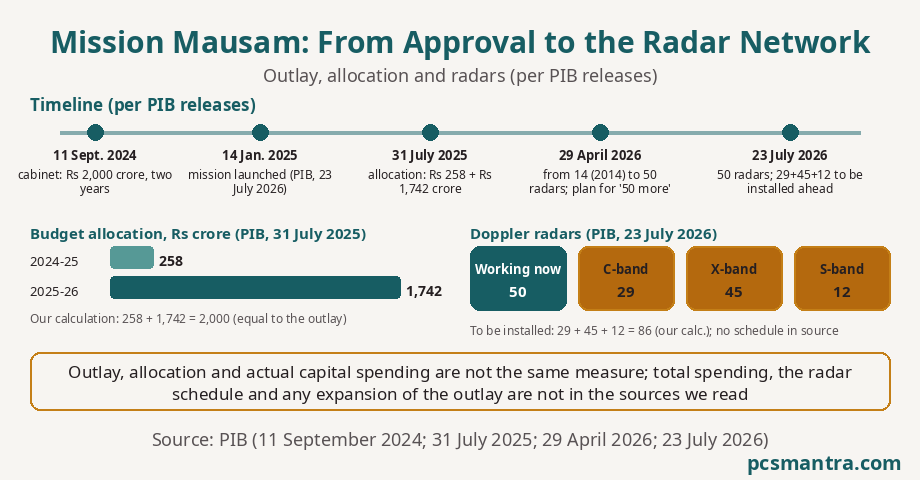
According to PIB's release of 11 September 2024, the Union Cabinet approved 'Mission Mausam' with an outlay of ₹2,000 crore for two years. It will be implemented mainly by three institutions of the Ministry of Earth Sciences — the India Meteorological Department (IMD), the Indian Institute of Tropical Meteorology (IITM) and the National Centre for Medium Range Weather Forecasting (NCMRWF) — with INCOIS, NCPOR and NIOT as their collaborators. In PIB's release of 31 July 2025, according to the minister's answer, the scheme is for the period 2024-2026 and the budget allocations are ₹258 crore in 2024-25 and ₹1,742 crore in 2025-26.
Why in the News
According to PIB's release of 23 July 2026, Minister of State (Independent Charge) for Earth Sciences Dr. Jitendra Singh told the Rajya Sabha in a written answer that Mission Mausam began on 14 January 2025 and that IMD currently receives data from 50 Doppler Weather Radars (DWR). According to the answer, this network is being strengthened with 29 C-band, 45 X-band and 12 S-band radars. Besides, there is a plan to install 19 wind profilers, 25 microwave radiometers and 60 new GPS radiosonde stations. The minister also said that the accuracy of forecasts of severe weather events has improved by 40% compared to the last decade; its basis or criterion was not given in the answer. On the same subject, Lok Sabha unstarred question 466 was answered on 22 July 2026 and question 1693 on 29 July 2026.
Key Facts and Figures
| Approval (PIB, 11 September 2024) | The Cabinet approved ₹2,000 crore for two years; implementation mainly by IMD, IITM and NCMRWF. |
|---|---|
| Budget allocations (PIB, 31 July 2025) | ₹258 crore in 2024-25 and ₹1,742 crore in 2025-26. |
| Actual capital expenditure (Lok Sabha answer 1693, 29 July 2026) | ₹159.55 crore in 2024-25 and ₹173.38 crore in 2025-26; in 2026-27, about ₹33 crore used by NIOT on initial works. |
| Radar network (PIB, 23 July 2026) | Currently 50 Doppler radars; 29 C-band, 45 X-band and 12 S-band are to be installed ahead. PIB's release of 29 April 2026 spoke of a rise from 14 in 2014 to 50, and a plan of "50 more" in Mission Mausam. |
| Computing (Lok Sabha answer 466, 22 July 2026) | Total capacity with "Arunika" and "Arka" was 28 petaflops in 2025, against 6.8 petaflops in 2014. |
Checking the Figures: What Tally and What Are Not Comparable
What tally (our computation): 258 + 1,742 = 2,000, that is, the two years' allocations equal the outlay. 29 + 45 + 12 = 86 radars are to be installed ahead. PIB's release of 29 April 2026 called the rise from 14 to 50 "more than 250%"; (50 − 14) ÷ 14 ≈ 257% tallies with this. According to the Lok Sabha answer, 6.8 to 28 petaflops is about 4.1 times (28 ÷ 6.8 ≈ 4.12). The sum of capital expenditure is 159.55 + 173.38 = 332.93 crore, but this is not total expenditure.
What are not comparable: it is not proper to divide ₹332.93 crore by ₹2,000 crore to derive "how much has been spent", because the answer has only capital expenditure; we have not read revenue or other heads' expenditure in any source. Likewise, the figure of 86 radars and the minister's "50 more" stated in April 2026 are in different words and dates; we do not call these a contradiction, but we cannot match them either.
What is unsaid: neither answer says by when the 86 radars will be operational, and according to Lok Sabha answer 1693, most advanced ocean-observation systems are proposed in the period of the Sixteenth Finance Commission (2026-31), while the approval is for two years (2024-26). Whether the outlay has moved forward or not is something we have not found in any read source. Question 466 had asked the timeline for advance warning of storms and hail in Meerut and Hapur; the answer has details of local automatic instruments, not a timeline.
Significance: Warning from Observation to the Last Person
Observation, models and communication are one chain: according to the answers, radars and other observations, the 12 km global model, the 6 km Bharat Forecast System (BharatFS), district-level impact-based warnings and forecasts reaching every village in "Mausamgram" are talked about. Each link's effect should be assessed separately, which is not in the answers.
Reach to the panchayat level: the "Panchayat Mausam Sewa" portal with the Ministry of Panchayati Raj, advice via WhatsApp to the mobile numbers of panchayat members and secretaries, and the use of the Krishi Sakhi and Pashu Sakhi networks have been mentioned. More than 7,300 farmer awareness programmes were held in 373 districts and about 3.67 lakh farmers are stated to have benefited (our computation: an average of about 50 farmers per programme); there is no figure of actual use or effect on decisions.
The federal and multi-agency framework: the dissemination of warnings involves the IMD, NDMA's SACHET app, state governments, panchayats and private platforms (CAP feed). So forecast accuracy and disaster preparedness are things to be measured separately.
Challenges and What We Have Not Read
The nature of government answers: these are the ministry's parliamentary answers; they carry no independent evaluation, no place-wise list of radars and no installation schedule. What criterion (such as which accuracy of which event) and from which base decade the "40% improvement" is measured is not in the answer, so we write it only as a government claim.
Schedule and finance: by when the "ongoing projects" radars will be installed, whether the outlay has moved forward, and how much the total (capital and other) expenditure has been — these three things are not in our read sources.
What we have not read: we have read in full PIB's release of 23 July 2026 and the official texts of Lok Sabha answers 466 and 1693. From PIB's releases of 11 September 2024, 31 July 2025 and 29 April 2026, we rely only on the parts quoted above. The IMD portal, the Cabinet note of the outlay and radar-wise lists were not read.
Way Forward
Take this as dated government information as of 23 July 2026; for the progress of radar installation and the next decision on the outlay, a new official announcement will have to be seen.
Difference in Concepts
Keep four things separate: (1) the current 50 radars and the 86 to be installed ahead; (2) the Cabinet's outlay, budget allocations and actual capital expenditure; (3) a government claim (such as 40% improvement) and an independent assessment; (4) PIB's number and our computation.
Mains Perspective
GS-III: science and technology, disaster management and climate; GS-II: government policies and service delivery.
Answer Outline
Introduction: Mission Mausam, Rs 2,000 crore and the 2024-26 period.
Main Body: Radars, models and computing; the difference between outlay, allocation and actual expenditure; communication down to the panchayat level; the limits of government claims and figures; way forward.
Conclusion: Test the expansion in observation, models and computing by whether it joins up with effective warning to the last person. Keep the announced scheme, actual achievement and expenditure separate, and make clear the limits of government claims.
Sources
- PIB, parliamentary question on Mission Mausam's implementation (Rajya Sabha, 23 July 2026)
- Lok Sabha unstarred question 466 and answer, 22.07.2026 (Parliament's official PDF)
- Lok Sabha unstarred question 1693 and answer, 29.07.2026 (Parliament's official PDF; capital expenditure)
- PIB, parliamentary question on Mission Mausam (31 July 2025; allocations)
- PIB, the Cabinet's approval of Mission Mausam (11 September 2024)
- PIB, the Doppler radar network (29 April 2026)
Sources: the text of PIB's release of 23 July 2026 and of the Lok Sabha's official answers 466 and 1693 were read in full. The quoted parts of PIB's releases of 11 September 2024, 31 July 2025 and 29 April 2026 were read. The IMD portal and radar-wise lists were not read.
Remember: according to PIB, as of 23 July 2026 IMD takes data from a network of 50 Doppler radars, and 29 C-band, 45 X-band and 12 S-band radars (our computation: 86 in total) are to be installed. The ₹2,000 crore outlay (allocations of ₹258 and ₹1,742 crore) and the actual capital expenditure of ₹159.55 and ₹173.38 crore are different measures; information on total expenditure, the radars' schedule and any extension of the outlay is not in our sources.
Download This Article: PDF