
Why in the news
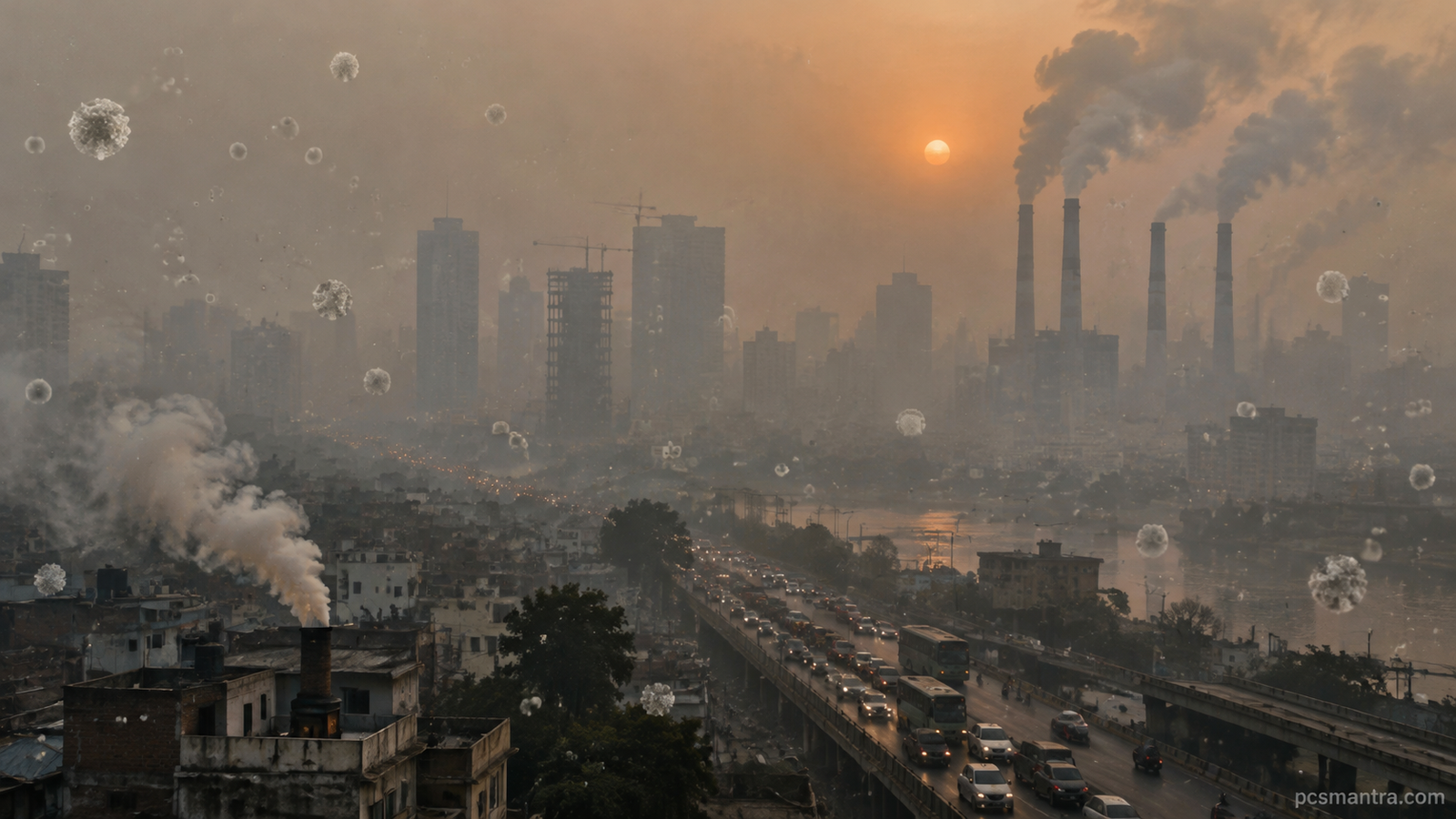
November 13, 2026: In early November 2026, Delhi's air quality once again approached the severe category, with the overall Air Quality Index (AQI) touching 391 on 6 November. Around the same time, an October 2026 analysis by the Centre for Research on Energy and Clean Air (CREA) presented a more unsettling picture: the three most polluted cities in India by monthly average PM2.5 concentration - Baraut (Baghpat), Khora (Ghaziabad) and Gajraula (Amroha) - were all in Uttar Pradesh. Against this backdrop, the demand has gained strength that the National Clean Air Programme (NCAP), launched almost eight years ago, must be fundamentally reworked to move beyond road-dust mitigation and control all major emission sources.
The NCAP journey and its present shape
Launch: The Ministry of Environment, Forest and Climate Change launched NCAP in January 2019 as India's first national-level air quality management strategy.
Target: The initial target was to cut PM10 concentration by 20 to 30 per cent by 2024 (base year 2017) in 131 non-attainment cities - cities whose air quality persistently breaches national standards; the goal was later made more ambitious for 2025-26.
The core criticism: Implementation under NCAP has leaned heavily on suppressing road dust, plantation drives and expanding monitoring, while the largest emission sources - industry, power plants and household fuel - received inadequate attention.
Not just dust: multi-source emissions
According to the CREA analysis and the demands built on it, NCAP should now work in three directions:
- Controlling emissions from industry, power generation and residential sources: Thermal power plants, brick kilns, small industries and solid fuel burnt in homes together form a large share of PM2.5.
- Controlling directly emitted particulate matter: Fine particles released straight into the air must be stopped at the source.
- Controlling gaseous precursors: Gases such as sulphur dioxide (SO2) and nitrogen oxides (NOx) react in the atmosphere to form secondary PM2.5. Controlling dust or direct particles alone does not reduce this component.
The October 2026 numbers show how widespread the problem is: 13 cities in Uttar Pradesh, 11 in Haryana, 3 in Gujarat and 2 each in Madhya Pradesh, Punjab and Rajasthan breached the national 24-hour PM2.5 standard. The crisis is no longer confined to Delhi-NCR; it has spread to smaller cities across several states.
The airshed approach: from city to region
An airshed is a geographic area within which air and the pollutants it carries circulate together - much like a river's watershed. Pollution respects no boundaries: smoke from one district can foul the air of another.
- Current policy is largely city-centric - each city drafts its own plan.
- Recent research, including a study on the Indo-Gangetic Plain, shows that the dominant emission sector differs across critically polluted regions - agriculture in one, transport and domestic sources in another, small industries and brick kilns elsewhere.
- A single uniform plan cannot therefore work across a whole region; district-level, region-specific planning and inter-state coordination within an airshed are essential.
- The Commission for Air Quality Management (CAQM, 2021) for Delhi-NCR is one example of regional coordination; the rest of the country has no such mechanism yet.
NAAQS 2009: standards falling behind the times
The National Ambient Air Quality Standards (NAAQS) were last promulgated in November 2009. The 24-hour PM2.5 limit of 60 micrograms per cubic metre is roughly four times more lenient than the World Health Organisation's 2021 guideline (15 micrograms per cubic metre). The demand is to update the standards, especially the safe limits for PM2.5, so that policy targets themselves become health-based.
Way forward
Taking NCAP to its next stage calls for clear steps: emission-based (total load, not just concentration) standards for industry and power; tighter rules on SO2 and NOx with firm deadlines for flue-gas treatment; a faster shift from solid household fuel to clean fuel; airshed-based planning with an inter-state mechanism instead of city silos; revision of NAAQS; and stronger technical and enforcement capacity in pollution control boards. Experience shows that without standards, money and accountability together, clean-air plans remain on paper. The test ahead is whether India treats the air of its smallest cities as seriously as it treats Delhi's.
Prelims practice questions
Question 1. Consider the following statements:
1. The National Clean Air Programme (NCAP) was launched in 2019 and covers non-attainment cities
2. The National Ambient Air Quality Standards (NAAQS) were last revised in 2015
Which one of the following is correct in respect of the above statements?
(a) Statement 1 is correct, but Statement 2 is not correct
(b) Statement 1 is not correct, but Statement 2 is correct
(c) Both Statement 1 and Statement 2 are correct
(d) Neither Statement 1 nor Statement 2 is correct
Answer and explanation
Answer: (a)
Statement 1: NCAP was launched in January 2019 by the Ministry of Environment, Forest and Climate Change covering 131 non-attainment cities, so this statement is correct. Statement 2: NAAQS were last promulgated/revised in November 2009, not 2015, so this statement is not correct.
Question 2. In the context of air pollution management, which of the following best describes the term 'airshed'?
Which one of the above is correct?
(a) A device that measures PM2.5 concentration in air
(b) A geographic area within which air and pollutants circulate together and which can be treated as a unit for a shared pollution-control plan
(c) An industrial zone where emissions come only from power plants
(d) A law that fixes emission standards for vehicles
Answer and explanation
Answer: (b)
An airshed is a region where, due to atmospheric circulation, pollutants spread beyond administrative boundaries; pollution-control planning therefore takes this region, not the individual city, as its unit. Options (a), (c) and (d) do not define an airshed.
Mains practice question
"India's air quality policy needs to move from city-centric dust control to multi-source emission control and airshed-based management." Critically examine. (250 words, 15 marks)
Answer outline:
In the introduction: NCAP (2019) - its achievements and limits; the October 2026 data.
In the body: The need for multi-source control - industry, power, residential fuel; direct PM and secondary PM2.5 precursors (SO2, NOx). The airshed logic - regional flow of pollution, region-specific dominant sectors, inter-state coordination, CAQM as an example. Institutional gaps - outdated NAAQS 2009, board capacity, financing.
In the conclusion: Updated standards, emission-based regulation, health-centred targets.
Frequently Asked Questions (FAQ)
Summary answer: November 13, 2026: In early November 2026, Delhi's air quality once again approached the severe category, with the overall Air Quality Index (AQI) touching 391 on 6 November.
Question: When and by which ministry was NCAP launched?
In January 2019 by the Ministry of Environment, Forest and Climate Change; it is the national strategy to cut PM10 in 131 non-attainment cities.
Question: What is secondary PM2.5?
Fine particles formed by atmospheric chemical reactions of gases such as SO2 and NOx; controlling them requires curbing the precursor gases.
Question: How do the NAAQS and WHO PM2.5 standards differ?
India's 24-hour standard is 60 micrograms per cubic metre (since 2009), while the WHO's 2021 guideline is 15 micrograms per cubic metre - the national standard is about four times more lenient.
Sources
- [Press] https://www.newindianexpress.com/india/2026/Nov/06/national-clean-air-programme-needs-urgent-overhaul-must-move-beyond-road-dust-control-congress
- [Press] https://www.nature.com/articles/s44407-026-00109-x
- [Press] https://www.pib.gov.in/newsite/PrintRelease.aspx?lang=2®=3&relid=187400
Download This Article: PDF
