
Why in the news
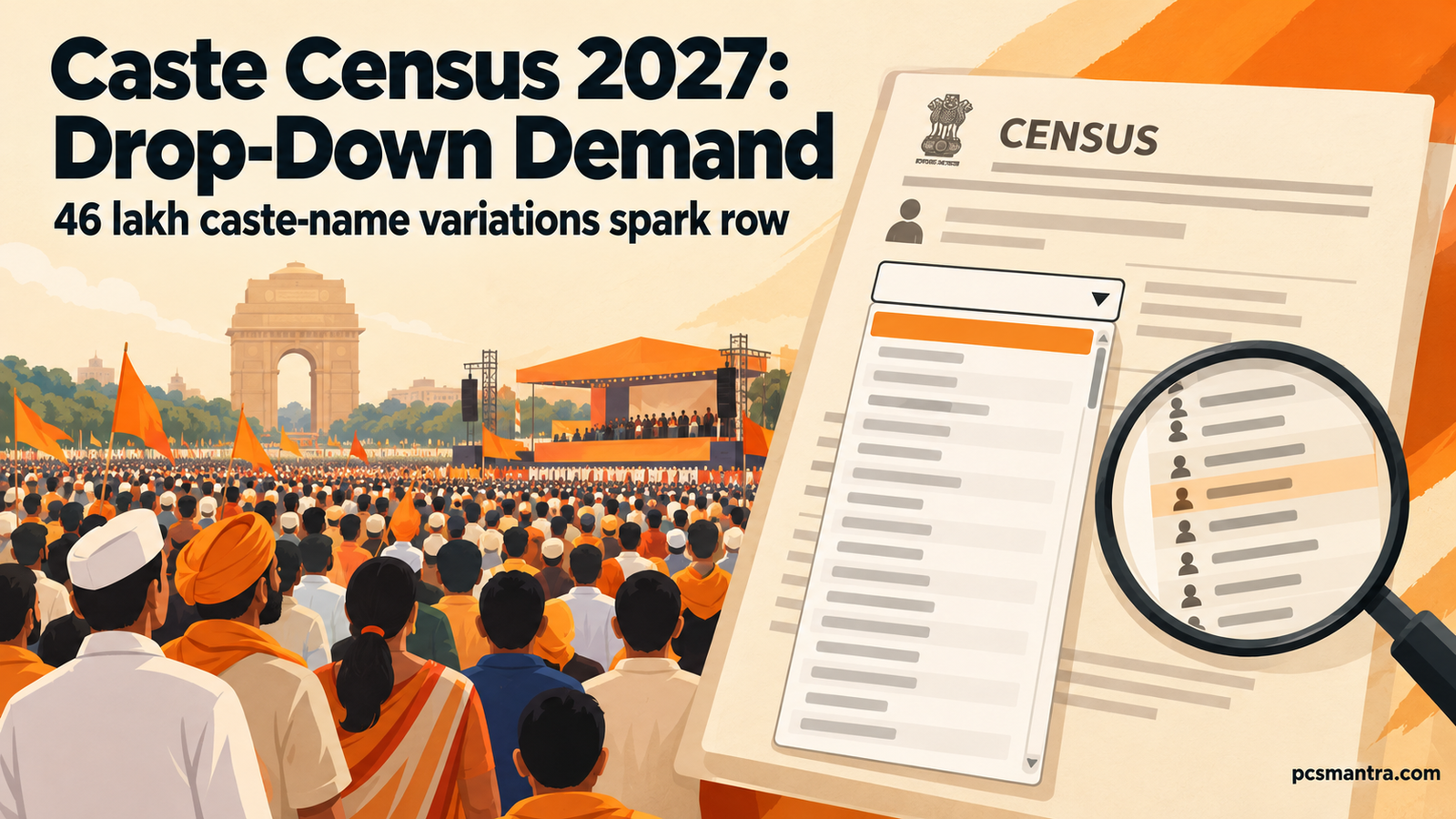
November 13, 2026: The debate over how caste enumeration will be conducted in Census 2027 has intensified. On November 12, 2026, the All India Caste Census Coordination Committee called for a nationwide agitation at Delhi's Ramlila Maidan on November 28, 2026. The demand is that the census should have a pre-loaded drop-down menu for all castes, not only for Scheduled Castes and Scheduled Tribes. A few days earlier, on October 28, 2026, the Supreme Court, hearing a petition seeking a pre-loaded drop-down caste menu, had allowed the petitioner to approach the Registrar General of India (RGI). In other words, the issue is now on both the street and the administrative fronts.
Census 2027 and the place of caste enumeration
India's census is conducted under the Census Act, 1948 and is carried out by the office of the Registrar General and Census Commissioner, under the Ministry of Home Affairs. Census 2027, being held after a gap of 16 years since 2011, will take place in two phases - the first, the houselisting phase (listing houses and households), and the second, the Population Enumeration phase (details of every individual). Caste enumeration is proposed in this second phase. A full caste enumeration in a general census will happen for the first time since 1931, which is why deciding its method matters. (For the full explanation of the Census 2027 timeline and the questions on caste enumeration, read: Census 2027: new timeline and caste enumeration)
Drop-down versus open column: the root of the dispute
Open column: the enumerator writes down the caste stated by the respondent exactly as told. This was the method used in the 2011 Socio-Economic and Caste Census (SECC), and the result was that more than 4.6 million caste names came up - in places spelling variants, in places surnames and gotras got recorded as castes. Cleaning and classifying such scattered data became practically impossible, so the caste data could not be used properly in policymaking.
Pre-loaded drop-down menu: the enumerator has a ready, verified list of castes, from which the correct name is selected. This removes spelling variants, speeds up enumeration and keeps the data directly tabulatable. For Scheduled Castes and Scheduled Tribes, constitutionally notified lists already exist, so the Centre's plan is to keep the drop-down for these two categories only; for everyone else - that is, OBCs and other castes - an open column is proposed.
The argument of the agitating organisations: when the data-quality problem applies to everyone, the solution should also be for everyone. With an open column, the data of OBC castes will repeat the same errors made in SECC 2011. On the other hand, there is also the concern of who will prepare the drop-down list - a caste whose name is not on the list could be left out of the count. That is why the process of preparing the list, the hearing of objections and provisions such as an 'other' option are also part of the debate.
The position on the judicial front
On October 28, 2026, the Supreme Court, hearing the petition seeking a pre-loaded drop-down caste menu, allowed the petitioner to approach the Registrar General. Note that the court did not accept the demand, nor did it issue any direction to the Centre - it only kept open the path of placing the plea before the administrative body. The proposed agitation of November 28 is now an attempt to turn this demand into public pressure.
Way forward
- A balanced approach: the drop-down list can carry an 'other' option and a later verification window, so that no caste is left out of the count.
- Transparent list-building: a draft list of castes can be published first and objections invited.
- The SECC lesson: the 2011 experience makes it clear that if data quality is not fixed at the start, the figures are of no use later; read our analysis of data quality in digital enumeration: Digital census: beyond faster monitoring, the quality of data
- Pilot testing: both methods can be tested on a trial basis and the findings made public.
Significance for the exam
This issue connects social justice, the role of data in policymaking and the census process - all three. In Prelims, SECC 2011, the Census Act 1948, the RGI and the phases of the census can be asked; in Mains, an essay-type question on 'data-based social justice' is possible.
Prelims practice questions
Question 1: Consider the following two statements:
Statement-I: The 2011 Socio-Economic and Caste Census (SECC) used an open column for caste
Statement-II: More than 4.6 million caste names were recorded in SECC 2011
Choose the correct answer from the options given below:
(a) Both Statement-I and Statement-II are correct
(b) Statement-I is correct, Statement-II is incorrect
(c) Statement-I is incorrect, Statement-II is correct
(d) Both Statement-I and Statement-II are incorrect
Answer and explanation
Answer: (a)
Statement-I is correct: in SECC 2011, the caste stated by the respondent was written in an open column.
Statement-II is correct: this same open method produced more than 4.6 million caste names, which became a data-quality problem.
Question 2: In which phase of Census 2027 is caste enumeration proposed?
(a) In the houselisting phase
(b) In the Population Enumeration phase
(c) In both phases
(d) In neither phase
Answer and explanation
Answer: (b)
Caste enumeration is proposed in the second phase of Census 2027, that is, the Population Enumeration phase; the first phase is about listing houses and households.
Question 3: On October 28, 2026, what did the Supreme Court do on the petition seeking a pre-loaded drop-down caste menu?
(a) Directed the Centre to implement the drop-down menu
(b) Allowed the petitioner to approach the Registrar General of India
(c) Dismissed the petition
(d) Stayed the caste enumeration
Answer and explanation
Answer: (b)
The court did not accept the demand; it only allowed the petitioner to place the plea before the administrative body, that is, the RGI.
Mains practice question
'The first condition of a policy of social justice is reliable data.' Examine this statement in the context of the ongoing debate over the method of caste enumeration (pre-loaded drop-down versus open column) in Census 2027. (General Studies-II; 250 words, 15 marks)
Answer outline:
In the introduction: State that Census 2027, being held after 16 years, proposes the first full caste enumeration since 1931, and the debate is over its method.
In the body: Explain the open column of SECC 2011 and the problem of more than 4.6 million caste names; present the benefits of a drop-down (standardisation, error-free tabulation) and the risks (fear of being left off the list, transparency of list-building); refer to the organisations' demand and the court allowing the petitioner to approach the RGI; suggest middle paths such as an 'other' option, objection hearings and pilot testing.
In the conclusion: State that the method of counting is not a technical matter but a policy decision - both data quality and inclusion must be ensured.
Frequently Asked Questions (FAQ)
Summary answer: Demanding a pre-loaded drop-down menu for all castes, including OBCs, in Census 2027, organisations will hold an agitation at Delhi's Ramlila Maidan on November 28, 2026; the Centre's plan is to keep an open column for everyone except Scheduled Castes and Scheduled Tribes.
Question: What is the difference between a drop-down menu and an open column?
In an open column, the enumerator writes the stated caste exactly as told, which produces spelling variants and millions of names. In a drop-down, the choice is made from a pre-verified list, so the data remains standardised and tabulatable.
Question: What was the main problem with the caste data of SECC 2011?
Because of the open column, more than 4.6 million caste names were recorded, which even included surnames and gotras. Classifying such scattered data became practically impossible.
Question: Has the Supreme Court accepted the demand for a drop-down caste menu?
No. On October 28, 2026, the court only allowed the petitioner to approach the Registrar General of India; it gave no order or direction on the demand.
Sources
Download this article: PDF
