
Background and Context
The real knot of India's employment problem is double: jobs are fewer, and of those that exist most are informal - without social security, without PF and pension. For decades, policy emphasis stayed on the 'supply side' - skill the youth, and the job will come on its own. But a skill certificate does not become a job guarantee; the real barrier is often on the demand side - why does an employer shy away from fresh hiring? The answer to this question is 'Employment Linked Incentive' (ELI): the government puts money directly on the decision on which a job is created - a new hire. From this idea, the cabinet-approved ELI scheme came into force on 1 August 2025 under the name 'Pradhan Mantri Viksit Bharat Rozgar Yojana' (PM-VBRY) - with an outlay of ₹99,446 crore and a target of more than 3.5 crore jobs in 2 years. On 19 June 2026 came the scheme's first big national-level incentive distribution.
Why in the News
On 19 June 2026, at a programme held at Vigyan Bhavan, New Delhi, the Prime Minister distributed incentives of about ₹2,400 crore under PM-VBRY; programmes were held simultaneously at about 200 places across the country (PIB, 19 June 2026). According to PIB's figures, since August 2025, 70 lakh first-time employees have joined the formal workforce under the scheme, the incentive has supported the employment of more than 15 lakh beneficiaries, about 20 lakh youth have completed 6 months in their first job, about 10 lakh beneficiaries have received the incentive at this milestone, and more than ₹2,000 crore has reached accounts directly. The Prime Minister described the scheme's feature: 'Most schemes are centred either on the employee or on the employer - this programme supports both together'; he called it 'a bridge between youth and industry'.
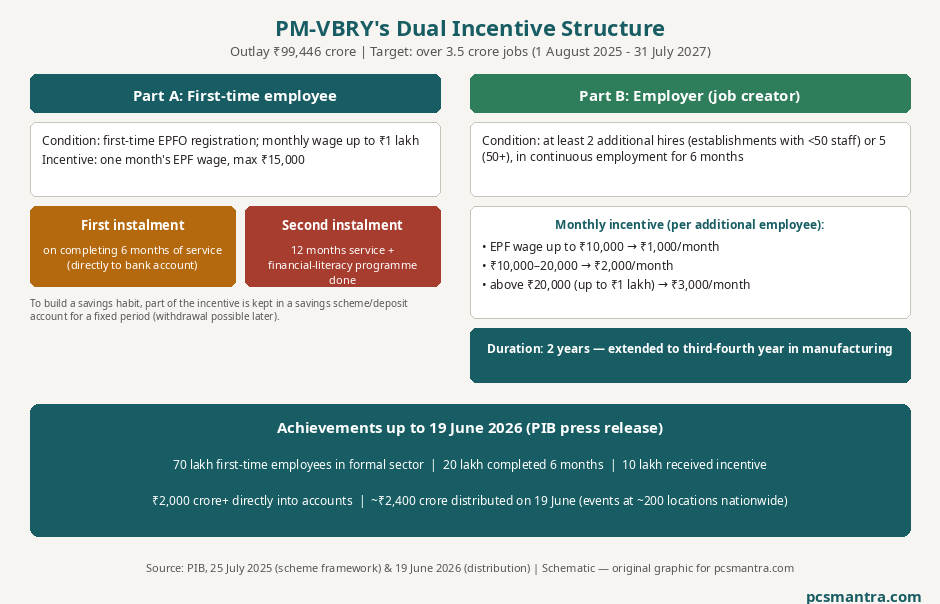
Key facts and figures
| The event | Distribution of incentives of ~₹2,400 crore under PM-VBRY - Vigyan Bhavan, New Delhi, 19 June 2026; ~200 simultaneous programmes across the country (PIB) |
|---|---|
| The scheme's structure | ELI scheme to PM-VBRY, effective 1 August 2025; outlay ₹99,446 crore; target 3.5 crore+ jobs (2 years); 1.92 crore first-time employees; benefit period: jobs created between 1 August 2025 and 31 July 2027 (PIB, 25 July 2025) |
| Part A (employee) | First-time registration in EPFO, salary up to ₹1 lakh/month - one month's EPF wage, maximum ₹15,000, in two instalments: the first on 6 months of service, the second on 12 months plus a financial-literacy programme; some part kept in a savings scheme for a fixed period |
| Part B (employer) | On additional hiring (establishments with fewer than 50 employees: at least 2; 50+: at least 5; 6 months of continuous employment) - ₹1,000/₹2,000/₹3,000 per month according to the EPF wage slab, for up to 2 years; extended to the third and fourth years in manufacturing |
| Progress (19 June 2026) | 70 lakh first-time employees in the formal workforce; 20 lakh completed 6 months; 10 lakh received the incentive; ₹2,000 crore+ reached accounts directly; the incentive supported the employment of 15 lakh+ beneficiaries (PIB) |
How the dual structure works - on both the demand and supply sides
The employer side (demand): the hiring decision rests on cost and benefit. An incentive of up to ₹3,000/month lowers the marginal cost of a new employee - especially in the low-wage slab, where even ₹1,000/month can be up to 10% of the salary. The minimum additional-hiring condition (2 or 5) stops it from becoming a 'business-as-usual' wage subsidy - the incentive is only on the 'additional' job
The employee side (supply/retention): the rate of leaving the first job is the highest. The 6-month and 12-month instalments give a cash reward for 'staying'; the financial-literacy condition and keeping some part in a savings scheme - this design makes the incentive not spending, but asset-building
The formalisation chain: both parts have EPFO registration as the threshold. That is, every incentivised job also joins the social-security net (PF, pension, insurance) - the 70 lakh new EPF registrations are the result of this very chain
The manufacturing preference: the incentive is 2 years in general sectors, but up to 3-4 years in manufacturing - deeper and longer support for production-based employment; this matches industrial priorities like 'Make in India' (PIB, 25 July 2025)
The scheme's significance
A change in policy direction: a clear expansion from skill-centred supply policy towards job-creation-centred demand policy - employment generation is now directly a subject of financial incentive
The first-job economy: the target of 1.92 crore first-time employees is an attempt to connect the demographic dividend to the formal economy
The expansion of social security: because of the EPFO condition, every new job comes within the pension-insurance circle - in the long run its formalisation effect can be bigger than the incentive's cost
Challenges and question marks
Verifying additionality: the incentive is on 'additional' hiring - but would these jobs have been created even without the incentive (deadweight loss)? EPFO data measures flows, not causation; real evaluation demands independent study (analytical)
The quality of employment: the six-month milestone delivers the instalment, but not durable, growing employment - the scheme's real test will be whether the jobs last after 2027 (analytical)
The reach of small establishments: EPFO documentation, the application process and payment time can become a burden for small employers - where the employment capacity is the highest (analytical)
Way Forward
Three directions will be decisive: (i) quality evaluation - data on 12-24-month retention and wage growth should be published, so that the 'lasting' of the jobs 'created' also becomes a policy criterion; (ii) simplification - the application and payment cycle should be simple for small establishments; (iii) combination - skill schemes (supply) and PM-VBRY (demand) should run in coordination, so that a trained youth reaches an incentivised job. The expansion decision after the 2027 deadline will rest on this very data.
Distinctions in the concept
Supply-side policy (skill training - raising the employee's capability; not a job guarantee) versus demand-side policy (PM-VBRY - an incentive only when a new, formal job is created; not capability creation). The two are not rivals but complementary: a skill scheme makes the youth 'employable', PM-VBRY makes the employer 'ready to give a job'. A third distinction: employment-guarantee schemes (like the rural employment framework) give direct public employment, while PM-VBRY incentivises private-sector job creation.
Mains viewpoint
GS-III: employment, formalisation, manufacturing policy; GS-II: social security and welfare delivery (DBT). In the answer, keep the scheme facts (₹99,446 crore, the 3.5 crore target, Parts A/B, the 19 June 2026 figures - PIB attributed) and the demand-supply analytical frame.
Sources
- PIB - details of the PM-VBRY incentive distribution (19 June 2026)
- Prime Minister's Office - details of the distribution programme (19 June 2026)
- PIB - PM-VBRY's scheme structure and launch details (25 July 2025)
The scheme structure (outlay, target, Parts A/B conditions) is from PIB's 25 July 2025 details; the progress figures of 19 June 2026 are from the PIB/pmindia details - all verified verbatim.
Remember: PM-VBRY's distinction is the pairing - the incentive will come only when a job is created, and every incentivised job will be formal. The first year's figures (70 lakh new registrations) are encouraging; the real test of how many of these jobs last will appear after 2027.
Download This Article: PDF