
Why in the News
Researchers of the National Institute of Science Education and Research (NISER), Bhubaneswar, India, and from Belgium have together developed a new generation of portable muon-tracking detector: a glass-based, gas-tight Resistive Plate Chamber (RPC) that catches muon particles produced by cosmic rays with more than 95% efficiency. With this, 'muography', a technique for looking inside volcanoes, tunnels, dams and old monuments without disturbing them, may become easier to take into the field. The paper was published online on 3 September 2026 in Nuclear Instruments and Methods in Physics Research A (NIMA, volume 1093) (printed issue January 2027); the science-outreach news is dated 24 October 2026, so note the difference in dates. The lead author is R. Karnam; co-authors include B. Mohanty, V.K.S. Kashyap (NISER/HBNI) and S. Ikram, A. Giammanco, E. Cortina Gil (Belgium).
What Is Muography?
Muography can be called an 'X-ray of large objects'. High-energy rays from space collide with the atmosphere and make heavy particles called muons, which can pass through hundreds of metres of rock, concrete or metal, but are absorbed or deflected according to density. By counting the muons passing at different angles, scientists make a density map of the inside. The problem was that existing detectors were heavy, delicate and gas-consuming, so it was difficult to carry them to the slope of an active volcano or a remote tunnel. The NISER-Belgium team claims that the new glass-RPC system is small, sealed and able to run autonomously, that is, fit to work outside the laboratory, in the real field. Uses of this technology are already known, from finding hollow chambers inside pyramids to volcano monitoring; the new thing is the instrument becoming 'field-ready'.
The series is also worth noting: the team's work on a gas-tight RPC has continued in stages since 2024 (JINST) and 2025 (Journal of Applied Physics), and the new NIMA paper is the mature form of that, that is, not a one-night discovery but years of engineering refinement.
How Does the Detector Work?
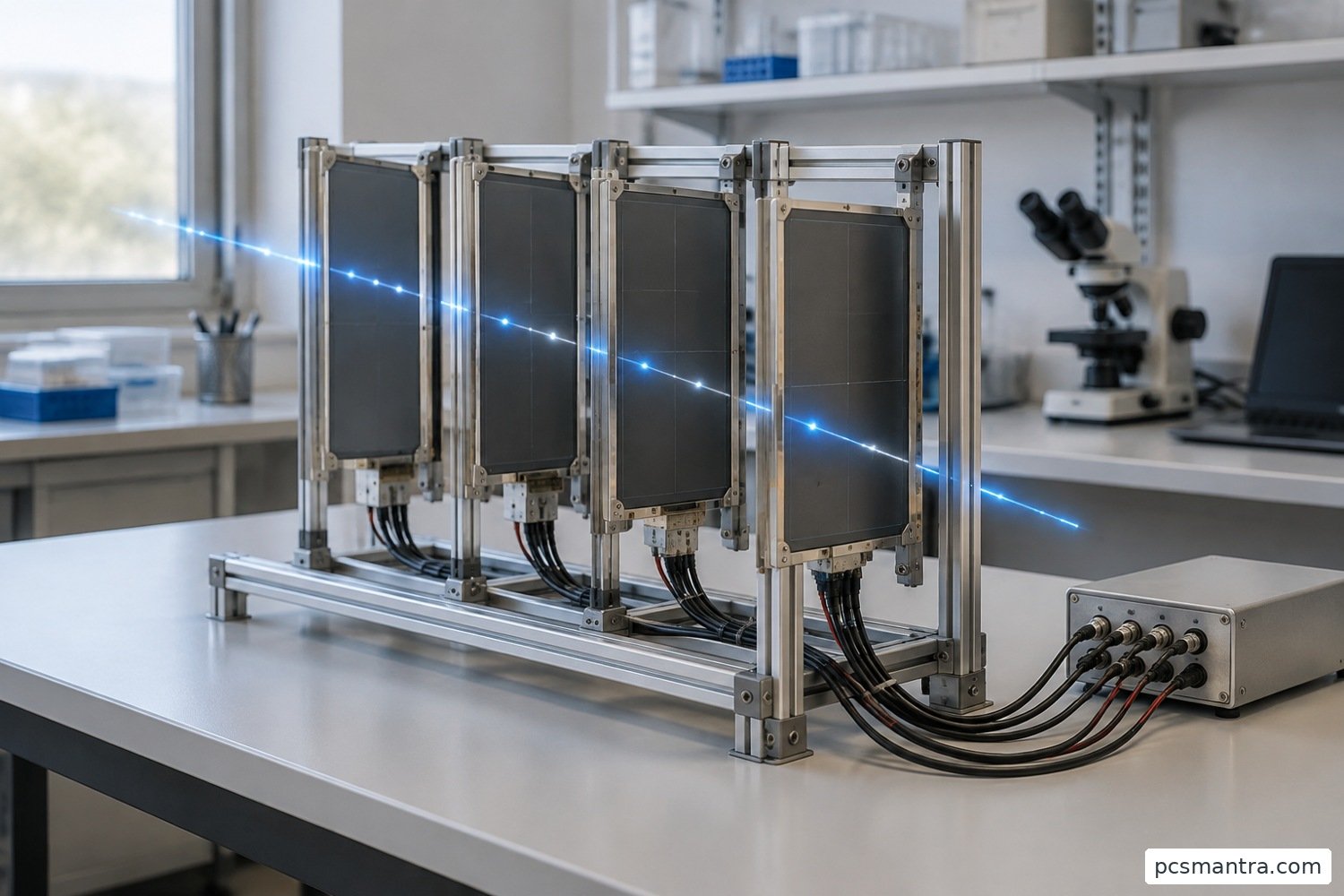
A resistive plate chamber is made of a thin gas gap between two parallel high-resistance plates. A charged particle such as a muon, as soon as it passes through the gas, ionises gas molecules and a small electrical 'avalanche' (an avalanche-like signal) forms. Crossing rows of copper strips placed above and below give the two-dimensional coordinates of the particle from this signal. The team built three prototypes (A, B and C), with thin glass electrodes (1.1 to 3 mm), a layer of semi-resistive paint and a uniform gas gap. The special thing is the 'sealed mode': the gas mixture can be kept closed in an airtight aluminium/acrylic enclosure, which drastically reduces gas consumption. With front-end ASIC chips and FPGA processing, signal reading remained clean and efficient.
Performance Figures
Efficiency: Cosmic-muon detection efficiency of more than 95% in the working voltage range, recorded in the highlights of the paper.
Timing precision: A timing resolution of about 1.8 nanoseconds, and the signal remained confined to one or two readout strips (low strip multiplicity), that is, the track could be read cleanly.
Lead absorption test: For a proof of principle, a block of heavy lead was placed between two plastic scintillator triggers and two glass-RPC layers. According to the news report, about 55,000 muon tracks were recorded in the open-sky measurement; as soon as the lead block was in place, the count fell to 30,894, a direct map of the density difference. The same principle is the basis of 'radiography' of dense materials.
Environmental stability: The design is adapted for autonomous operation and harsh outdoor conditions; the paper presents this as a possibility for field surveys.
Where Could This Technology Be Useful?
Three areas are the most direct. Geology: Monitoring magma pathways and density changes inside active volcanoes. Muography is already used in volcanology, and a portable instrument can make monitoring routine. Engineering: Old bridges, tunnels and dams, identifying hollow or weak layers inside without breaking them; the paper's introduction also mentions rail tunnels. Archaeology: Hidden chambers or corridors inside monuments and pyramid-like structures, without harming cultural heritage. Exploration of mineral deposits is also on the list. Note that these are possibilities; long field confirmation remains in each area.
Comparison with Other Non-Destructive Methods
There are other techniques for looking inside large structures: seismic surveys, ground-penetrating radar (GPR) and ultrasonic testing. But each has a limit: radar has limited depth, the seismic method needs an active source and heavy deployment, and ultrasound does not penetrate the surface. The special feature of muography is its complete passivity, with no source needed, as the cosmos itself gives the 'beam', and its penetration of hundreds of metres. The price is paid in time: because of the weak flux, it can take weeks to months to build a map. So this technique is a complement, not a substitute, and being portable takes it to places where a heavy set-up is not possible.
Limits and Cautions
Keep several things measured. First, this is prototype-level performance: the lead-block experiment is a laboratory confirmation, not a survey of any real volcano or monument. Second, the researchers themselves write that some prototypes still depend on continuous gas flow or a heavy aluminium enclosure, and that some configurations lack wide directional coverage; an upgrade is necessary for large scans. Third, muography is slow by nature: long data collection is needed for a sufficient muon count; it is not a tool for quick inspection. Fourth, a density map shows 'integrated density'; it cannot identify the material (which rock/metal). Fifth, the count figures 55,000 to 30,894 are from a science-outreach report; these exact numbers are not seen in the available abstract of the paper, so take them as news-based. Sixth, the difference of dates: the paper online 3 September 2026 (printed issue January 2027), the preprint of this series April 2025, the news 24 October 2026; this is timely science outreach, not a new laboratory announcement of today.
What to Watch Next
Three things: (1) the four-layer configuration of Prototype B and the alt-azimuthal platform, which will give coverage of the hemisphere of the sky; (2) the larger active area and high-granularity readout of Prototype C, to improve the signal-to-noise ratio; and (3) reducing weight with a 3D-printed carbon-fibre/polymer structure. After that comes the real test: the first field survey on a real volcano, tunnel or monument. From India's point of view, this work is a useful translation of NISER-HBNI's particle-physics laboratory craft into an international collaboration (Belgium), and in future it may link to needs such as domestic monument conservation (ASI) or dam safety.
Reference Points for the Reader
Remember three things. First, the muon is a roughly 200-times heavier 'cousin' of the electron: free, natural and harmless; many pass even through our bodies every second. Second, muography is of two kinds, absorption and scattering; this work is on the absorption side. Third, the RPC is a 'gas detector', a technology proven for decades in huge experiments like the LHC; the renewed part is making it sealed, small and autonomous, not a new particle-detection principle.
Mains Practice Question
How do technologies arising from basic research in particle physics reach other areas of society? Using the example of the portable version of muography, discuss its possibilities and limits in disaster monitoring, infrastructure safety and archaeological conservation. (General Studies III: Science and Technology; 250 words, 15 marks)
Sources and Limits
- Primary research paper (NIMA, Elsevier): Karnam et al., "A portable glass-RPC based muon tracking system for muography applications", volume 1093, online 3 September 2026, printed issue January 2027; DOI 10.1016/j.nima.2026.172018. Abstract and highlights read; access to the full text limited.
- Crossref record: registration 3 September 2026; confirmation of volume/issue.
- Research Matters: 24 October 2026: three prototypes, 95%+, 1.8 nanoseconds, 55,000 to 30,894 lead test, future upgrades (news).
- arXiv 2504.08146 (preprint, April 2025): the development paper of the same series (J. Appl. Phys. 138, 174502, 2025): initial working analysis of the gas-tight RPC.
- JINST 19 C04027 (2024): performance test of the gas-tight portable RPC: basis of the technical lineage.
- Limits: Prototype performance, real field survey remaining; some configurations still on gas flow/heavy enclosure; muography is slow and measures only density; count figures from a news report; date differences (paper 3 September, news 24 October); direct checking from the full text limited.