
12 November 2026 update: Rs 482 crore restoration package, relief extended to all blocks of three districts
The state government has sanctioned Rs 482.42 crore from the State Disaster Response Fund (SDRF) to the Panchayati Raj and Drinking Water Department for repair and reconstruction of damaged infrastructure across 6 districts hit by Cyclone Arnab and subsequent floods - Ganjam Rs 306.54 crore, Gajapati Rs 109.97 crore, Kandhamal Rs 42.57 crore, Nuapada Rs 15.08 crore, Nabarangpur Rs 7.78 crore and Rayagada Rs 97.60 lakh. The funds will repair damaged school buildings, community halls, panchayat offices, anganwadi centres, roads, bridges, culverts, health sub-centres and drinking water projects.
After Chief Minister Mohan Charan Majhi announced a uniform relief package, every affected household in all blocks of Ganjam, Gajapati and Kandhamal - the three worst-hit districts - will receive 50 kg of rice and Rs 2,500 in cash. Special Relief Commissioner Rajesh Prabhakar Patil directed collectors to complete beneficiary identification and verification quickly but with full transparency; block-wise daily reports will go to the State Emergency Operation Centre.
Chief Secretary Anu Garg said there was no lapse in flood management; the floods were caused by unprecedented rainfall. The central team that visited the region for field assessment was of the same opinion.
New sources:
- The New Indian Express: Relief extended to all blocks of 3 districts, 12 November 2026
- Times of India: Rs 482 crore SDRF for 6 districts, 12 November 2026
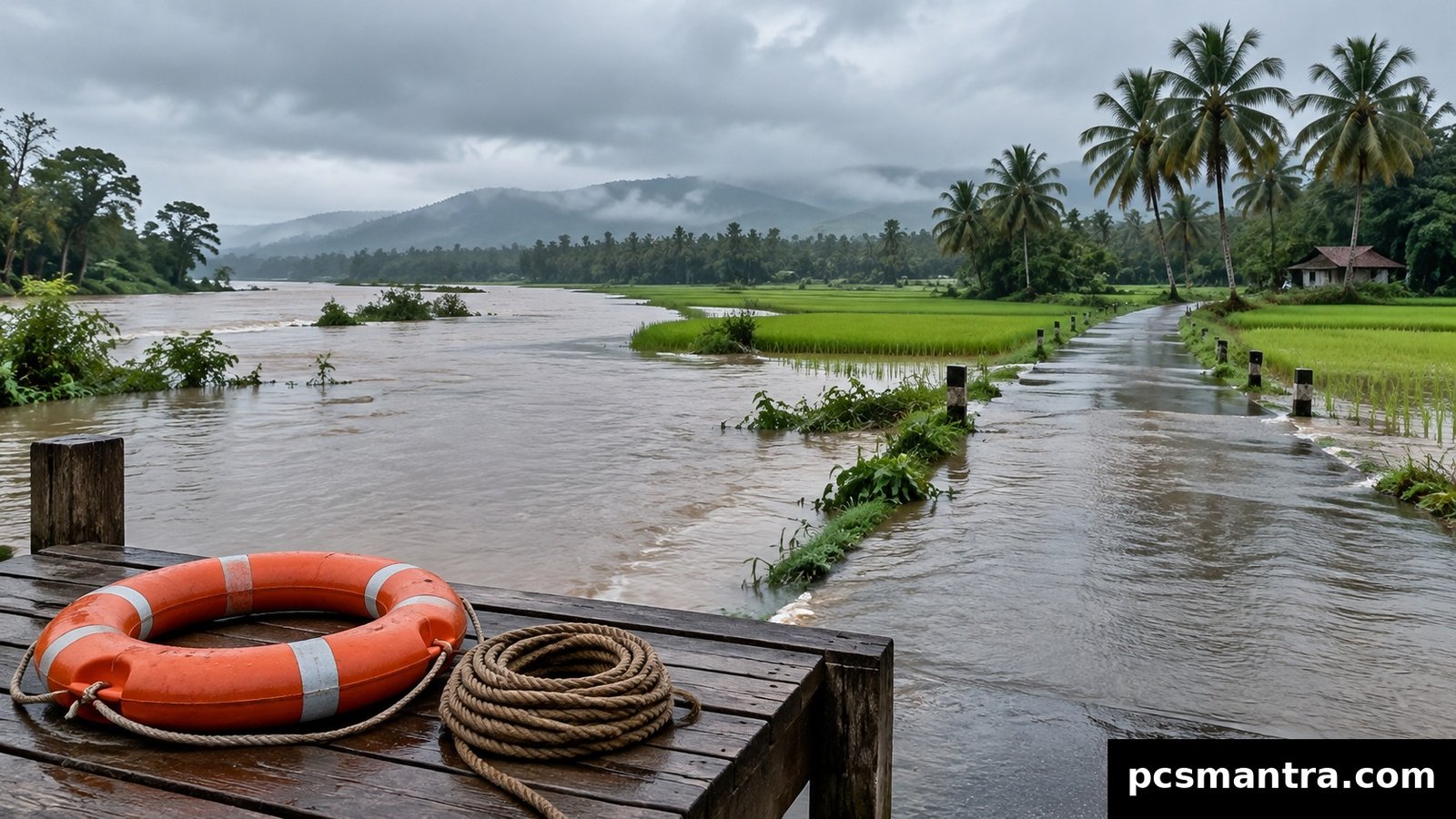
Original symbolic image: pcsmantra.com
Why in the News
After Cyclone Arnab, news of floods, waterlogging and broken contact in southern Odisha showed that a disaster's danger does not end once the strong wind subsides. A Down To Earth report of 29 October 2026 spoke of about 62,500 people affected in Ganjam and Gajapati districts. A New Indian Express report of 30 October described about 42,500 affected people in Ganjam and the swelling of rivers in Gajapati. These are news reports of the respective dates, not a final official assessment of the current damage.
After the Wind, the Danger of Water
The reports mention the rising water levels of the Rushikulya and Bahuda rivers from heavy rain, the breaching of embankments and water filling low-lying areas. In Gajapati, villages were reported affected by the swelling of the Vansadhara and Mahendratanaya. So treating a cyclone as only a coastal-wind or sea-wave danger is not enough; rain and flow in river catchments also raise the risk.
According to Down To Earth, heavy rain in the upper catchment increased the inflow into the Baghalati reservoir and water had to be released. Even after rain lessens at one place, water coming from above can keep the danger alive in areas below. The main lesson of this event is the combined monitoring of river floods and contact disruption after a cyclone.
The Affected, the Marooned and the Evacuated
Citing the administrative review of 29 October, Down To Earth mentioned about 42,500 affected people in Ganjam and about 20,000 in Gajapati. It reported 11,882 people from Ganjam and 17,441 from Gajapati moved to safe places. The same report said 2,328 people in 70 villages of Ganjam were marooned by floodwater.
The New Indian Express report of 30 October mentions 22 villages of Ganjam being marooned. These figures of different dates and different reports have not been treated here as one number or as an unchecked changed situation. Affected population, people marooned by water and people evacuated to safety are different categories; working out a new total by adding or subtracting between them is not appropriate.
Obstacles to Relief and Contact
Both news reports described the participation of the state's ODRAF, the central NDRF and fire services teams. Down To Earth's 29 October report mentioned consideration of helicopter rescue for remote areas. According to the later New Indian Express report, an Indian Coast Guard helicopter evacuated six stranded people in Dharakote; clouds were also hindering the air operation. So calling the later action merely a plan under consideration would be incomplete.
Rail traffic was reported disrupted as the Bahuda's rising water level and water reached up to bridges near the Odisha-Andhra Pradesh border. Broken roads and landslides also made access difficult. These are the conditions of 29-30 October; the article does not report whether any particular train or road is open or closed today. For travel, the current information of the relevant service must be checked separately.
The Wider Question of Disaster Management
When river floods, road blocks, power cuts and communication difficulties come together, the question of relief is not limited to the availability of a boat or a helicopter. Access to food, drinking water, health assistance and safe shelter is equally essential. Down To Earth recorded directions to provide dry food and water and the action of moving pregnant women to safe places.
The analysis emerging from this event is that monitoring and response should continue even after the cyclone. Watching together the catchment's rain, reservoir inflow, river levels and local access gives a better picture of the risk. No independent check of official IMD or state relief bulletins has been done here; the facts are presented with attribution to the respective reports.
Way Forward
After relief, the priority should be safe return, inspection of houses and roads, restoration of power and water, and a transparent assessment of livelihood damage. When ending the temporary role of schools or shelter sites, it is essential to watch the safety of families. These are policy suggestions, not a new government announcement.
For future preparedness, joining river-flood and coastal-risk information, identifying alternative routes to remote settlements and pre-arranging assistance for vulnerable groups will be useful. Until the final damage assessment arrives, the date and source should be kept with the early figures.
Exam Angle
Prelims points: Ganjam and Gajapati are in Odisha; the news context of the Rushikulya, Bahuda, Vansadhara and Mahendratanaya; the distinct institutional identities of ODRAF and NDRF; the difference between the categories of affected and evacuated people.
Mains: GS-III - post-cyclone floods, multi-hazard monitoring, relief and restoration of basic services. Do not take the weather weakening at the coast as the end of risk for the whole catchment.
Question. Why can the danger of floods and contact disruption persist even after a cyclone? With reference to the southern Odisha event, state the priorities of monitoring, relief and restoration. (Write the answer in 150 words. 10 marks)
Introduction: give a brief context of the post-cyclone floods in Ganjam-Gajapati.
Main Body: explain upper-catchment rain, river swelling, reservoir inflow, embankments and contact routes. Write the coordination of boats, air rescue, shelters, water and health assistance. State the need to keep the figures of the affected, the marooned and the evacuated separate.
Conclusion: end on multi-hazard preparedness and safe restoration.
Question 1. With reference to post-cyclone floods, consider the following statements:
Statement-I: As soon as the coastal wind weakens, the flood danger ends in the entire river catchment. Statement-II: Rain in the upper catchment can affect the river's water level in the area below.
Which of the above statements is/are correct?
- (a) Both Statement-I and Statement-II are correct
- (b) Statement-I is correct, but Statement-II is not correct
- (c) Statement-I is not correct, but Statement-II is correct
- (d) Neither Statement-I nor Statement-II is correct
Answer and Explanation
Answer: (c). The timing of wind, river flow and waterlogging is not the same. Water coming from above can raise the danger in areas below.
Question 2. Which is the correct use of early disaster-related figures?
- (a) Adding up all affected and evacuated people, necessarily treating them as separate
- (b) Merging the number of marooned villages of different dates without checking
- (c) Giving the figure with the date, area and category kept clear
- (d) Calling early news the final damage assessment
Answer and Explanation
Answer: (c). When the area, date and category change, figures may not be comparable. Addition or subtraction without the source's limits would be misleading.
