
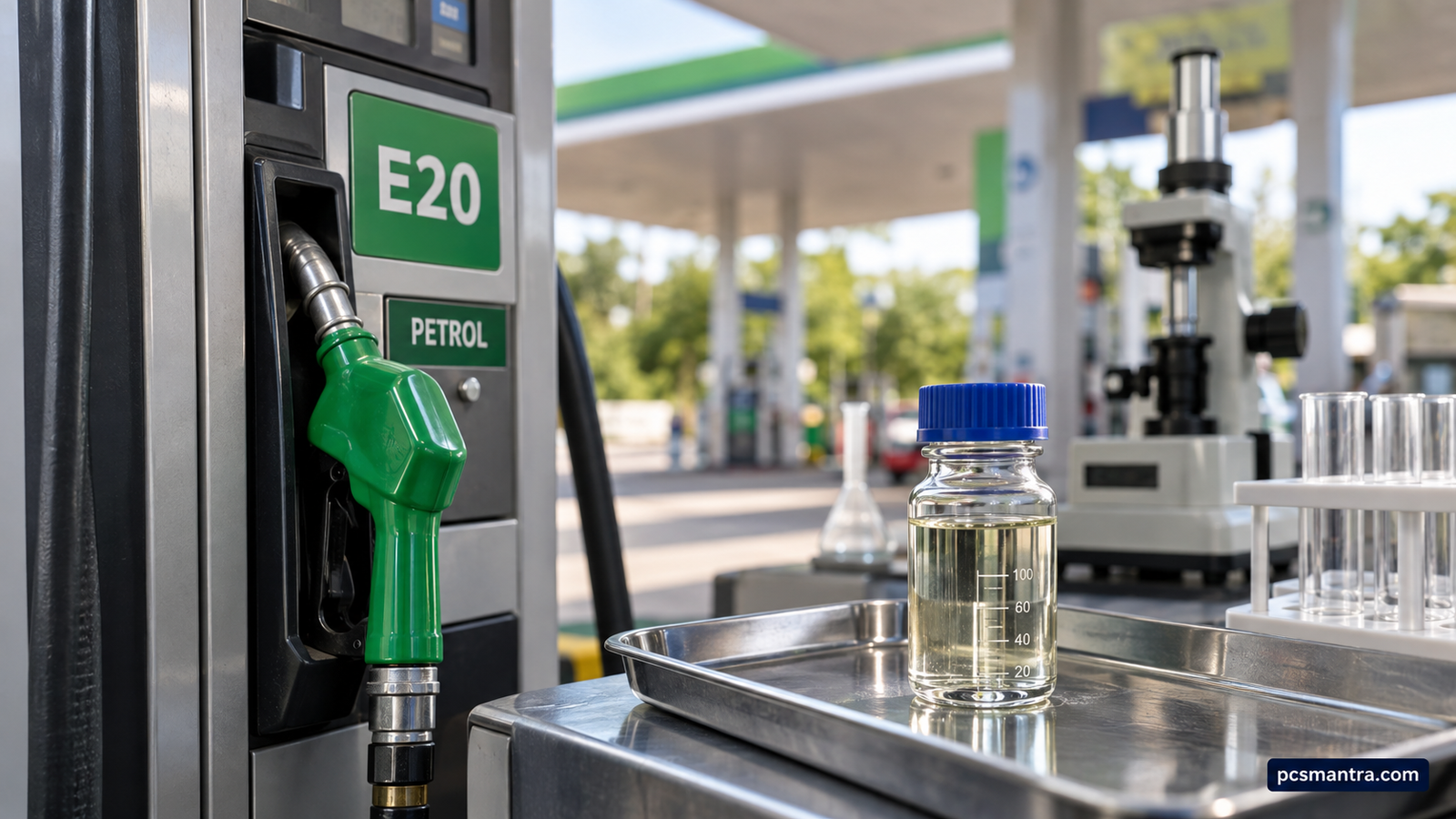
E20: First Understand the Name and the Ratio
According to a parliamentary answer of the Ministry of Petroleum, E20 is a blend of 20 per cent anhydrous ethanol and 80 per cent motor gasoline by volume. '20' should not be understood as a percentage by mass or as a 20 per cent change in the mileage of every vehicle. It is the name of a blend. The Karnataka report of 8 November 2026 mentions extending the probe into the alleged higher ethanol to the links of distribution and blending. Here the focus of Prelims is not to declare any party finally right, but to understand the difference between sample, standard and test method.
Three Separate Questions
| Question | What to look at |
|---|---|
| What is the name of the blend? | The volume-based ethanol-petrol ratio in E20 |
| Does the fuel sample conform to the standard? | Proper sample collection, the prescribed test and the relevant quality standard |
| What is the effect on a vehicle? | The vehicle's design, fuel compatibility, calibration and evidence of actual performance |
Do not mix these three in one answer. Having a target of ethanol blending in policy is not proof of the quality of every retail sample. Similarly, a complaint about a vehicle does not automatically prove extra blending in fuel across the country.
Who Claims What in the Dispute?
The news report has the details of the state government's alleged test of extra blending and a further probe into the supply chain. On the other hand, the Ministry of Petroleum's statement of 7 November claims that 893 samples of public sector oil marketing companies were taken from 27 States and Union Territories and found within the prescribed limit. It states 19-20 per cent ethanol in 56 samples from Karnataka.
These are claims linked to different groups of samples and test procedures. Do not add 893 and 56 to make a new total: in the Ministry's account the 56 samples are part of the wider survey. One can neither call the state's results wrong without an independent check, nor call an allegation at one place the condition of all pumps.
Identifying the Standard and the Test Method
The Ministry's statement mentions IS 17021 for E20 motor gasoline. According to the same clarification, there are prescribed methods such as FTIR, water extraction and gas chromatography to check the quantity of ethanol. It is not enough to write only the name of a test; the applicable standard, the preparation of the sample and the reference material are also important in repeating and verifying the result.
| Method | Reference in the Ministry's clarification |
|---|---|
| FTIR | Fourier Transform Infrared Spectroscopy; ASTM D5845 |
| Water extraction | Annex C of IS 17021 |
| Gas chromatography | ASTM D4815/D6839; including the prescribed sample preparation and reference material |
This list is not an instruction to test in a laboratory oneself. In the exam it is used to recognise that saying 'checked by gas chromatography' and proving compliance with the full standard method are different things.
What Does the Chain of Custody Tell Us?
From which pump the sample was taken, when and in whose presence; how it was sealed; to whom it was handed over and to which laboratory it reached - the record of these is the basis of the chain of custody. The Ministry described the procedure of six one-litre samples under the 2005 Control Order and the Marketing Discipline Guidelines 2024: two to the dealer, two with the company or department and two for the designated laboratory. Requirements such as joint signatures and notice of the result are also stated.
A counter-sample and clear records make a re-check of the original result possible. Before treating results with a different date, a different place or a different sample preparation as comparable, these differences should be checked. The chain of custody does not declare any party's claim right; it strengthens the process of verification.
The Right Conclusions for the Exam
- The name E20 is linked to a volume-based blend, not to a guarantee of mileage.
- The target of a policy and the laboratory result of a sample are separate evidence.
- In conflicting tests, a comparison of sample collection and method is necessary.
- Identify separately the roles of the oil company, the state's probe and independent re-testing.
- See the scope of a number: a state's subset may be inside a national survey.
Prelims Practice
1. With reference to ethanol blending in petrol, consider the following statements:
1. E20 generally means a petrol blend containing about 20% ethanol by volume.
2. The existence of a policy target for ethanol blending automatically certifies the quality of every retail sample.
Which of the statements given above is/are correct?
(a) 1 only
(b) 2 only
(c) Both 1 and 2
(d) Neither 1 nor 2
Answer and Explanation
Answer: (a) 1 only
E20 is the name of a blend. Actual fuel quality requires proper sampling and standard testing; a policy target does not by itself certify every sample.
2. With reference to reliability in fuel testing, consider the following statements:
1. The chain of custody records the handling of a sample from collection to testing.
2. When samples from different times and places yield conflicting results, the method and comparability must be examined.
Which of the statements given above is/are correct?
(a) 1 only
(b) 2 only
(c) Both 1 and 2
(d) Neither 1 nor 2
Answer and Explanation
Answer: (c) Both 1 and 2
Sealing, custody, counter-samples and the prescribed test method make a result verifiable. Results from different sample groups do not directly provide a final conclusion without checking comparability.
Sources
- Ministry of Petroleum, 7 August 2023: the definition of E20
- Ministry of Petroleum, 7 November 2026: OMC testing and sampling method
- Indian Express: expansion of Karnataka's probe
Download This Article: PDF