
Background and Context
In a democracy, the right to protest and the state's responsibility to maintain public order are both constitutionally valid. The clash arises when the police act before an offence has occurred. This is called "preventive action". The Bharatiya Nagarik Suraksha Sanhita (BNSS), 2023 has several different tools of such action, and each one's condition, duration and manner of oversight differ. In the exam these tools are often mixed into one another, so this article's purpose is to explain their ladder, not to settle the accusations of any side.
Why in the News
According to reports, amid the protests running in Delhi over the demand for the Chief Election Commissioner's resignation and for changes in the Special Intensive Revision (SIR) of the voter list, on 16 October 2026 (Friday) the founder of a youth movement (Cockroch Janata Party, CJP) was detained a little before a proposed march at Connaught Place. According to the police, proceedings were started against him under sections 126 and 170 of the BNSS. On 17 October (Saturday) he was produced before a Special Executive Magistrate (SEM) and released on a bond of 50,000 rupees, with a stated condition of not breaching the peace. Around the same time, the Supreme Court has agreed to hear a criminal writ petition by an academic and columnist challenging the prohibitory orders of section 163 and the preventive detentions. The bench of the Chief Justice has agreed to list it with other petitions on 19 November (The Hindu).
This article gives no opinion on the merits of the protest's demands. The allegations of police excess made by political parties and organisations are allegations, and no confirmation of them is claimed here. The question of law is when preventive tools are valid.
The Main Concept: The Ladder of Preventive Action and the Test of Article 19(1)(b)
Article 19(1)(b) gives citizens the right "to assemble peaceably and without arms". Under Article 19(3), the state can place "reasonable restrictions" on this right in the interest of "the sovereignty and integrity of India" or "public order". That is, a ban is possible, but it must be reasonable and must have a basis in law. The preventive sections of the BNSS give such a legal basis, and within each section are conditions that set its limit.
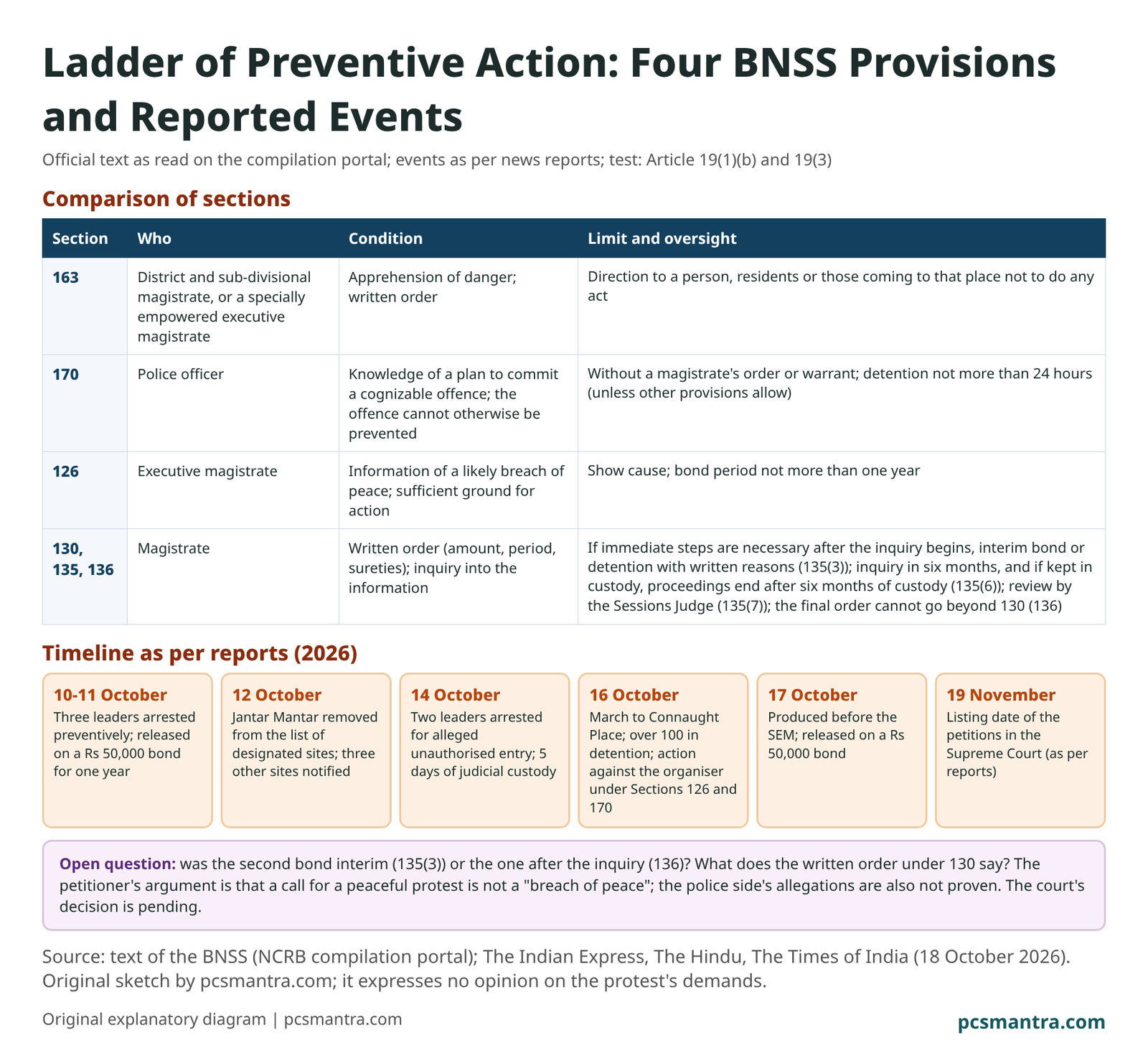
Read four tools separately (the text was read on the National Crime Records Bureau's Sankalan portal): (1) Section 163, prohibitory orders: a written order of the District Magistrate, Sub-Divisional Magistrate or a specially empowered Executive Magistrate, which, apprehending danger, directs a person, the residents of an area or those coming to that place not to do an act. (2) Section 170, preventive arrest: when a police officer knows of a design to commit a cognisable offence and feels the offence cannot be otherwise prevented, he may arrest without a magistrate's order or warrant; such a person cannot be kept in custody beyond 24 hours, unless further custody is necessary or permitted under this Sanhita or any other law. (3) Section 126, bond for keeping the peace: when an Executive Magistrate receives information that a person is likely to breach the peace or disturb public tranquillity and there is sufficient ground for proceedings, he may ask that person to show cause why he should not be made to execute a bond, or a bail bond, for keeping the peace for a period not exceeding one year. (4) Sections 130, 135 and 136, procedure: the written order must state the substance of the information, the amount of the bond, its duration and the number of sureties (130); then the truth of the information is inquired into (135); and only when the necessity is proved in the inquiry is the bond ordered, whose amount and duration cannot exceed the section-130 order (136).
Under section 135(3), after the inquiry begins and before it is completed, if the Magistrate considers immediate measures necessary to prevent a breach of the peace, a disturbance of public tranquillity, an offence or to protect public safety, he may, for recorded reasons in writing, direct the person concerned to execute a bond for keeping the peace or for good behaviour until the inquiry is completed, and may keep him in custody until the bond is executed or, if it is not, until the inquiry is completed. This sub-section has conditions: those not facing proceedings under sections 127, 128 or 129 cannot be made to execute a good-behaviour bond, and the bond's conditions cannot be stricter than the section-130 order. Under section 135(6), the inquiry should be completed within six months of starting, otherwise the proceedings of this chapter stand terminated at the end of that period, unless the Magistrate directs otherwise for special reasons recorded in writing. Under the proviso of the same sub-section, proceedings against a person kept in custody while the inquiry remained pending, if not already terminated, terminate when six months of such custody are completed. If the Magistrate directs the proceedings to continue, then under 135(7) the Sessions Judge, on the application of the aggrieved party, can cancel that direction if satisfied it was not based on a special reason or was perverse. Section 141 states the consequences of a bond's breach; we have not read its text for this article, so treat its details as based on reports.
Main Facts and Figures
| The first action | According to reports, three leaders of the movement were preventively arrested on 10 October 2026 and released the next day on a bond of 50,000 rupees on the condition of keeping the peace and good behaviour for one year (The Indian Express). The dates in that article have appeared in both 10 and 11 October forms, so the original order will have to be seen for the correct date. |
|---|---|
| The protest site | According to the Indian Express and The Hindu, on 12 October Delhi Police removed Jantar Mantar from the list of designated protest sites; according to the Indian Express, three other sites (Ramlila Maidan, Burari Maidan and CBD Ground) were notified. |
| 14 October | Two leaders of the movement were arrested over alleged unauthorised entry into Jantar Mantar and hoisting the national flag, and sent to five days' judicial custody; according to the police, they face charges of breaking the earlier bond, violating the prohibitory order, trespass and obstructing public servants in their work (The Indian Express). |
| 16 October | The "Lehra Do Tiranga" march at Connaught Place; according to the Indian Express, about 2,000 people (estimate) gathered and more than 100 were detained. The founder was detained in the evening a little before the march; according to reports, he had earlier been given a notice not to march and, according to the police, he did not comply with it. |
| 17 October | Produced before the SEM, released on executing a 50,000-rupee bond, condition: not to take part in any peace-breaching activity (The Hindu). According to the police, his case was linked to a violation of section 163. His lawyer raised the question of why he was repeatedly taken before the SEM. |
| Another student leader | According to the Indian Express, the president of a student organisation was removed under section 65 of the Delhi Police Act, 1978 and released the next morning (reports state the duration of custody differently: about 12 hours according to The Hindu). We have not read the text of that Act. |
| The Supreme Court | The petitioner's argument (The Hindu): treating a call for peaceful protest as a "breach of the peace" is improper; a "breach of the peace" is when a violent or criminal act is near; preventive detentions, some of about 24 hours, are illegal. These are the petitioner's arguments. We did not find the Centre's or the police's reply in these reports. A listing date of 19 November has been stated for the hearing. |
| The rally ahead | Delhi Police gave the Congress a no-objection certificate for the period 25 October to 3 November for the 1 November rally at Ramlila Maidan (The Indian Express). |
| What is not clear yet | Whether the second bond was the interim bond of 135(3) or the post-inquiry order of 136; what the written order of 130 says; which notice or order was allegedly violated. We have read neither the SEM's order, nor the FIR, nor Delhi's section-163 order. |
Analysis: Four Questions Asked of Every Preventive Action
The framework below is our analysis, not any court's decision. First: which tool? Section 170 gives the police the power to arrest without a magistrate's order, but the condition is knowledge of a design to commit a cognisable offence; whether a "call for a peaceful protest" is by itself a design to commit a cognisable offence is the petition's core dispute. Section 126 is the magistrate's tool, not the police's, and it has a process of written order and inquiry. Second: what basis? In 126 there is the condition of "sufficient ground" and in 170 of "the offence cannot be otherwise prevented"; that is, the room for trying a less harsh measure first is examined. Third: duration and oversight. In 170(2) there is the 24-hour limit, while in 126 the bond can be of a maximum of one year; under 135(3), an interim bond or custody during the inquiry is possible only when immediate measures are necessary and with recorded reasons, and the inquiry's time limit and the Sessions Judge's review are provided in 135(6) and (7). Fourth: proportionality. Article 19(3)'s "reasonable restrictions" means the reason should match the restriction placed, and the restriction should have a legal basis.
At the level of facts there is a practical question raised by the petitioner in the reports: in a chain of designated protest sites being removed, prohibitory orders and refusals of permission, what lawful path remains for a person. This is an argument and the court will answer it. The points of the police's side in the reports (defiance of the notice, violation of the prohibitory order, trespass) are also allegations and not proven.
On whether action can be taken again after a bond has already been executed, according to the Indian Express's explanation, executing a bond does not give exemption from a later preventive arrest, and a fresh arrest under 170 and the procedure of 141 on a bond breach are separate paths. We have not read the text of 141, so read this as a report.
Significance: The Institutional Test of the Balance Between Rights and Order
The validity of preventive action depends on under which law, on which basis and for how long it was done. This is the reason the same event is seen divided into different tools. The judiciary's role is to decide whether the tool was used within its conditions. This is relevant for both GS-II (rights, governance, the role of the police and the judiciary) and GS-IV (the ethical test of civil liberty versus order).
Challenges and What the Reports Do Not Have
The first challenge is of facts: reports differ on dates and the duration of custody, and the SEM's order or FIR is not publicly with us. Second, we have not read the police's and the government's side regarding the petition, so no conclusion forms on one-sided arguments alone. Third, several different laws are coming together (BNSS 163, 126, 170, section 65 of the Delhi Police Act), and reports sometimes describe them as one process. Fourth, organisations have alleged mistreatment of women and other protesters; according to The Hindu a memorandum was submitted to the police headquarters, but we have not read the outcome of any investigation of those allegations.
Way Forward
These points are our analysis. (1) Keeping recorded reasons and a limited duration clear in preventive orders, so that their judicial review is possible later. (2) A clear, pre-announced arrangement of designated sites for protests and the permission process, so that compliance stays possible. (3) Access to a lawyer and family and documentation in the first 24 hours of custody. (4) A formal arrangement of dialogue points between the police and protesters. (5) Standard operating procedures per the Supreme Court's directions when its decision comes.
The Difference in Concepts
| Point | Difference |
|---|---|
| Section 163 versus section 170 | 163 is a magistrate's written order restricting acts in an area; 170 is the police's power of preventive arrest, whose condition is knowledge of a design to commit a cognisable offence and a 24-hour limit. |
| Preventive arrest versus peace bond | Arrest is immediate prevention; the bond (sections 126 to 136) is a guarantee of behaviour for a period after the magistrate's inquiry. Both can come one after the other, but they are separate processes. |
| Preventive action versus punishment | Preventive action is not a punishment after an offence is proven; it is a caution based on apprehension, so its conditions are strictly examined. |
| Allegation and argument versus judicial finding | The petition's arguments and the police's allegations are not findings until a court or magistrate decides. |
The Mains View
GS-II: fundamental rights (Article 19), the powers of the police and executive magistrates, the role of the judiciary; GS-IV: the ethical balance between civil liberty and public order; GS-III: internal security and public order.
Answer Outline
Introduction: The balance of Articles 19(1)(b) and 19(3), and the reports of 16 to 18 October 2026 (inquiry and hearing pending).
Main Body: The difference of the three tools: 163 (restriction on an area), 170 (arrest up to 24 hours on a design to commit a cognisable offence), 126 (bond after the magistrate's inquiry); the tests: legal basis, recorded reasons, necessity and proportionality, duration and judicial oversight; matching with the reported situations, which should be called initial and disputed; suggestions: clear protest sites, written orders, access in custody.
Conclusion: Do not treat preventive action for public order as punishment; judge validity on each section's separate condition, written reasons, necessity, proportionality and judicial oversight, and do not turn disputed reports into judicial findings.
Sources
- Text of the Bharatiya Nagarik Suraksha Sanhita, 2023: sections 126, 130, 135, 136, 163, 170 (National Crime Records Bureau, Sankalan portal)
- The Constitution of India, text of Articles 19(1)(b) and 19(3) (Legislative Department, Government of India)
- Explanation of the peace bond and the sections, timeline: The Indian Express (Explained), 18 October 2026
- Bail, the number of detainees, permission for the 1 November rally: The Indian Express, 18 October 2026
- Release, the bond's condition and the police's side: The Hindu, 18 October 2026
- The petition in the Supreme Court and the listing date of 19 November: The Hindu, 18 October 2026
- Summary of the sequence of events: The Hindu (live updates), 18 October 2026
- Confirmation of the mention of sections 126 and 170: The Times of India (live), 18 October 2026
Note: The SEM's order, the FIR, Delhi's section-163 order, the text of BNSS section 141 and of the Delhi Police Act, and the Centre's or the police's reply have not been read. Reports differ among themselves on dates and durations, as recorded above. The article gives no opinion on the protest's demands.
Download This Article: PDF