
Actual publication date: 20 October 2026
Constitution: the Union executive and the Council of Ministers
Topic Context:
This is a conceptual polity topic with no specific news date. The study is based on the original text of Articles 74 and 75 of the Constitution of India (official version updated to 1 May 2024, Legislative Department, Government of India).
In the parliamentary system, the President is the nominal head of the Union and the real executive power lies with the Council of Ministers led by the Prime Minister. For the prelims, the facts tied to the provisions have been kept at the centre.
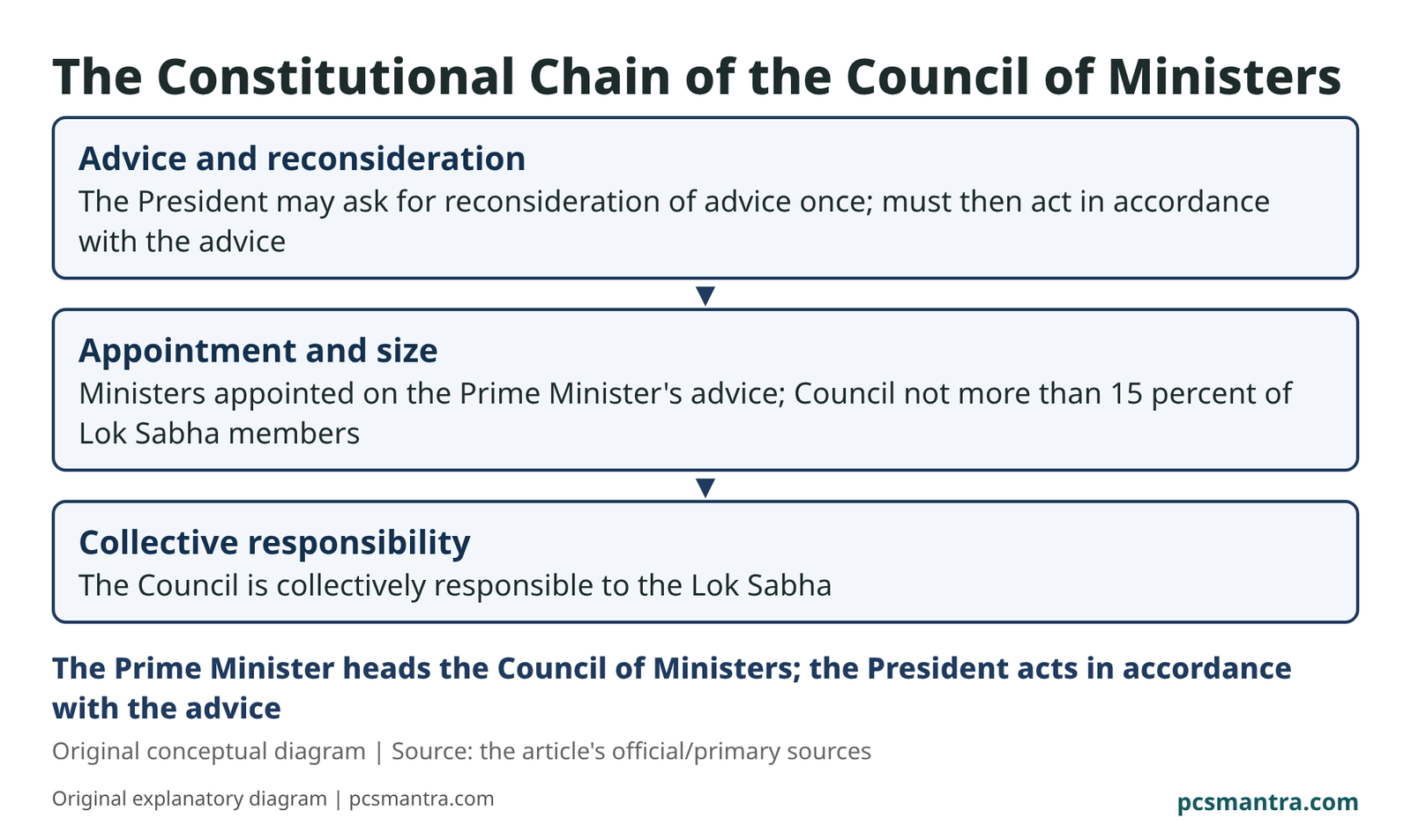
Advice and reconsideration: the President can ask for the advice to be reconsidered once; then they must act in accordance with the advice
Appointment and size: ministers are appointed on the advice of the Prime Minister; the Council of Ministers not more than fifteen per cent of the members of the Lok Sabha
Collective responsibility: the Council of Ministers is collectively responsible to the Lok Sabha
The Prime Minister heads the Council of Ministers; the President acts in accordance with the advice
Article 74: The Framework of Advice:
There shall be a Council of Ministers with the Prime Minister at its head to aid and advise the President, and the President shall act in accordance with such advice in the exercise of their functions. The 42nd Amendment (1976; effective 3 January 1977) made explicit the obligation to act in accordance with the advice.
The 44th Amendment (1978; effective 20 June 1979) added a proviso: the President may require the Council of Ministers to reconsider such advice, either generally or otherwise, but the President shall act in accordance with the advice tendered after such reconsideration. Under Article 74(2), the question of what advice was tendered by ministers cannot be inquired into in any court.
Article 75: Appointment, Pleasure and Size:
The Prime Minister is appointed by the President, and the other ministers are appointed on the advice of the Prime Minister. Ministers hold office during the pleasure of the President, and before entering upon office the President administers to them the oaths of office and secrecy according to the Third Schedule.
Under Article 75(1A), added by the 91st Amendment (2003; effective 1 January 2004), the total number of ministers, including the Prime Minister, cannot exceed fifteen per cent of the total number of members of the Lok Sabha.
Collective Responsibility:
Under Article 75(3), the Council of Ministers is collectively responsible to the Lok Sabha. On losing the confidence of the house, the Council of Ministers must leave office; this is the basis of accountability in parliamentary government.
Collective responsibility means that ministers are answerable to the Lok Sabha not individually and separately but as a group; so the acceptance of decisions and their defence are done by the Council of Ministers together.
Prelims: Practice Questions
Question 1. From which amendment did the President get the right to ask once for the reconsideration of the Council of Ministers' advice?
(a) 42nd Constitutional Amendment, 1976
(b) 44th Constitutional Amendment, 1978
(c) 52nd Constitutional Amendment, 1985
(d) 73rd Constitutional Amendment, 1992
See Answer and Reason
Answer: (b). The 44th Amendment added the proviso to Article 74(1); after one reconsideration, the President must act in accordance with the advice. The 42nd Amendment had made explicit the obligation to act in accordance with the advice.
Question 2. Under Article 75(1A), what is the correct limit on the size of the Council of Ministers?
(a) Ten per cent of the members of the Lok Sabha
(b) The total number of ministers, including the Prime Minister, not more than fifteen per cent of the total membership of the Lok Sabha
(c) Fifteen per cent of the total members of both houses
(d) No statutory limit
See Answer and Reason
Answer: (b). From the 91st Amendment (2003), the total number of ministers, including the Prime Minister, cannot exceed fifteen per cent of the total membership of the Lok Sabha; the base is the Lok Sabha alone.
Question 3. Under Article 75(3), to whom is the Council of Ministers collectively responsible?
(a) To the President
(b) To the Rajya Sabha
(c) To the Lok Sabha
(d) To the Supreme Court
See Answer and Reason
Answer: (c). The Council of Ministers is collectively responsible to the Lok Sabha; on losing confidence, it must leave office.
Source:
Download This Article: PDF
