
Why in the News
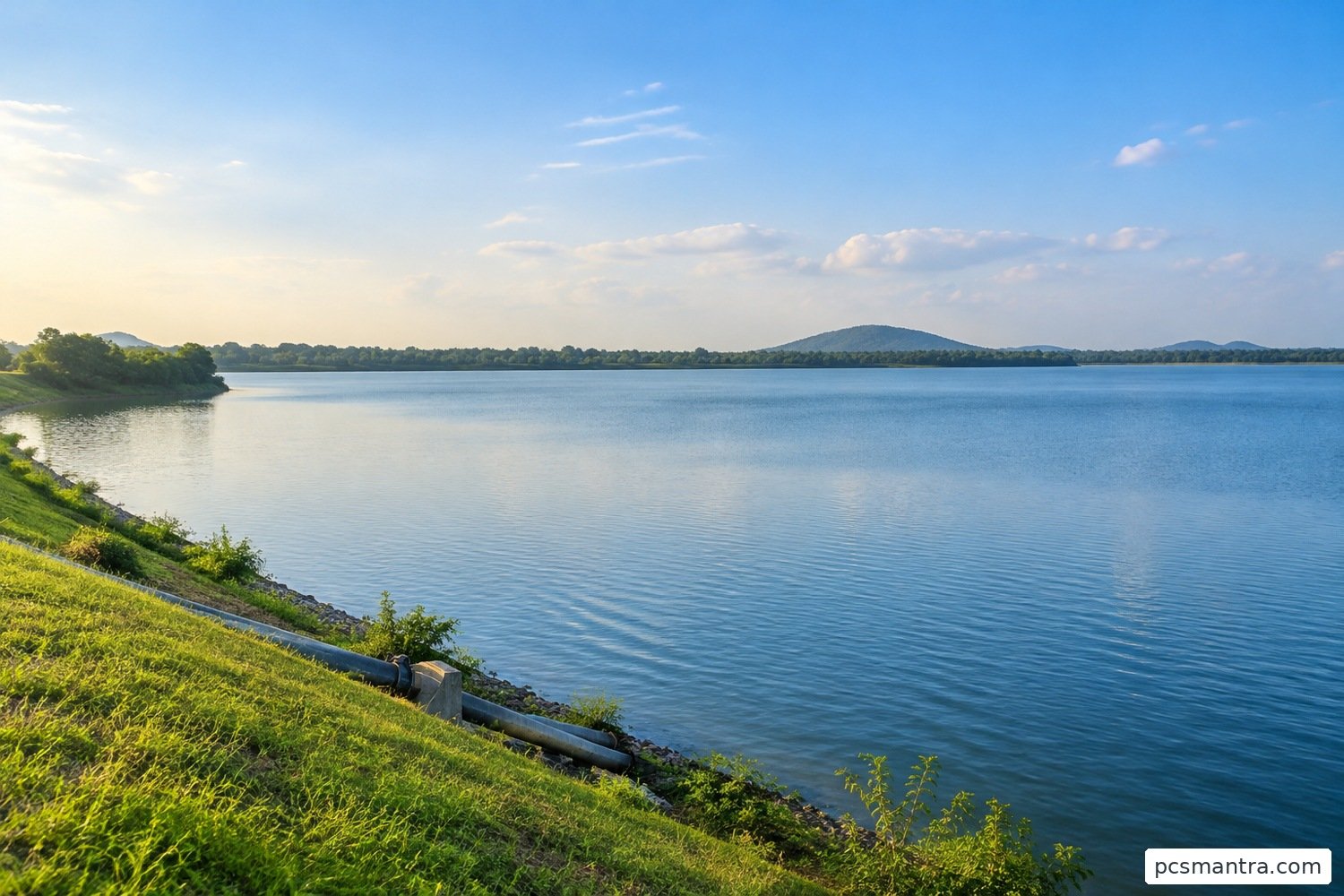
The Red Hills reservoir (local name Puzhal lake) is located in Tamil Nadu's Tiruvallur district and is a major part of Chennai's drinking water supply system. It is linked to the early protected surface water supply system developed in the British era.
Key Facts (According to the Chennai Metro Water Board)
- Organised water supply in Chennai began in 1872; water from the Tamaraipakkam dam on the Kosasthalaiyar river was conveyed by gravity through the Cholavaram tank to the Red Hills lake.
- Poondi (Sathyamurthy Sagar, 1944), Cholavaram and Red Hills - the combined storage capacity of these three reservoirs was 5,596 million cubic feet (Mcft), of which Red Hills' share was 2,440 Mcft.
- Jones Tower (1881): A gravity intake tower built at the lake's deepest point, named after the British-era engineer J.A. Jones. Through it, raw water reaches the Red Hills water treatment plant about 100 metres away; this British-era structure is still functional today (The Hindu, 2024).
Ecological Importance
The area around the lake is a habitat of birds and is also mentioned in the context of the Central Asian Flyway. (This detail has been kept as general ecological knowledge.)
Context and Detailed Explanation
The speciality of the Red Hills reservoir lies in its gravity-based engineering. In Chennai's organised water supply that began in 1872, water of the Kosasthalaiyar river was diverted from the Tamaraipakkam dam and conveyed through the Cholavaram tank to the Red Hills lake - the whole system ran on the strength of the slope, without pumping. The combined storage capacity of the three reservoirs Poondi (Sathyamurthy Sagar, 1944), Cholavaram and Red Hills was 5,596 million cubic feet, of which Red Hills' share of 2,440 Mcft is the largest component of this chain.
Jones Tower (1881) is a peak example of this vision: standing at the lake's deepest point, this gravity intake tower conveys raw water to the Red Hills water treatment plant about 100 metres away and, according to The Hindu (2024), is still functional - that is, the British-era structure has been in service for more than 140 years. This tower, named after the British engineer J.A. Jones, is a direct point for questions on historic engineering.
Note the ecological side too: the area around the lake is a habitat of birds and connects to the context of the Central Asian Flyway (kept in the article as general ecological knowledge). In the exam, the name of the river (Kosasthalaiyar), the district (Tiruvallur) and the tower's year (1881) - all three are direct facts.
Exam Utility
Urban water management, historic engineering, lake ecology - Prelims geography/environment.
Prelims Style: Practice Questions
Question 1. In which district of which State is the Red Hills reservoir located?
(a) Andhra Pradesh - Chittoor
(b) Tamil Nadu - Tiruvallur
(c) Karnataka - Kolar
(d) Kerala - Palakkad
Answer and explanation
Answer: (b) Tamil Nadu - Tiruvallur. Near Chennai.
Question 2. In which year was the Jones Tower built and what is its function?
(a) 1872; water distribution
(b) 1881; gravity intake of raw water from the lake
(c) 1914; water treatment
(d) 1944; flood control
Answer and explanation
Answer: (b) 1881; gravity intake of raw water from the lake. Located at the lake's deepest point.
Question 3. In Chennai's early water supply system, water was diverted from which river?
(a) Cauvery
(b) Adyar
(c) Kosasthalaiyar
(d) Palar
Answer and explanation
Answer: (c) Kosasthalaiyar. From the Tamaraipakkam dam.
Sources
- Chennai Metropolitan Water Supply and Sewerage Board (details of the water supply system): https://cmwssb.tn.gov.in/water-supply-system
- The Hindu (23 August 2024): https://www.thehindu.com/news/cities/chennai/jones-tower-an-intake-structure-built-in-1881-that-still-helps-supply-water-to-chennai/article68555096.ece
Download This Article: PDF