
Science and Technology | First publication of the research: 6 May 2026 | Mains: General Studies-III
Why in the News
Researchers associated with the Indian Institute of Science have presented a strategy for turning iron obtained from red mud into a useful electrocatalyst material. This catalyst has been developed for the electrochemical process that converts nitrate into ammonia. The authors of the study, published in Green Chemistry, are Kanhai Kumar and Karuna Kar Nanda. The date of first publication in the journal is recorded as 6 May 2026.
The study connects two waste-related questions: using the iron present in the residue of the alumina industry, and making a useful nitrogen product from nitrate in water. This is a research-level direction of the circular economy. It should not be read as a solution for all red mud, as ammonia production without energy expenditure, or as a technique that instantly makes any polluted water drinkable.
What Is Red Mud?
The residue left after alumina is extracted from bauxite by the Bayer process is generally called red mud or bauxite residue. So it is not the waste of the final process of directly producing finished aluminium metal, but a material tied to the refining process before that. Along with iron oxide, it can contain minerals with silica, alumina, titanium and calcium, as well as sodium salts.
Its high alkalinity is the main challenge for environmental management. Safe storage of the residue, drainage of water, structural stability and the safety of nearby communities are essential. Guidance from the International Aluminium Institute states that even when useful materials are possible, most residue has to be safely managed. Finding one use in a laboratory does not end the responsibility for the vast quantity already deposited.
From Waste to Value-Added Material
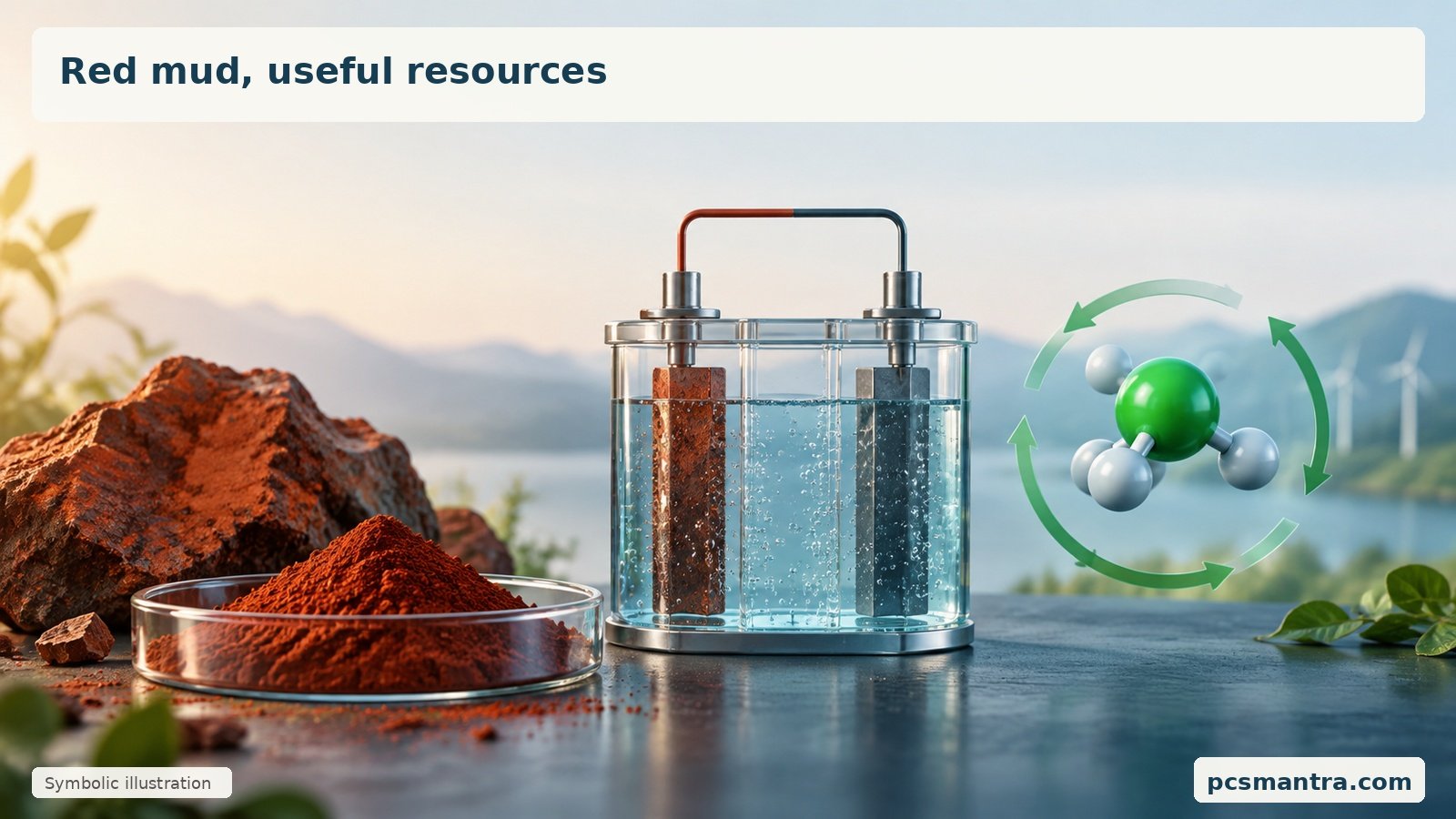
In the new research, instead of using red mud merely as filling material, the focus is on making a catalyst from its iron. According to the primary abstract, iron oxides with distinct phases were prepared through a tannic-acid-based coordination process. These include ferric oxide and magnetite. In this way, an attempt was made to turn an element obtained from waste into a controlled material for a specific task.
This distinction is important: finding iron in a waste and making a reliable catalyst from that iron are separate stages. A material's chemical state, surface and structure can affect its performance. For this reason the research did not treat the total iron content alone as sufficient. Here the value-addition claim is tied to a material that performs a useful function, not to selling off the whole residue as if it were pure iron.
The Role of Tannic Acid
The institutional description speaks of bringing red mud's iron into solution through acidic leaching and then forming an iron-tannate complex with tannic acid. Leaching simply means extracting a substance present in a solid into a suitable liquid medium. In coordination or chelation, chemical groups bind to a metal ion and can play a role in building its subsequent structure.
This tannic-acid-based route is part of the strategy for preparing the catalyst. It does not mean that merely adding acid eliminates every toxic component of any red mud. The composition of residue can change with its source. The solids remaining after treatment, the liquid waste and the recovered material will have to be tested separately. The success of one stage should not be made an automatic confirmation of complete waste remediation.
Why Ammonia from Nitrate?
Nitrate pollution is an important question for water bodies and public health. On the other hand, ammonia is used in agriculture and many industrial applications. Electrochemical nitrate reduction is based on the idea that the nitrogen present in nitrate can be converted into a product such as ammonia. The raw nitrogen source for this route is nitrate, not atmospheric nitrogen gas directly.
So it cannot be called an immediate substitute for every form of conventional ammonia production. The availability of nitrate, its level in water and the need to separate the product will matter. Turning a pollutant into a useful chemical is attractive, but the benefit will be complete only when the material flow remains controlled. Merely changing the chemical's name is not equivalent to safe water management.
What Does an Electrocatalyst Do?
An electrocatalyst is a material that facilitates a chemical reaction taking place at an electrode. Here the goal is the selective conversion of nitrate towards ammonia. The process requires electrical energy and suitable reaction conditions. The catalyst is not itself an endless source of electricity, and the word 'green' does not eliminate the need for energy.
The primary abstract identifies iron's oxidation state and the surface's chemical characteristics as decisive factors for performance. The implication is that it is not proper to assume different iron oxides will work identically. Along with a good production rate, selectivity, other products, the electrical energy used and stability over continuous operation must also be examined. One measure cannot be made the evaluation of the whole process.
What Did the Research Establish?
The authors have presented the making of phase-controlled iron-oxide catalysts from red mud as a proof of concept. The primary abstract reports a notable rate of ammonia production for a carbon-linked ferric oxide material. This is a useful experimental result, but directly comparing only rates without accounting for the differing conditions of separate studies would not be appropriate.
The institutional description ties this to lower-temperature iron extraction and potential resource savings. Even so, the energy or reagent cost of any one stage of iron extraction should not be treated as the cost of the whole ammonia system. Electricity supply, electrodes, product separation, equipment and treatment of the leftover material are separate costs. Similarly, the possibility of large scale and long-term performance in an established industrial plant are different achievements.
Making Ammonia Is Not the Final Destination of Water Safety
Ammonia is a useful industrial substance, but at sufficient concentration it can also be directly toxic to aquatic life. The US Environmental Protection Agency's account states that conditions such as temperature and acidity-alkalinity affect its aquatic toxicity. So converting nitrate into ammonia and leaving it in the same water is not by itself a guarantee of environmental benefit.
In a practical system, recovery of the ammonia and testing of residual nitrate and other possible products will be necessary. If the purpose is water reuse, verification against the relevant quality standards is also needed. Whether the catalyst's components are leaching into the water is a separate question too. The research's useful direction connects pollution with a resource; further controls are needed to make its final outcome safe.
Lessons for the Circular Economy and Policy
This study has two levels of circularity. First, making an active material from a metal-rich industrial residue; second, obtaining a useful product from a nitrogen-bearing pollutant. This gives an example of thinking about mineral resources, waste management and chemical manufacturing together. For India, such research can become the basis of useful testing programmes between industry and scientific institutions.
Policy will have to attend not only to laboratory results but to the complete material and energy balance. Transport of the waste, its variability by source and the use of supporting reagents will also have an effect. Independent proof is needed of what use the remaining red mud is safe for. Fungus growing in a picture is not a complete test of agricultural safety. No new use should weaken the existing responsibility for safe storage and environmental monitoring.
What to Watch Next?
Going forward, tests with red mud from different industries, real waste water and long-running operation will be useful. Product purity, ammonia recovery, catalyst stability and residual pollution will have to be examined together. Life-cycle assessment and techno-economic analysis will show how much of a limited stage's benefit survives in the full system. Answers to these questions are necessary for industrial expansion.
The balanced conclusion is that making iron-oxide catalysts from red mud to valorise nitrate is a promising research direction. It is neither final proof of zero waste, nor by itself a drinking-water technology.
Practice question: How can the strategy of making catalysts from red mud and obtaining ammonia from nitrate contribute to a circular economy? Discuss its environmental benefits and practical limitations. (250 words)
Sources: Primary research | Indian Institute of Science | Bauxite residue management guidance | Aquatic toxicity of ammonia
Download This Article: PDF