
Background and Context
The country's statute book retains laws that have ceased to be needed - old Acts, provisions that have served their time, or laws replaced by new legislation. The process of removing them is called repeal. At the Centre this work is usually done through Repealing and Amending Acts, though sometimes a new subject-specific law (such as a new shipping law) also repeals an old one. The Law Commission and government committees identify such laws.
Why in the News
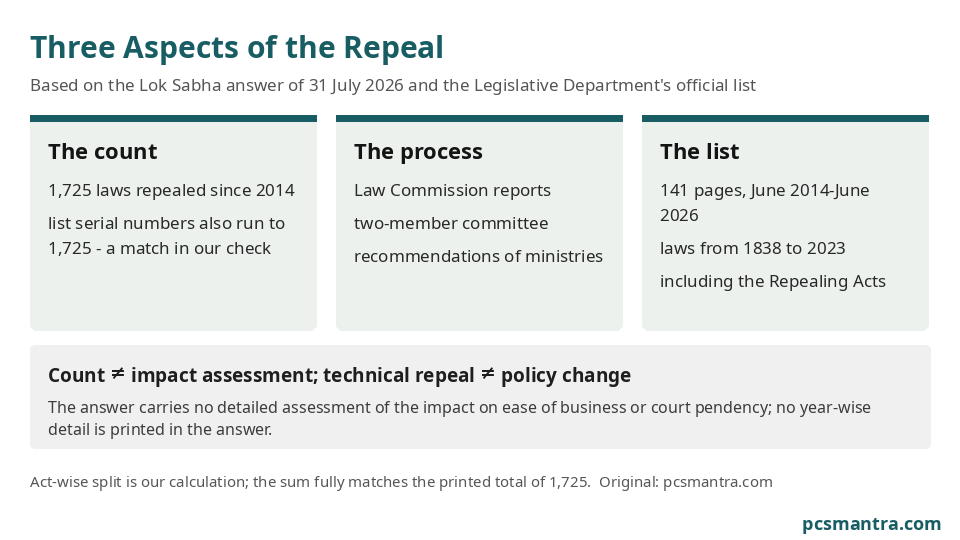
In the answer to Lok Sabha Unstarred Question 2232 on 31 July 2026, the Ministry of Law and Justice said that since 2014 a total of 1,725 obsolete and redundant laws have been repealed through various Repealing and Amending Acts and other Acts. The answer described the mechanism of identification - the Law Commission's reports, the government's two-member committee and the recommendations of ministries - and, for the list of repealed laws, referred to the Legislative Department's official 141-page list (June 2014 to June 2026). This is not a new policy announcement; it is a status report of a process running since 2014.
Key Facts and Figures
| Total repeals | Since 2014, 1,725 obsolete and redundant laws repealed - the number printed in the answer. In the Legislative Department's list (June 2014 to June 2026) the serial numbers run from 1 to 1,725; this match was checked with our calculation. |
|---|---|
| The largest repealing Acts (our calculation from the list) | 756 by the Appropriation Acts (Repeal) Act 2016; 293 by the Repealing and Amending Act 2016; 141 by the R&A (Second) Act 2017; 106 by the R&A Act 2017; 90 by the R&A (Second) Act 2015; 76 by the R&A Act 2023; 71 by the R&A Act 2025; 58 by the R&A Act 2019; 35 by the R&A Act 2015 - 1,626 in all from these nine dedicated repealing Acts, and the remaining 99 from other laws (such as the new labour codes, tax and regional laws); the sum is 1,725, a complete match with the printed total. No table is printed; this distribution is our calculation from a full machine analysis of the list. |
| Oldest and newest | The list's first entry is the Coasting Vessels Act 1838 - repealed by the Merchant Shipping Act 2025. The last entries are amendment Acts of 2023 (such as the Central Universities (Amendment) Act 2023) - repealed by the R&A Act 2025. That is, laws from 1838 to 2023 are in the list. |
| Identification mechanism and further review | The Law Commission's reports, the government's two-member committee and the recommendations of the ministries concerned; the draft is prepared by the Legislative Department. The twenty-third Law Commission was constituted by a notification of 02.09.2024, whose terms of reference include identifying laws fit for repeal. |
How does the system work?
From identification to bill: ministries review the laws they administer and recommend; the reports of the Law Commission and the two-member committee become the basis. The Legislative Department prepares the draft of a repeal bill as per the procedural manual of the Ministry of Parliamentary Affairs. As per the answer, the goal is simple, clear and unambiguous drafting.
Two routes of repeal: first, dedicated Repealing and Amending Acts that remove dozens to hundreds of laws at once. Second, a new subject-specific law - as the Merchant Shipping Act 2025 repealed the Coasting Vessels Act of 1838. Both appear in the list; do not count repeal as only the R&A Acts.
The role of the list: the Legislative Department's 141-page list records, for every repealed law, the original Act year, the Act number, the name and the Act that repealed it. But the list has no ministry-wise column, nor a year-wise repeal table - the year of repeal has to be inferred from the year of the repealing Act. That is, the ready details for parts (a) and (b) of the question are not in the list either; they have to be compiled from it separately.
Reading the number correctly
Number versus impact: 1,725 is a large number, but it includes regular technical repeals such as the 756 of the Appropriation Acts (Repeal) Act 2016 - appropriation Acts are repealed after serving their purpose. So do not take the total number directly as a measure of the depth of reform; subject-wise analysis is necessary.
The answer's period versus the list's period: the answer says "since 2014"; the list runs from June 2014 to June 2026. Both yield the number 1,725, but the closing dates of the two periods are printed as they are - it is not established for us that they are identically defined periods.
The empty space of impact assessment: the asked-for assessment of repeal's effect on ease of doing business, pendency in courts and the compliance burden is not detailed in the answer. The government's argument is of reduced compliance burden and clarity; we have not read an independent evaluation.
Which conclusions to avoid?
Total is not depth of reform: the 1,725 include both technical and policy repeals. No percentage cut in regulatory burden follows from the number; that needs a separate assessment, which the answer does not have.
The limit of our calculation: the Act-wise figures from the list are our calculation from a full machine text-analysis of the list; the sum of the nine dedicated repealing Acts, 1,626, plus the remaining 99 from other laws, gives 1,725, a complete match with the printed total. Even so, do not treat these as an official year-wise table; no such table is printed in the answer.
Repeal does not mean policy reversal: a repeal removes a law from the statute book, but many repealed laws had already been replaced by new legislation or were practically obsolete. In such cases repeal is a technical cleaning of the books, not a change of policy on the ground - so do not read every repeal entry as proof of policy change.
The limit of our reading: both pages of the question-answer and the first and last parts of the list were examined; the middle pages were machine-analysed. The twenty-third Law Commission's further work and state-level repeal campaigns are outside the scope of this article.
Way Forward
Our policy suggestion is that a year-wise and ministry-wise table be given in the answer itself along with the repeal list, so that Parliament and citizens do not have to depend on machine analysis. A periodic assessment of the impact of repeal - compliance burden, number of cases, process time - should be published. Technical repeals (such as appropriation Acts) and policy repeals should be shown in separate columns. The position of the twenty-third Law Commission's recommendations should remain public. States should also be encouraged to adopt a similar list and repeal schedule for their obsolete laws.
Distinction of Concepts
Repeal is not amendment. A technical repeal (a law that has completed its work) is not a policy repeal (a change of policy). The total number is not an impact assessment. The answer's period ("since 2014") is not the list's period (June 2014-June 2026) - exactly as printed.
Mains Perspective
GS-II: governance, the law-making process and regulatory reform. In an answer keep all three: the number (1,725), the mechanism (Law Commission, committee, ministries) and the limit (absence of impact assessment); make the difference between cleaning and reform clear.
Answer Outline
Introduction: The meaning of repeal.
Main Body: The figure of 1,725 and the mechanism; technical versus policy repeal; the absence of impact assessment; list-based transparency; suggestions.
Conclusion: Test repeal not only as clearing up the statute book but on its results for compliance burden, number of cases and processing time. Keep technical and policy repeals separate, because the count of 1,725 alone does not show the depth of reform.
Sources
- Lok Sabha Unstarred Question 2232, answer 31.07.2026 (two pages)
- Legislative Department, Ministry of Law and Justice: list of repealed laws, June 2014 to June 2026 (141 pages)
The figures are taken from the Lok Sabha answer of 31 July 2026 and the Legislative Department's official list. The number 1,725 is printed in the answer; the list's serial numbers run to 1,725, and the Act-wise distribution (1,626 + 99) also sums to 1,725 - this match and the distribution are our calculation from a full machine analysis of the list. Year-wise and ministry-wise details and the impact assessment are not detailed in the answer; this difference is recorded as it is. The remaining calculations and policy suggestions are ours.
Remember: the true test of repeal is not the number but the measured impact - the removal of 1,725 laws is certainly a big cleaning of the statute book, but until its impact assessment is public, it can be taken as a right step towards good governance, not a completed reform.
Download This Article: PDF
