
Background and Context
Teesta Stage-VI is NHPC's 500 MW run-of-river hydropower project in Namchi district. A head race tunnel, HRT, carries water from a reservoir to turbines. The young, tectonically active and steep Himalayas make tunnelling risky.
The Hindu notes earlier flood and landslide damage, including the October 2023 glacial-lake flood that destroyed Chungthang dam. A gas explosion inside a tunnel was a new type of event for the state.
Why in the News
Sikkim statements record an accident in the ADIT-3 tunnel at Samardung on 20 July 2026. The IPR update of 23 July reports 22 bodies recovered with rescue continuing. Media give a final total of 25: Down To Earth places the event around 1 pm and says all bodies were recovered after 96 hours; AP also gives 25. The source did not find 25 on a state-government page.
The Hindu reports suspicion of sudden release of trapped methane and toxic gases, with NHPC and the state announcing inquiries. This is suspected causation, not an inquiry finding.
Methane Risk and a Suspected Cause
Methane is colourless, odourless and flammable; at particular air concentrations, a spark can trigger an explosion. The Hindu quotes NHPC officials saying tunnel surveys examine structural, geotechnical and hydrological conditions, but no single test detects methane. This is NHPC's position, not an independent scientific finding.
The report says Sikkim has no coalfield but GSI studies identify about 1.40 lakh tonnes of coal in south Sikkim, mainly Namchi, with regional exploration underway since December 2025. This geological context does not establish the gas source.
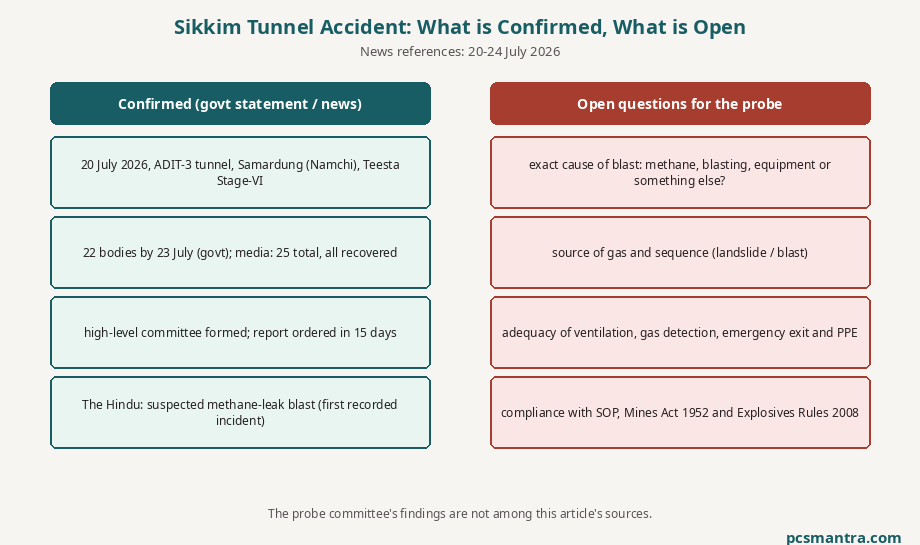
Diagram: original pcsmantra.com illustration separating confirmed facts from inquiry issues, based on government/IPR, The Statesman, The Hindu and Down To Earth.
Key Facts and Figures
| Item | Details |
|---|---|
| Event | 20 July 2026, about 1 pm according to Down To Earth; ADIT-3, Samardung, Namchi, NHPC Teesta-VI, 500 MW |
| Deaths | IPR: 22 recovered by 23 July. Down To Earth, 24 July, and AP: 25 total after a 96-hour operation; 25 not confirmed on a government page |
| Rescue | NDRF/SDRF teams and Eastern Coalfields Limited rescuers from Asansol, according to IPR. High methane, low oxygen and waterlogging hindered work, according to Down To Earth |
| Inquiry | High-level committee notified by the Chief Secretary, chaired by IG Police, Law and Order, Tashi Wangyal; report due in 15 days, The Statesman, 23 July |
| Terms of inquiry | Sequence and exact cause; blasting, methane/other gases, equipment or other factors; compliance with SOPs, Mines Act 1952, tunnel-safety guidelines and Explosives Rules 2008; ventilation, gas detection, exits and PPE |
| First event? | The Hindu calls it the state's first recorded explosion involving suspected methane leakage |
Three Layers of Inquiry and Accountability
State committee: It must report findings and prevention measures within 15 days. Its broad remit means methane cannot be presumed the settled cause.
Project responsibility: Owners and contractors bear tunnel-safety duties. NHPC and Patel Engineering Ltd attended the Chief Secretary's 21 July review. The consulted sources establish no conviction or final responsibility.
Legal framework: The committee must examine Mines Act 1952 and Explosives Rules 2008 compliance. The source did not read the precise tunnel-safety guidelines.
Why the Event Matters
Himalayan tunnelling: The Hindu lists Parbati-II, May 2021, four deaths; Subansiri Lower, June 2022; Khooni Nala, May 2022, ten deaths; and Silkyara, November 2023, rescue of 41 workers. Their causes differ; this adds another risk type.
Infrastructure and safety: Reports describe tunnels as necessary for Northeast border-village connectivity, making safety assessment more important.
Challenges and Precautions
Detection: If NHPC's claim about testing limits holds, continuous construction-stage gas monitoring becomes more important. Independent expert views were not found in the source set.
Premature causation: The committee's final findings are absent; methane remains suspected.
Transparency: Public inquiry results, compensation and responsibility require later information.
Way Forward
Suggested examination points include continuous gas monitoring, ventilation standards, risk-based geological surveys, emergency exits, rescue training and public inquiry reports. These are the source article's suggestions, not newly announced government measures in the consulted reports.
Conceptual Distinctions
Separate landslide/rockfall structural causes, gas-explosion chemical causes and flood/GLOF hydrological causes such as Chungthang 2023. Accounts differ or are unclear about sequence: Down To Earth reports landslide followed by methane leakage; The Hindu treats methane as the suspected cause.
Mains Perspective
GS-III: disasters, management and energy infrastructure. GS-I: Himalayan geomorphic vulnerability. Include both facts, 20 July, media 25 versus official 22 by 23 July and the 15-day inquiry, and uncertainty over causation.
Original UPSC CSE Mains-style Practice Question
Discuss risks in tunnel-based Himalayan infrastructure. Assess the adequacy of safety standards and inquiry arrangements using the recent Sikkim accident. (150 words, 10 marks)
Answer Outline
Introduction: Himalayan fragility and the need for tunnels.
Main Body: The event: 20 July, ADIT-3, deaths (22 official, 25 media), cause suspected. Inquiry framework: the high-level committee and its terms. Earlier incidents and lessons. Suggestions: gas monitoring, ventilation, a public report.
Conclusion: Join the need for tunnels with worker safety, and put forward suggestions on gas monitoring, ventilation, emergency preparedness and a public inquiry report. Keep the suspected cause, the casualty counts of different dates and the findings of the inquiry distinct, and do not fix blame without a report.
Sources
- Sikkim government: Chief Secretary review, 21 July 2026
- Sikkim IPR: Rescue and 22 deaths, 23 July 2026
- The Statesman: High-level committee, 23 July 2026
- The Hindu: Causes of the Namchi disaster, 22-23 July 2026
- Down To Earth, Hindi: All 25 bodies recovered, 24 July 2026
- AP: Death toll rises to 25
The account is limited to 20-24 July 2026, excluding final inquiry findings and later developments. NHPC's own release could not be opened for the source article. It read the full two government pages, The Statesman, The Hindu and Down To Earth. AP was read only at the top and used only for the figure 25.
Further Reading
Zojila tunnel breakthrough and Kashmir-Ladakh connectivity, linked below.
Remember: Media report 25 deaths; the 23 July official update gave 22. Methane is a suspected cause, not a definitive finding before the inquiry report.
Download This Article: PDF