
Why in the News
If the energy-storing material in a battery dissolves in the electrolyte (the medium that carries ions) and starts reaching the other electrode (the battery's active, electricity-contacting part), then even a higher theoretical capacity is no guarantee of a useful battery. The room-temperature sodium-sulfur battery struggles with this very problem. IIT Madras researchers have presented a way of limiting this leakage and speeding up the reactions by applying a five-metal oxide as an intermediate layer. In the laboratory's coin cell, the initial reversible specific capacity was 998 milliampere-hours per gram at a 0.1 C rate. In a separate cycling test, capacity retention of 93.2 per cent after 200 cycles at 0.2 C is reported. These are figures from different conditions; do not take them as the start and end of one test. The study's authors are Y. Sai Swaroop Sarma, Tanveer Ansari, Manu Jaiswal, Sundara Ramaprabhu and S.S. Bhattacharya.
A science news report of 12 October presented this research as an Indian effort tackling a barrier of the sodium-sulfur battery. The core contribution is not a ready vehicle battery but the testing of a working material and its role inside a cell. In the energy transition, the value of a new battery chemistry will not be decided by higher capacity alone. Availability of raw material, manufacturing cost, safety, long life and performance at large size are also necessary. This study shows how an attempt can be made to control the movement of soluble intermediate products by changing a material's structure. From a policy view, it is more appropriate to take it as an example of diversifying energy-storage research than to declare it an immediate substitute for lithium.
Background: The 'Shuttle Effect' in Sodium-Sulfur
In this battery, during charge and discharge, sulfur changes into different sodium compounds. Some of the sodium polysulfides formed in between dissolve in the electrolyte. Because of the concentration difference, they can spread towards the sodium-metal anode (the negative electrode), change there and then return towards the cathode (the positive electrode). This unwanted movement is called the shuttle effect. It reduces the use of active material, affects charging efficiency and can reduce capacity over repeated cycling. There are other barriers too: the low electronic conductivity of sulfur and of the final discharge product, and the increase in volume during the reaction. So merely reducing the shuttle effect does not end every problem.
Carbon-based frames help carry electrons and hold material, but according to the original paper's introduction, their mere physical enclosure may not be enough to hold soluble polysulfides for long. Researchers therefore look for polar surfaces and catalysts that chemically bind these compounds and aid their conversion. The new layer is an experiment in this direction, not the first identification of the shuttle effect or its only possible solution.
The Method: A Five-Metal Oxide Layer
The team made a rocksalt high-entropy oxide with cobalt, copper, magnesium, nickel and zinc. Its formula is (Co,Cu,Mg,Ni,Zn)O and its short name R-HEO. Here rocksalt is the name of the crystal structure; it does not mean that ordinary table salt was put into the battery. In a high-entropy oxide, many kinds of cations (positively charged ions) are present at the sites of one crystal arrangement. From the differences in their size and chemical properties, local distortion and different active sites can form. This should not be taken as a universal guarantee of good performance from every mixture.
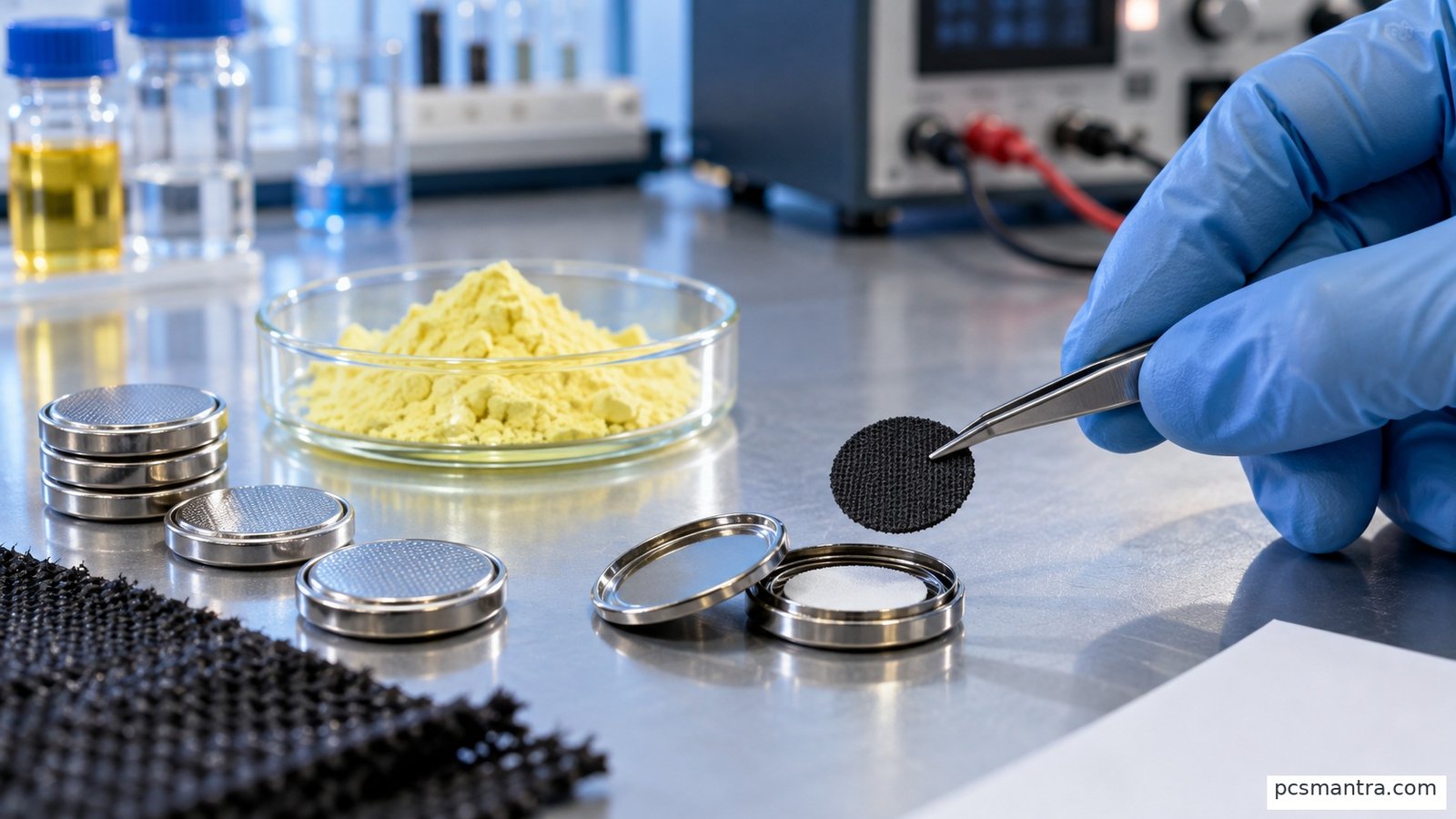
According to the paper's available introduction and conclusion portions, the material was made by the reverse co-precipitation method (making metal-bearing substances together as a precipitate from a solution) and later calcined at 1000 degrees Celsius (heating at a high temperature to form the oxide). The average particle size is stated as 1.56 ± 0.68 micrometres. The news report's description speaks of applying the oxide on a flexible carbon cloth and placing it between the cathode and the separator (the layer that stops the two electrodes from touching directly). The original introduction mentions an acid- and heat-treated carbon nanotube-sulfur composite cathode and coin-cell construction. The high temperature of synthesis and the battery's operation at room temperature are two different things.
What Was Found: Chemical Signals Alongside Capacity
The original abstract gives an initial reversible specific capacity of 998 milliampere-hours per gram at 0.1 C. The figure of 93.2 per cent retention is tied to 200 cycles and 0.2 C. The C rate is a way of linking the speed of charge or discharge to the reference capacity; a good result at a low rate is not proof of the same performance in faster use. Reading specific capacity per gram as the energy density of the whole battery pack would also be wrong. The weight of the electrolyte, separator, current collector, casing and other parts adds to a pack.
The team examined the interaction of the layer and the polysulfides with X-ray photoelectron spectroscopy and Fourier-transform infrared spectroscopy. Calculations of density functional theory (a method of computing a material's properties on the basis of electron density) were also used. According to the authors, adsorption on the surface and the formation of polythionate complexes (chemical groups of sulfur and oxygen) contribute to binding the soluble products and increasing the reaction's speed. In adsorption, a substance attaches to a surface; do not take it as the same as absorption into the whole material. Finding favourable adsorption in calculations supports the explanation of the mechanism, but by itself it says nothing about the life or cost of a large commercial cell.
Limits and Cautions
The first limit is of scale: the results are from a coin cell, not from a large pack for a vehicle or the grid. Second, 200 cycles are useful initial evidence, but not proof of years of real use. Third, capacity and retention were measured at different rates; do not rank directly against other studies without conditions such as rate, electrode loading and electrolyte. Fourth, this is an additional layer; its manufacturing uniformity, weight and processing cost will also matter in a large cell. Fifth, the availability of sodium and sulfur does not by itself prove the whole technology cheap or safe. The mixed oxide also contains cobalt and nickel, so the supply and environmental side of the material choice will have to be assessed separately.
Sixth, the explanation of the mechanism is built from the agreement of experiment and calculation; do not write it as a complete prohibition of all polysulfides in every condition. Seventh, the study's available results contain no confirmation of commercial production cost, pack-level safety or long outdoor performance. Eighth, the layers of the publication's dates are separate: the news is of October, while the journal's issue shows December. In this article, no unverified online-first date has been made a final fact.
Way Forward
The next test should be in more practical conditions: with an electrode carrying more active material, limited electrolyte, a larger cell and longer cycling, how much of the benefit remains? How uniform does the layer form, and do results change with its thickness or the process of applying it? In comparative testing, how much is the benefit against no layer and against other available barriers? An examination of manufacturing energy consumption, material cost, recycling and safety will also be needed. These are evaluation questions to be asked ahead, not a list of programmes already completed in this paper.
The Sequence of Dates
The news report is of 12 October 2026. The original journal page shows 30 December 2026 for volume 696; Crossref's print metadata gives December 2026. The article number is 241465 and the DOI 10.1016/j.jpowsour.2026.241465. An independent clear date of online-first publication was not settled by the available check, so any aggregator's September date has not been adopted. The date of the news arriving, online availability and the issue date are not one event. The date of the present Hindi article is 24 October 2026.
Reference Points for the Reader
Remember four distinctions: operation at room temperature versus the temperature of making the material; specific capacity versus the whole pack's energy density; adsorption on the surface versus absorption inside; and laboratory cycling stability versus commercial service life. This research is a meeting of materials science, electrochemistry and energy policy. The value of public research is not limited to an immediate market product, but it is necessary to keep the original scientific achievement and the market's promise separate.
Mains Practice Question
What is the shuttle effect in sodium-sulfur batteries? On the basis of the recent Indian study of a high-entropy oxide layer, explain on which technical and economic tests a new battery material should be assessed to take it from the laboratory to commercial use. (General Studies-III; 250 words, 15 marks)
Sources
Original study: Journal of Power Sources; Crossref metadata; Research Matters report; IIT Madras researcher's publication list.