
Why in the News
In Keralam's treatment programme for Spinal Muscular Atrophy (SMA), there has been debate over a shift from branded risdiplam to a lower-priced generic product. An updated report of 27 October 2026 brought out some families' demand for evidence and transparent information, and the position of the government and doctors. Labels on the medicine bottle related to samples or clinical trials also raised concern. The label dispute and the assessment of the medicine's actual quality are separate questions.
The complete regulatory approval file of the product concerned, specific exemptions and independent comparative results are not available here. So declaring any product unsafe or fully equivalent is not this article's conclusion. Nor is this news of a new scheme beginning on 27 October.
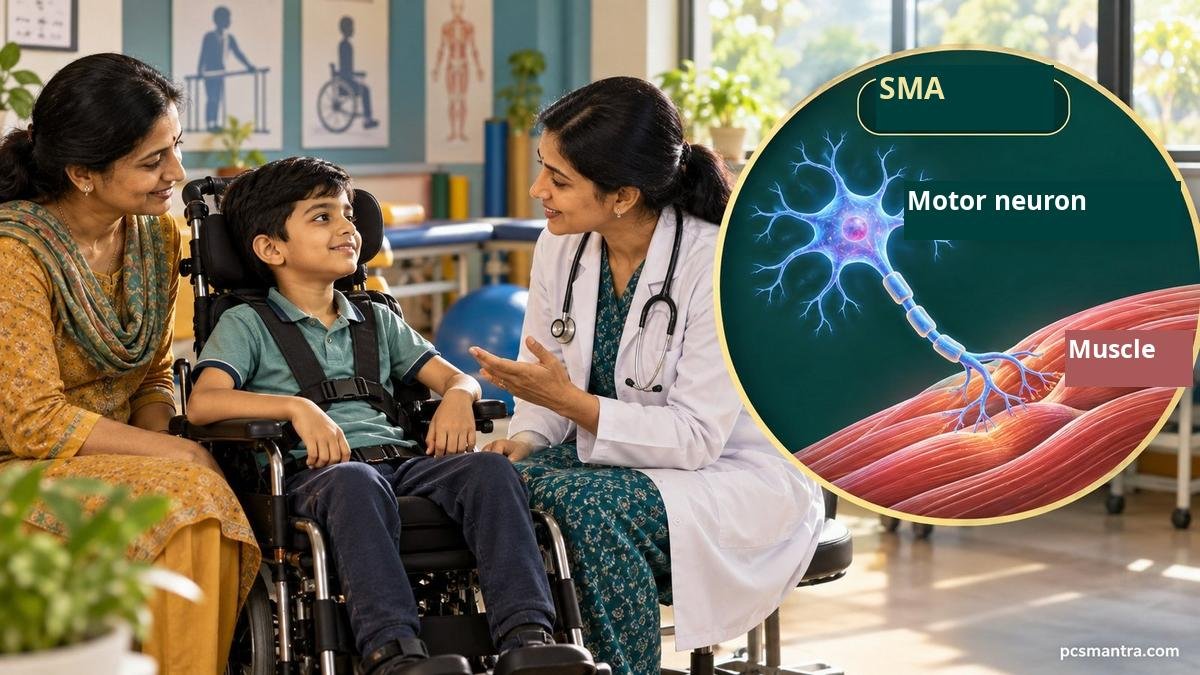
In simple terms: SMA is a group of genetic nerve-muscle diseases. Motor neurons carry movement messages from the brain and spinal cord to the muscles. When they are damaged, muscles can become weak and small. This is called muscular atrophy.
What Changes from Gene to Muscle?
In the most common 5q SMA, a change in the SMN1 gene, located on chromosome 5, or the loss of a part of it, prevents enough functional SMN protein from being made. This protein helps keep motor neurons alive. Its deficiency destroys the cells and reduces the signals reaching the muscles. The weakness is often greater in the trunk and the muscles close to the body than in the extremities; breathing and swallowing can also be affected.
SMN2 is a related gene that can produce some functional protein. More copies of it are generally associated with less severe disease, but a person's full future cannot be determined just by looking at the number of copies. Other genetic factors and treatment also matter. It would be wrong to consider every kind of SMA as linked only to SMN1.
Inheritance and Identification
5q SMA is generally autosomal recessive. The disease-causing changes are present in both copies of the gene. A person with one changed copy is usually a symptom-free carrier. If both parents are carriers, each pregnancy has a 25 per cent probability of an affected child. This does not mean that one in every four children is necessarily affected.
Genetic testing is useful for diagnosis and for counselling the family. Newborn screening identifies risk; it does not by itself give a final diagnosis. Some screening methods look for the absence of a particular part of SMN1; they do not catch every genetic change. So a normal test result does not rule out the disease completely in all circumstances.
How to Understand the Disease Types?
| Type | Usual onset and features |
|---|---|
| Type 0 | Rare, extremely severe; signs may appear before birth. |
| Type 1 | Usually in the first six months; severe weakness and difficulty in breathing and swallowing. |
| Types 2 and 3 | In later infancy or childhood; differences in the ability to sit, stand and walk. |
| Type 4 | Onset in adulthood; generally relatively mild. |
This is a traditional classification, not a rigid prediction. The types have some overlap, and new treatments are changing the disease's expected course. Calling Type 1 the most severe of all types would ignore Type 0.
Not Just Treatment of Symptoms
Risdiplam is an oral medicine that helps increase the amount of SMN protein. Nusinersen and gene-based treatment are also among the treatment methods for SMA. These are treatments that affect the disease's course; calling them merely symptom-reducing medicines is incomplete. Even so, available treatments are not a guarantee of a complete cure. Eligibility can differ by country, product and patient; a foreign approval does not become an Indian approval.
Early identification and appropriate treatment can give more benefit. Respiratory support, nutrition, physiotherapy and assistive devices may also be needed. Choosing or changing a medicine is a matter for specialist supervision; this article is not individual medical advice.
Trust Along with Affordability
According to Kerala's Health Department, the State began providing free treatment for SMA in 2022. The department's 2026 information mentions raising the age limit for Type 2 patients confirmed by genetic testing to 25 years. Do not read this as automatic eligibility for all ages and all types.
A generic medicine contains the same active pharmaceutical ingredient, but manufacturing quality, dosage form and compliance with applicable regulatory conditions are also necessary. A bioequivalence study looks at the rate and amount of the medicine's absorption into the body compared with the reference product. The World Health Organization's guideline keeps room for exemption from additional equivalence studies in some oral solutions under specified conditions. This is neither an automatic exemption for every generic nor proof of approval of any particular Indian product.
Way Forward
In government procurement, regulatory documents, quality testing, continuity of supply and monitoring of treatment outcomes should be clear, along with price. Families should be told the reason for a change and the available evidence in simple language. Reporting of adverse effects and the route for complaints should remain accessible. The goal is not merely a cheaper product, but reliable and continuous care.
Prelims Practice Questions
Question 1. With reference to common 5q SMA, consider the following:
Statement 1: A change in SMN1 can affect the adequate production of SMN protein.
Statement 2: More copies of SMN2 ensure a complete absence of the disease in every person.
Statement 3: Damage to motor neurons is linked to muscle weakness.
How many of the above statements are correct?
(a) Only one
(b) Only two
(c) All three
(d) None
View answer and explanation
Answer: (b) Only two. Statements 1 and 3 are correct. More copies of SMN2 are generally associated with less severity; they are no guarantee of complete protection.
Question 2. If both parents are symptom-free carriers of 5q SMA, which statement is correct under usual recessive inheritance?
(a) Only sons can be affected
(b) Every fourth child will necessarily be affected
(c) Each pregnancy has a 25 per cent probability of an affected child
(d) Carrier parents cannot have an affected child
View answer and explanation
Answer: (c). The risk applies separately in every pregnancy; it is not a fixed order number of children. An autosomal disease is not considered limited to sons.
Question 3. Consider the following about the treatment of SMA:
Statement 1: Along with treatment that affects the disease's course, supportive care may also be needed.
Statement 2: A product being a generic by itself fulfils its every regulatory condition automatically.
Choose the correct answer:
(a) Only 1
(b) Only 2
(c) Both 1 and 2
(d) Neither 1 nor 2
View answer and explanation
Answer: (a) Only 1. Along with the medicine, respiratory support, nutrition and rehabilitation may be needed. Applicable quality and regulatory conditions remain in force on a generic product too.
Mains Practice Question
In the treatment of rare diseases, affordability and patients' trust are not opposing goals. Discuss with reference to government procurement, regulation and continuity of care. (150 words, 10 marks)
Answer Outline
Introduction: Mention the large financial and care burden on families despite the small number of patients.
Main Body: Connect quality-based procurement, transparency of evidence, specialist services, family participation, monitoring of adverse effects and continuous funding.
Conclusion: Link the benefit of lowering prices to access to safe, timely and continuous treatment.
Sources
- Health-controversy report updated on 27 October
- NIH: SMA, types and treatment
- MedlinePlus: genes and inheritance
- HRSA: screening and carrier risk
- Kerala Health Department: eligibility expansion
- World Health Organization: conditions of equivalence
Download This Article: PDF
