
Research paper: Zootaxa 5729(2): 335-348, publication date 15 December 2025 • News: India TV News (Published/Updated 6 February 2026 on the page), based on a ZSI statement
Prelims • Environment, biodiversity and taxonomy
Why in the News
According to India TV News, the Zoological Survey of India (ZSI) announced two new species of marine polychaete worms from the coastal waters of West Bengal: Namalycastis solenotognatha and Nereis dhritiae. Both belong to the family Nereididae. The research paper had been published on 15 December 2025, while the news is of February 2026.
The Key Point to Remember:
According to the abstract, both species were found in intertidal areas, one near a mangrove and the other near a sandy shore. With them the total number of Nereididae on the Indian coast became 73; of these, 5 species are of Namalycastis and 9 of Nereis.
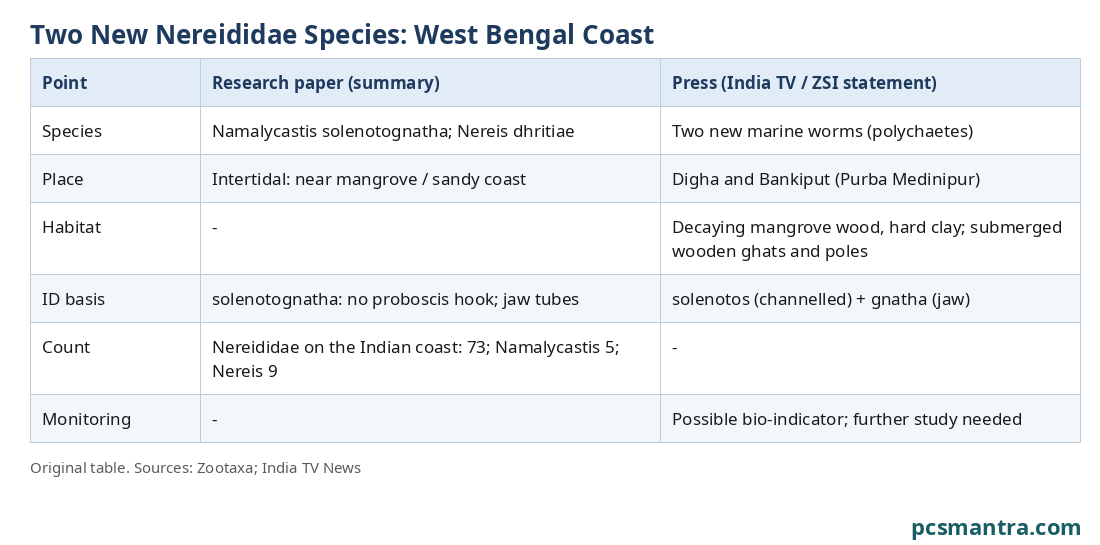
Namalycastis solenotognatha
Intertidal area near a mangrove; no dorsal chaetae (notochaetae)
Nereis dhritiae
Intertidal area near a sandy shore
Count
Nereididae on the Indian coast: 73 species
Diagram: original table.
What Is in the Paper?
The title of the paper is "Description of two new species of nereidids (Annelida: Nereididae) from West Bengal, India, Bay of Bengal". According to the abstract, Namalycastis solenotognatha and Nereis dhritiae were found at two different intertidal places, near a mangrove and a sandy shore respectively.
N. solenotognatha differs from similar species of Indian waters mainly in that its anterior segments have heterogomph spinigers in the sub-ventral-lateral chaetae and no notochaetae; the number of tubules in the jaws also helps identification. N. dhritiae differs from the three species of infra group I.B.2 recorded in India: the blade of the falcigers of its dorsal parapodium has a distinct tendon, area V has one paragnath, and the anterior row of areas VII-VIII has only small paragnaths.
With this discovery the species of Nereididae on the Indian coast became 73, of which five are of Namalycastis and nine of Nereis.
According to India TV, the ZSI statement described the discovery as from the Digha and Bankiput areas of Purba Medinipur. The name of the first species is formed from the Greek words solenotos (grooved) and gnatha (jaw), and it is found on shores with sulphide-rich, organic-rich mud, in decaying mangrove wood and in hard clay. The second species is named in honour of Dr Dhriti Banerjee, the first woman director of ZSI, and was found in the wooden jetty pillars of sandy shores submerged by the tide. According to the statement, both species were found in areas affected by human activity and pollution and could be bio-indicators in monitoring coastal health, but further study is needed for this.
Where Does Confusion Arise in the Exam?
The new species were described in the paper on 15 December 2025; the news of February 2026 is based on the ZSI statement. Digha and Bankiput, the habitat details and the "bio-indicator" point are from the press, not in the abstract; the abstract only gives intertidal places near a mangrove and a sandy shore. Even for "bio-indicator" the statement itself says that further study is necessary.
Direction of Preparation from Past Questions:
In the official UPSC Prelims 2023 General Studies Paper-I, statement-based questions have come. So prepare the species, the place and the basis of identification separately. The questions below are original practice, not actual PYQs.
Prelims Style: Practice Questions
1. On the basis of the abstract of the paper on the new species of Nereididae, consider the following statements:
Statement 1: Both new species were found in intertidal areas.
Statement 2: With them the total number of Nereididae on the Indian coast became 73.
Statement 3: According to the abstract both new species belong to the genus Namalycastis.
How many of the above statements are correct?
(a) Only one
(b) Only two
(c) All three
(d) None
See answer and reason
Answer: (b) Only two. Statements 1 and 2 are in the abstract. Statement 3 is wrong; one species is of Namalycastis and the other of Nereis.
2. According to the abstract, which feature is included in the identification of Namalycastis solenotognatha?
(a) Absence of dorsal chaetae (notochaetae)
(b) Presence of wings
(c) Presence of a shell
(d) A backbone
See answer and reason
Answer: (a). The abstract mentions the heterogomph spinigers in its anterior segments and the absence of notochaetae.
3. According to India TV News (ZSI statement), where were the new worm species found?
(a) The Digha and Bankiput areas of Purba Medinipur
(b) Freshwater lakes of the Sundarbans
(c) Streams of the Himalaya
(d) The deserts of Rajasthan
See answer and reason
Answer: (a). According to the report, the discovery is from these coastal areas of Purba Medinipur in West Bengal.
Sources:
- Zootaxa 5729(2): Description of two new species of nereidids (Annelida: Nereididae) from West Bengal, India, Bay of Bengal, 15 December 2025.
- India TV News: ZSI discovers two new worm species in West Bengal's coastal waters, 6 February 2026.
- UPSC: Prelims 2023, question paper.
Download This Article: PDF
