
Why in the News
On 2 November 2026, in Aruna Roy and Others v. Union of India, Writ Petition (Civil) 249/2024, the Supreme Court asked the Rajasthan State Election Commission to reconsider the request for permission for a voter awareness campaign. The court quashed the related communication of 9 October 2026 and directed that an appropriate order be passed within two days. The case is connected to the request to run the campaign during the third phase of the panchayati raj elections.
This is a question of electoral participation and the role of civil society. But it does not mean that the court itself permitted the campaign, ended every electoral restriction or gave all organisations of the country the right to run programmes unconditionally. Understanding the exact scope of the order is necessary for both the exam and public discussion.
What Is in the Written Order?
- The Rajasthan State Election Commission was made a party as respondent No. 5.
- Reconsideration of the petitioners' permission application of 6 October 2026 was held necessary.
- The communication of 9 October 2026, which was Annexure A-13 with the application, was quashed.
- The State Election Commission has to decide again on the request for permission for the voter awareness campaign during the third phase of the panchayati raj elections.
- It was asked to pass an appropriate order within two days; the related interim application was disposed of.
Conclusion: The old decision was removed and a fresh decision process was directed. Whether permission will be given, and on what conditions, cannot be treated as already settled by this order. No later permission order of the Commission has been verified in this article.
The Difference Between Two Days and Three Days
In this very writ petition there is also a separate interim order of 19 April 2024. In it, when the competent authority received an application for permission for a public meeting for a democracy yatra or public education about elections, it was asked to decide in three days. That old order and the order of 2 November 2026 are not the same.
In some news accounts, three days have been written for the new direction too. Here the original written order of the Supreme Court of 2 November has been made the base, in which it is two days. Reading the date, the application and the direction together avoids the mistake of attaching the old order's time limit to the new order.
Keep Oral Remarks and Binding Directions Separate
News reports of the hearing mention a discussion of the role of civil society, the idea of any institutional monopoly over electoral awareness, the place and time of the programme, and broad prohibitions. These are remarks and arguments reported during the hearing. They should not be described as any universal legal declaration recorded in the original order.
The written order has not collectively declared all orders under Section 163 illegal. So it would be wrong to advise any civic group, on the basis of this news, to disregard the local permission process or the applicable safety directions. The centre of the analysis is: a reasoned decision, a hearing within a fixed time and lawful public participation.
The State Election Commission and the Election Commission of India
Under Article 243K of the Constitution, the responsibility of the superintendence, direction and control of the electoral rolls of the panchayats and their elections is of the State Election Commission. The Commission has a State Election Commissioner, whom the Governor appoints. Article 243ZA gives the responsibility of the elections of the municipalities to this same State Election Commission.
In contrast, Article 324 is the constitutional basis of the Election Commission of India for the elections of Parliament, the State legislatures and the President and Vice-President. Treating the two as one institution is wrong. In the present matter, the relevant body is the Rajasthan State Election Commission, because the request is linked to panchayati raj elections.
The autonomous arrangement of local elections does not mean that the purpose of voter education becomes different. At every level, a voter needs correct information, easy access and a free decision. But to which authority the application will go and which rule will apply will be decided by the type of election and the applicable law.
What Should Voter Awareness Be Called?
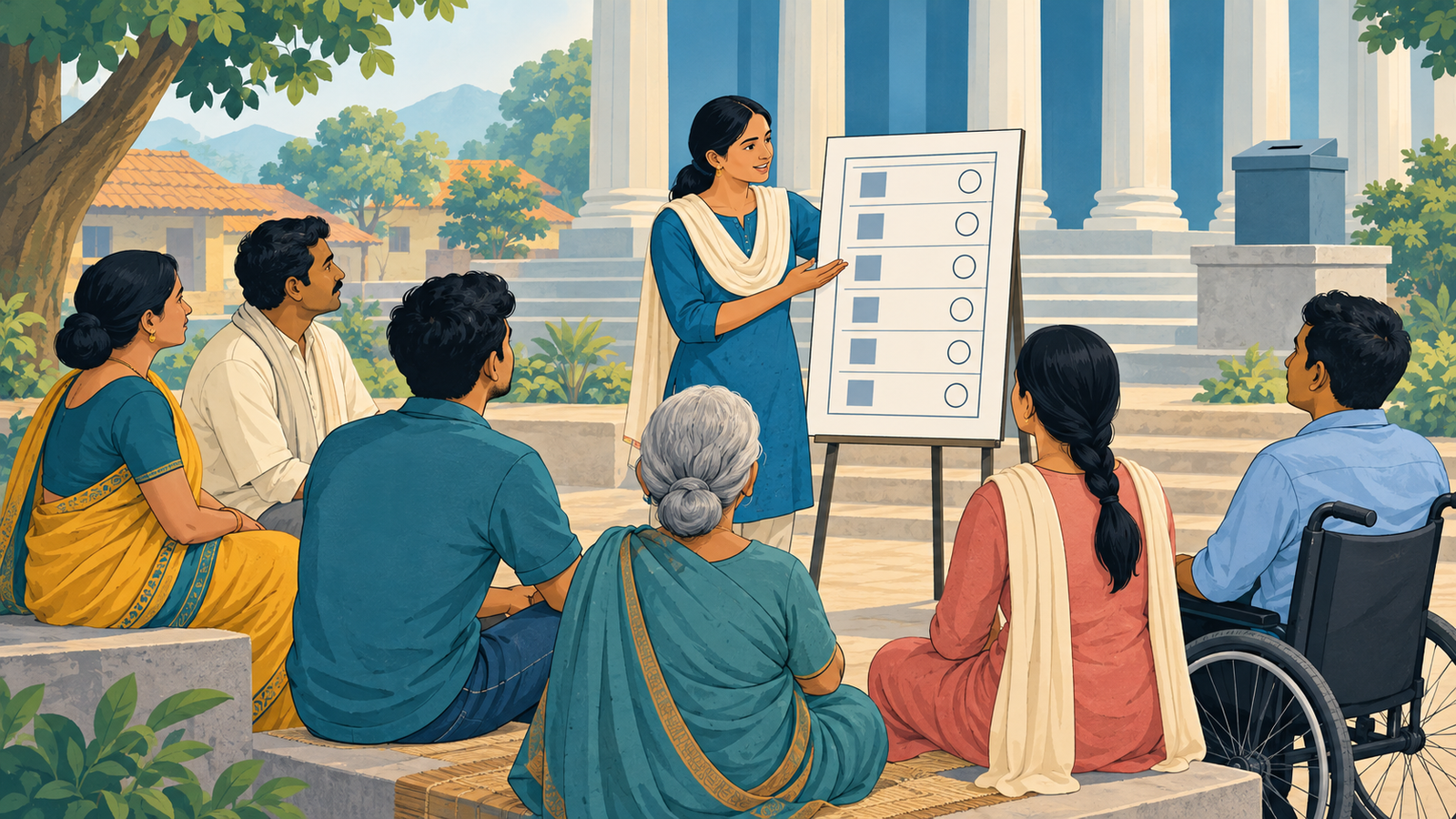
Its purpose is not to make any party or candidate win, but to explain the election process to the citizen. Checking one's name in the roll, understanding eligibility and registration, information on reaching the polling station, secret voting, and choosing free from inducement or pressure are examples of its subjects. Merely increasing the voting percentage is not a sufficient goal; informed and voluntary participation is also necessary.
Civil society can reach, through the local language, trust and social contact, those people who are missed by ordinary publicity. The information and access needs of women, first-time voters, the elderly and persons with disabilities are not the same. However, an institution calling itself non-partisan is not sufficient proof by itself; the content and conduct of the programme should also match that claim.
SVEEP and Continuous Electoral Literacy
According to the Election Commission of India, the full form of SVEEP is Systematic Voters' Education and Electoral Participation. It is the main programme of voter education, awareness and electoral literacy. Its educational framework stresses reducing the barriers that come in electoral participation through information, motivation and facilitation.
The Commission's release of 11 September 2026 described Electoral Literacy Clubs, or ELC 2.0, as a structured and digitally supported electoral education platform in schools, colleges and universities. In it there is talk of activities through the whole year for an understanding of registration, voting, counting and democratic values.
The mention of these programmes is an example that voter education should not be an activity of only a few days before voting. This context is not a rule that automatically gives permission to any private organisation in the present case. While understanding the roles of an administrative campaign and an independent civic initiative, their legal scopes must be kept separate.
What Should a Balanced Permission Arrangement Look Like?
In policy terms, organisers can make clear the programme's place, time, route, estimate of participants, content and a responsible contact. If the administration has a real safety or traffic problem, it should state its reason and a possible alternative arrangement. This is a recommended administrative method, not an exact repetition of mandatory conditions listed in the 2 November order.
- Neutral content: the boundary between voter education and partisan campaigning should be clear; there should be no false claim of an official institution's support.
- Equal treatment: applications in similar circumstances should be evaluated on clear and common standards.
- A timely decision: permission received after the election is over can be practically useless; so a decision on the application in time is necessary.
- A less restrictive option: if the problem is only of the route or the time, a safe alternative can be considered instead of a complete stop.
- Reliable information: adopt the local language and accessible formats; do not collect the voter's personal information unnecessarily.
Summary for the Exam
This case shows that the fairness of elections and civic participation should not be treated as mutually opposed. The constitutional responsibility of election-management bodies remains; at the same time, decisions on genuinely non-partisan efforts of voter education should come through clear reasons and a time-bound process. Remember the main facts: 2 November 2026, reconsideration, the third panchayati raj phase and two days; do not write it as automatic permission.
Mains Practice
Question: "Fair elections are strengthened not only by administrative control, but also by informed civic participation." Discuss with reference to the role of civil society in voter awareness and the permission arrangement. (150 words, 10 marks)
Answer outline:
Introduction: the importance of a free, informed and inducement-free vote.
Constitutional context: the institutional difference of Article 324 and Articles 243K and 243ZA.
Contribution: the local language, reach to deprived groups and electoral literacy.
Challenges: hidden partisan campaigning, misleading information and real safety arrangements.
Improvement: neutral content, common standards, reasoned and time-bound decisions.
Conclusion: the balance of fair management and civic participation; do not treat reconsideration as automatic permission.
Prelims Practice
Question 1. Consider the following statements:
Statement 1: The superintendence, direction and control of panchayat elections is vested in the State Election Commission under Article 243K.
Statement 2: Article 243ZA gives the control of municipal elections to the Election Commission of India.
Choose the correct option:
(A) Statement 1 only
(B) Statement 2 only
(C) Both statements
(D) Neither statement
Answer and explanation
Correct answer: (A) Articles 243K for panchayats and 243ZA for municipalities provide for the State Election Commission. The constitutional basis of the Election Commission of India is Article 324.
Question 2. Which statement about the order of 2 November 2026 in the Aruna Roy case is correct?
(A) The court gave unconditional permission for campaigns to all civic groups of the country.
(B) The court automatically ended all electoral restrictions.
(C) The Rajasthan State Election Commission has to reconsider the related request and give an appropriate order in two days.
(D) The court merged the State Election Commission into the Election Commission of India.
Answer and explanation
Correct answer: (C) Quashing the 9 October communication, a direction for reconsideration was given. This is not permission for the campaign by the court itself. The three-day time limit was in this case's separate interim order of 19 April 2024.
Sources
- Supreme Court: original order, 2 November 2026, W.P.(C) 249/2024
- Supreme Court: separate interim order, 19 April 2024
- Legislative Department: the Constitution of India, Articles 243K, 243ZA and 324
- Election Commission of India: SVEEP and voter education
- ECI VoICE.NET: the educational framework of information, motivation, facilitation and inclusive participation
- ECI release 115/2026, 11 September: ELC 2.0 and year-round electoral literacy
- LiveLaw, 2 November: report of the hearing; the original order given preference for the time limit