
Study month: September 2026 | Agriculture • Gender Equality • Inclusion | GS-II / GS-III
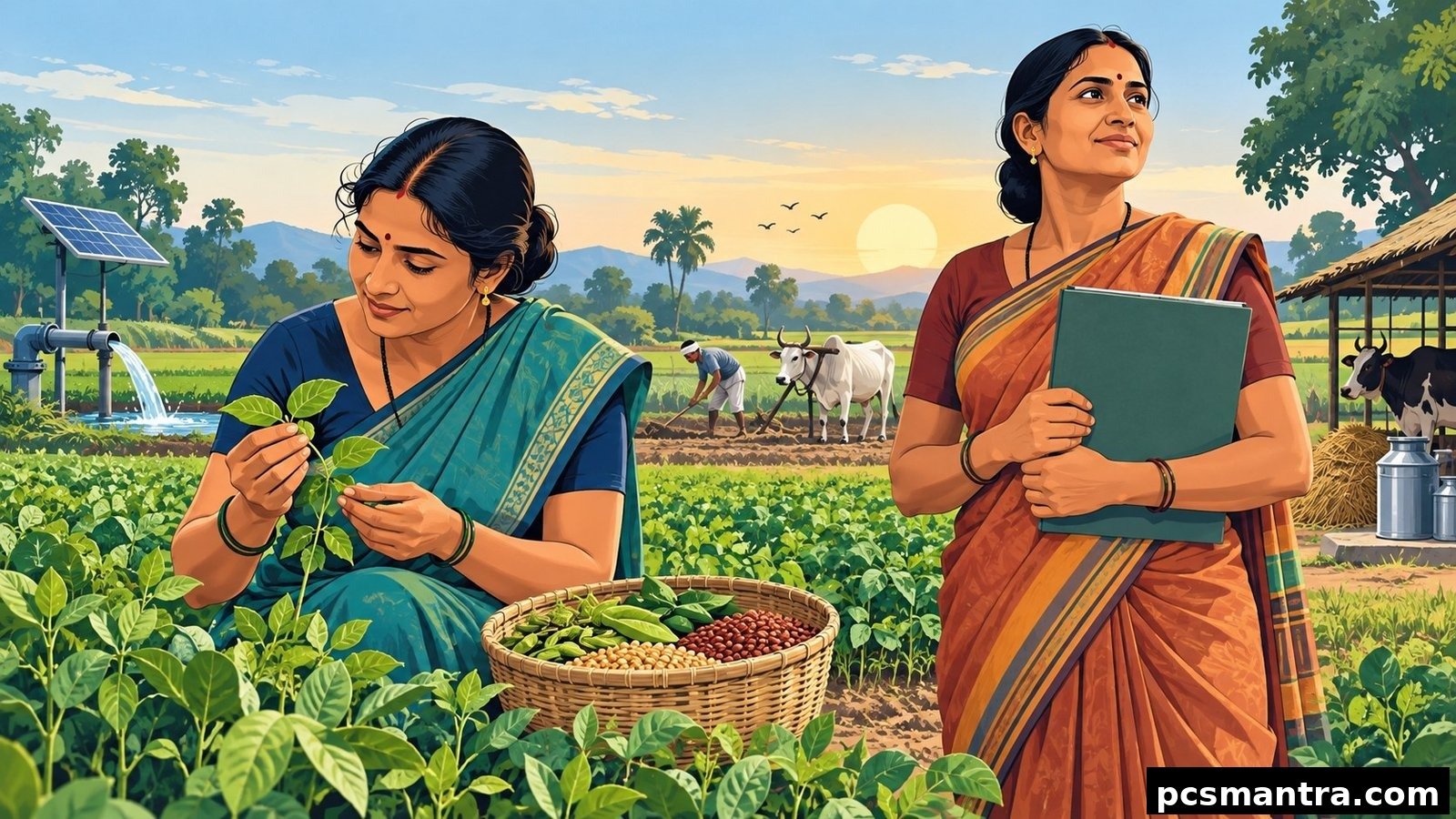
The woman who works in the field and the owner recorded in the land records need not be the same person. When the recognition for agricultural support gets tied only to land, many women making the real contribution can be left behind administratively.
Why in the News
An analysis published on 23 September 2026 discussed Maharashtra's women-farmer recognition law. This was not a new law made in September: the Maharashtra Women Farmer Empowerment Act, 2026 was published in the Gazette on 22 July 2026 after receiving the Governor's assent. Its significance lies in not confining the identity of a farmer to the ownership right over land.
Key Facts
A broad understanding of agriculture: The law includes activities such as livestock-rearing, dairy, fisheries, horticulture and primary processing alongside crop-growing. This creates room to recognise diverse contributions connected to farming.
A local recognition process: In a gram panchayat area, applications are placed before the gram sabha. The law also gives the gram sabha a path to identify eligible women who have not themselves applied. A separate process is provided for nagar panchayat areas.
Reasons and appeal: There is a provision for stating reasons when an application is rejected, and for appeal. This matters, because local verification will be inclusive only when wrongful exclusion can be challenged.
Benefits subject to conditions: For a certificate holder, there is a provision for access to schemes, services and assistance notified by the state government. Benefits depend on the conditions of the scheme concerned; automatic eligibility in every central or state scheme cannot be claimed.
Which links are needed from recognition to empowerment?
Being counted: The law provides for building a database of women farmers. Correct recognition can make visible the groups left out of policy, but incomplete registration can repeat old exclusion in a new digital form.
Real access to services: Even after recognition arrives, schemes and institutions will have to accept it for access to credit, insurance, training and markets. A rising number of certificates alone is no proof of economic benefit.
Participation in decisions: Along with resources, a woman's role in decisions about their use, income and production should strengthen. Only then can administrative recognition turn into real capacity within the home and the field.
Analysis and Way Forward
Implementation needs local awareness, a simple application, offline assistance and timely grievance redress. Special outreach to landless, single and migrant women should be built. While linking databases, care for the accuracy of information and privacy. To measure impact, look at credit received, training, income and participation in decisions alongside registration. Reforms tied to land rights and inheritance are also necessary; a recognition law does not take their place.
The Conceptual Difference
Ownership of land, operation of a farm and agricultural labour are three different situations. A woman may work in the field but not be the owner; land may be in someone's name while she herself does not farm. So the data and rights of these categories should not be merged with one another.
The Difference Between Work, Recognition and Benefit
| Aspect | What to understand? |
|---|---|
| Contribution in agriculture | The definition includes agricultural labourers and landless cultivators too; recognition is not confined to landowners. |
| Farmer certificate | It is proof of a woman farmer's identity for this Act; do not treat it as a title deed to land. |
| Scheme benefits | Benefits of schemes notified by the state government are subject to their conditions; automatic eligibility in every scheme is not available. |
Study table: based on Sections 2 and 8 of the Gazette copy of the Maharashtra Women Farmer Empowerment Act, 2026. This comparison is of this Maharashtra Act alone; it is not a claim of an identical arrangement across the country.
Mains Perspective
Treat recognition not as the final achievement but as the starting condition of access to opportunity. In an answer, make clear the difference between legal identity, eligibility for services and real control over resources.
Answer Outline: Introduction: the difference between contribution and recognition → the initiative: a work-based certificate → benefits: visibility and a route to services → limits: scheme conditions, ownership and social barriers → remedies: institutional acceptance and rights reform.
Sources
- Maharashtra Gazette, 22 July 2026: Women Farmer Empowerment Act, PRS copy
- The Hindu, 23 September 2026: analysis on recognising women farmers
Remember: Farmer identity can move beyond the name on the land; for empowerment, recognition will have to be joined with resources, services and decision-making power.
Download This Article: PDF