
Why in the News
According to PIB's release of 29 May 2026, the Ministry of Corporate Affairs (MCA) has widened the scope of corporate social responsibility (CSR) by adding a new item (xiii) to Schedule VII of the Companies Act 2013: "subscription to zero coupon zero principal instruments on the Social Stock Exchange".
For this, the Companies (CSR Policy) Rules 2014 were amended: definitions of non-profit organisation (NPO) and zero coupon zero principal instrument were added to Rule 2, and criteria for CSR implementation through this route were laid down in Rule 4A. The related notifications, G.S.R. 415(E) and G.S.R. 416(E), dated 27 May 2026, have been placed on MCA's website.
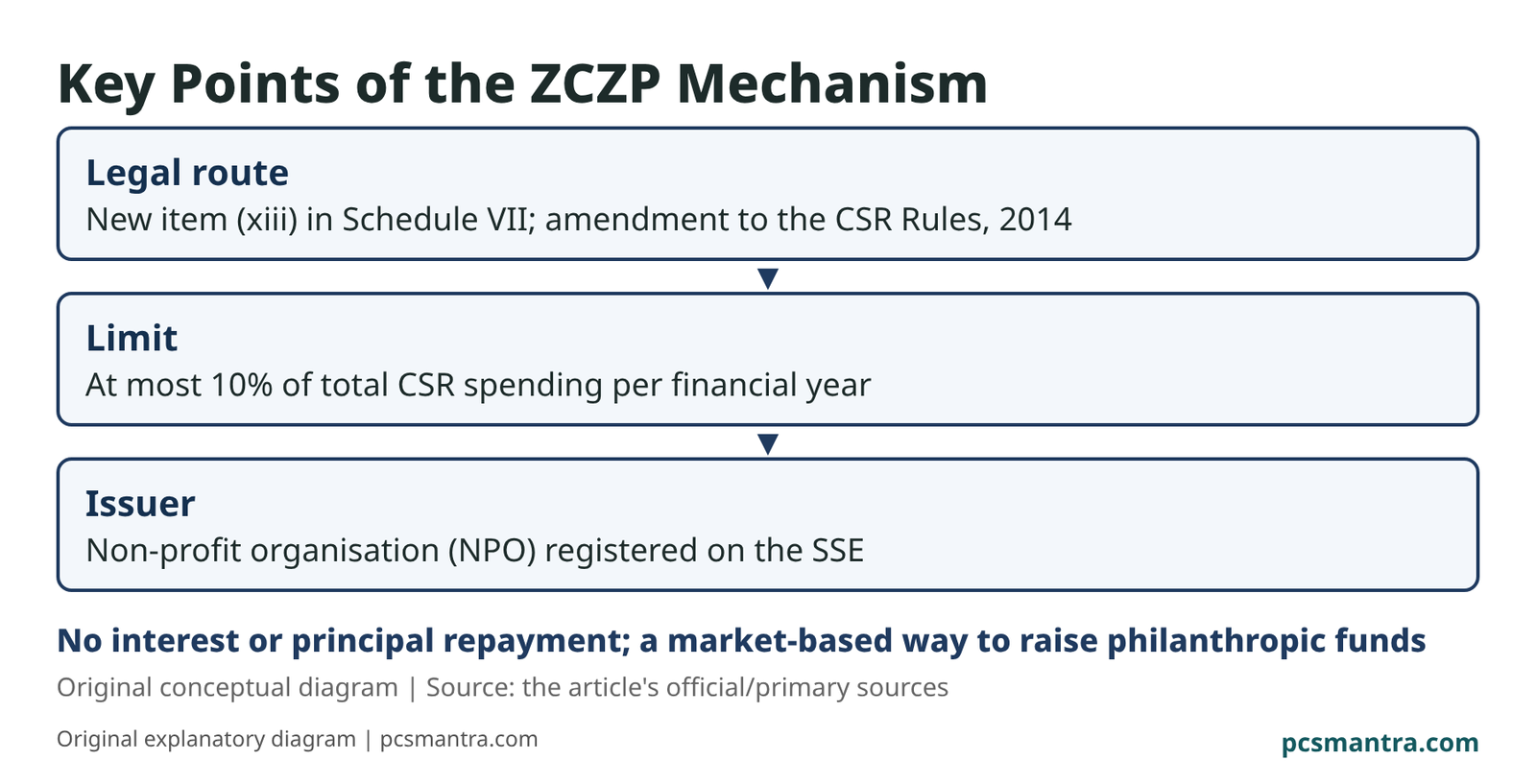
Legal route: new item (xiii) in Schedule VII; amendment to the CSR Rules 2014
Limit: a maximum of 10% of total CSR spending per financial year
Issuer: a non-profit organisation (NPO) registered on the SSE
No interest or principal repayment; a market-based channel for philanthropic fundraising
What Is ZCZP?
A zero coupon zero principal instrument is a financial instrument on which neither interest is paid nor principal is returned; it links philanthropic fundraising to a market framework. NPOs issue it on the Social Stock Exchange (SSE) under SEBI's regulations, and the funds are for a specified project or activity, to be completed within the period stated in the fundraising document.
According to SEBI's SSE master circular, a ZCZP will be issued only in demat (dematerialised) form and will not be transferable from the original subscriber/holder until the instrument's tenure is complete. These features separate it from an ordinary bond: here the investor's aim is not a return but the success of a social project.
The Legal Framework of CSR
Section 135 of the Companies Act 2013, Schedule VII and the Companies (CSR Policy) Rules 2014 together form the legal framework of CSR; Schedule VII lists the activities that can be undertaken as CSR. According to the release, this amendment simplifies compliance for companies and helps NPOs raise funds for public-welfare projects in a transparent, regulated way.
Under the new arrangement, spending by a CSR-bound company on such instruments will not exceed ten per cent of its total CSR spending for that financial year. This limit is kept for balance, so that traditional CSR activities are not affected.
Prelims: Practice Questions
Question 1. Through which new route did the May 2026 amendment make CSR possible?
(a) Direct investment in foreign partnerships
(b) Employee bonus distribution
(c) Subscription to ZCZP on the Social Stock Exchange
(d) Share buyback
See answer and reason
Answer: (c). PIB: new item (xiii) in Schedule VII: subscription to zero coupon zero principal instruments on the SSE.
Question 2. Choose the correct statements about ZCZP:
1. Both interest and principal are repaid on it.
2. It is issued only in demat form.
3. It is not transferable from the original holder until the tenure is complete.
(a) 1 and 2 only
(b) 2 and 3 only
(c) 1 and 3 only
(d) 1, 2 and 3
See answer and reason
Answer: (b). SEBI master circular: demat-only, non-transferable for the tenure; no interest/principal repayment.
Question 3. What is the maximum limit on spending in ZCZP through the CSR route?
(a) 5% of total CSR spending
(b) 25% of total CSR spending
(c) No limit
(d) 10% of total CSR spending
See answer and reason
Answer: (d). PIB: a maximum of ten per cent of total CSR spending for that financial year.
Sources
PIB: facilitating CSR through ZCZP, 29 May 2026
SEBI: master circular on the Social Stock Exchange framework
Download This Article: PDF