
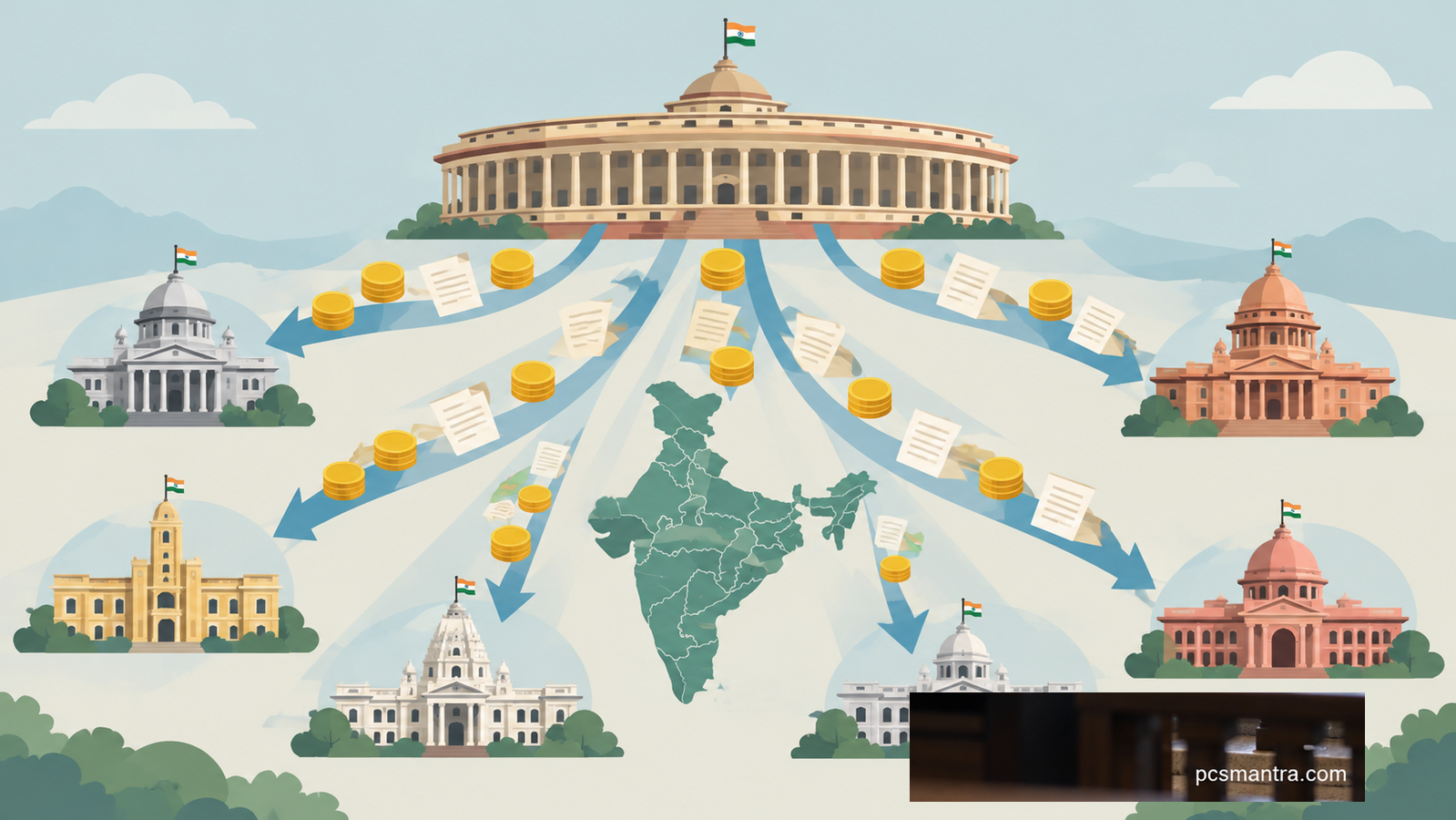
Original symbolic image: pcsmantra.com
Why in the News
On 31 October 2026 the central government released an additional/advance instalment of ₹1,09,019 crore of tax devolution to the state governments. According to the finance ministry, this amount is over and above the regular monthly devolution and is the second additional instalment of this financial year. The purpose: keeping the coming festive season in view, to enable states to speed up capital spending and finance development/welfare programmes. The state-wise detail is tabulated in the PIB release (e.g. Andhra Pradesh ₹4,597 crore, Assam ₹3,552 crore, Arunachal Pradesh ₹1,476 crore).
Background
Tax devolution is the states' share of the divisible pool of central tax revenue on the Finance Commission's recommendations - the Sixteenth Finance Commission's award covers 2026-27 to 2030-31, beginning on 1 April 2026. The finance ministry's February 2026 action memorandum says the government accepted the recommendation to retain the states' share at 41% (Finance Commission: Article 280; report and action memorandum: Article 281). Advance instalments directly affect the states' cash flow and capital-spending capacity - the time-sequencing of public investment in the festive demand cycle is an instrument of central fiscal policy. The main debating points in Union fiscal relations: the size of the divisible pool, the ratio of grants to devolution, and the growing share of Union cess and surcharge, which stays outside the divisible pool.
Keep the two levels distinct: vertical devolution divides the divisible pool between the Union and all states; horizontal devolution allocates the states' total share among individual states. The accepted Sixteenth Commission criteria include population, demographic performance, area, forest, per-capita-income distance and the state's contribution to GDP. A state-wise instalment should not be read simply as that state's share of tax collection.
Exam Perspective
Mains (GS-II/GS-III): the actual working of fiscal federalism; cess-surcharge versus the divisible pool; the macro reasoning of advance instalments (counter-cyclical timing); the states' capital-spending capacity and development gaps.
Prelims: the Finance Commission (Article 280), tax devolution of 41%, the Sixteenth Finance Commission (for reference).
Mains practice question
"Advance tax-devolution instalments are not merely cash-flow management but a counter-cyclical instrument of central fiscal policy." Comment with reference to the instalment of ₹1.09 lakh crore of 31 October 2026. (Answer in 250 words. 15 marks)
Answer Outline
Introduction: the essence of the advance instalment of ₹1,09,019 crore - over and above the regular monthly devolution, the second additional instalment of the financial year, the declared purpose of the festive season and faster capital spending.
Main Body: the case for it: the states hold a large share of capital projects; an advance instalment brings time-sequencing into construction demand and employment; better use of the centre's accumulated fund flow. The critique: advance instalments do not change the total share; the real issues are the rising share of cess/surcharge outside the divisible pool and grant dependence; the state-wise allocation reflects revenue-collection capacity unevenly. Balance: the instalment's timing is tied to the demand cycle, but it cannot be replaced by structural federal reform (the pool's definition, the review process).
Conclusion: advance instalments are useful but short-term instruments. Long-term reform should focus on transparency of the divisible pool, states' revenue capacity and implementation of the accepted Sixteenth Finance Commission recommendations.
Prelims practice questions
Question 1. With reference to tax devolution, consider the following statements:
Statement-I: On the Fifteenth Finance Commission's recommendation, the states' share of the divisible pool is 41%.
Statement-II: Revenue from cess and surcharge forms part of the divisible pool of central tax revenue.
Which of the above statements is/are correct?
(a) Both Statement-I and Statement-II are correct
(b) Statement-I is correct, but Statement-II is not correct
(c) Statement-I is not correct, but Statement-II is correct
(d) Neither Statement-I nor Statement-II is correct
Answer and Explanation
Answer: (b) - The Fifteenth Finance Commission fixed the states' share at 41% (reduced from the Fourteenth's 42% because of Jammu and Kashmir's reorganisation). Cess and surcharge revenue is not included in the divisible pool - this is the main point of the centre-state fiscal debate.
Question 2. With reference to the advance tax-devolution instalment released on 31 October 2026, which statement is correct?
(a) This amount of ₹1,09,019 crore was part of the regular monthly devolution
(b) It was the first additional instalment of this financial year
(c) It was an additional/advance instalment of ₹1,09,019 crore, whose purpose was to speed up the states' capital spending in the festive season
(d) This amount was given only to special-category states
Answer and Explanation
Answer: (c) - According to the PIB release, it is over and above the regular monthly devolution, the second additional instalment of the financial year; the purpose is capital spending and financing of development/welfare programmes in the festive season.
Sources
Download This Article: PDF
