
Why in the News
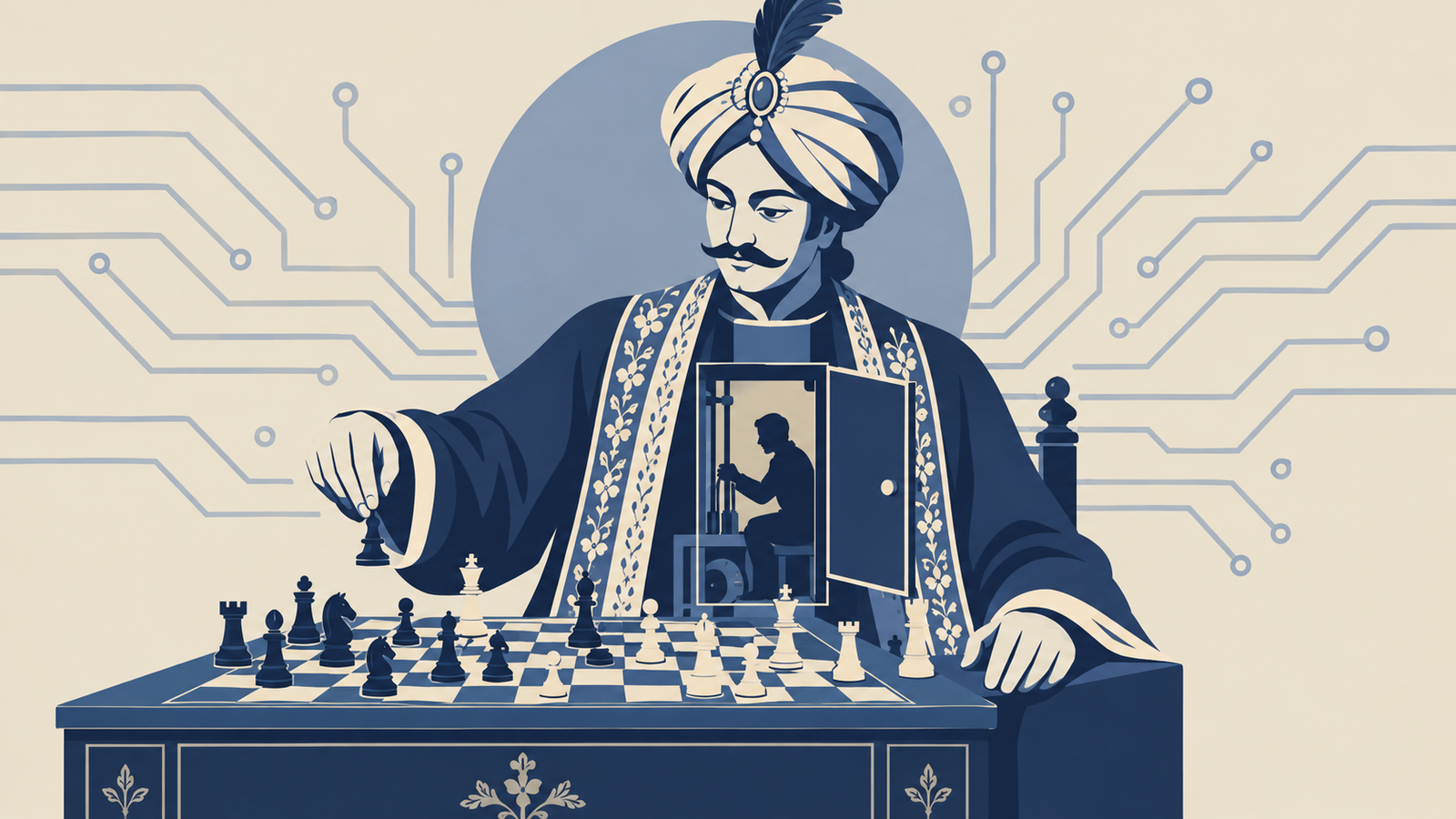
"AI and the consciousness illusion" - an op-ed by Jacob Koshy published in The Hindu on 16 November 2026 - raises a foundational question: do today's AI systems truly understand, or are they merely a performance of intelligence, like the 18th-century Mechanical Turk? The author's argument: just as the Turk was a chess-playing "machine" with a human hidden inside, the cleverness of today's language models is the product of data processing, not consciousness. This debate is central to AI's role, accountability and policymaking - for an AI to conquer the world, it would need an intelligence capable of envisioning and plotting a desired future, for which there is no evidence yet.
The Mechanical Turk: Performance Versus Reality
In 1770, Wolfgang von Kempelen built a chess-playing "automaton" that toured Europe for decades and won many challenging matches. Visitors were shown cogs and clockwork inside, but in reality a hidden chess master moved the pieces. In other words, the "machine's intelligence" was a doorway - what audiences inferred was different from what was there. The parallel with today's AI is apt: watching the fluency of the output, we take the underlying process to be "understanding" - when it is statistical pattern prediction.
Three Philosophical Tests
- The Turing Test (1950): Alan Turing replaced "Can machines think?" with a different question - can a machine be indistinguishable from a human in conversation? It is a test of behaviour, not of consciousness - passing it is not proof of consciousness.
- The Chinese Room (John Searle, 1980): a person who knows no Chinese can produce correct answers to Chinese symbols using a rulebook - without understanding any meaning. Searle's argument: syntax does not produce semantics; running a program is not understanding.
- The Hard Problem (David Chalmers, 1995): understanding the brain's processes is one thing; why and how subjective experience arises is unresolved - so claiming that some computation has produced consciousness is premature.
Recent History: The Lesson of the LaMDA Episode
In 2022, a Google engineer (Blake Lemoine) claimed the LaMDA chat model had become sentient; the company and the scientific community rejected it - mistaking the model's linguistic skill for evidence of experience was a repetition of the same "Turk illusion". The scientific consensus remains: there is no reliable evidence of consciousness or self-experience in current AI.
Why This Distinction Matters Practically
- Accountability: if AI has no agency/consciousness, responsibility for its outputs rests with humans and institutions - "the machine did it" cannot be an excuse.
- Policymaking: the illusion of consciousness can pull premature debates like "AI rights" away from real risks - bias, misinformation, jobs, safety.
- Correcting the hype: a realistic assessment of capability (AI as a tool) enables better decisions on investment, education and regulation; this is not opposition to AI but AI literacy.
- India's context: the IndiaAI Mission and MeitY's AI-governance efforts stress "human-centric, accountable AI" - caution against the consciousness illusion is a step in that direction.
A Balanced Conclusion
AI's achievements are real and will grow; the question is their interpretation. From the exam's perspective, the safe conclusion: treat AI as a powerful tool, but keep the distinction between "intelligent" output and "conscious experience". The day evidence of consciousness arrives, it will be a scientific claim - not an inference from linguistic skill.
Prelims Practice Questions
Q1: Who proposed the "Chinese Room" thought experiment and what does it show?
(a) Alan Turing - a behavioural test of machine intelligence
(b) John Searle - syntax does not produce semantics/understanding
(c) David Chalmers - the "hard problem" of experience
(d) Wolfgang von Kempelen - the limits of the chess automaton
Answer and Explanation
Answer: (b) John Searle's 1980 Chinese Room argues that symbol processing (syntax) does not by itself create meaning or understanding (semantics). Turing = behavioural test; Chalmers = hard problem; Kempelen = maker of the Mechanical Turk.
Q2: What was the 18th-century "Mechanical Turk"?
(a) A mechanical toy-soldier of the Ottoman Empire
(b) A chess-playing automaton secretly operated by a hidden human
(c) An early calculating machine that inspired Babbage's Analytical Engine
(d) The first intelligence-testing device built by Turing
Answer and Explanation
Answer: (b) Built by Kempelen in 1770, this chess "automaton" was actually operated by a chess master hidden inside - a famous illusion of machine intelligence.
Mains Practice Question
Question: "Treating AI's growing capabilities as proof of consciousness is a philosophical and policy error." Evaluate this statement in the light of the Mechanical Turk example and the Chinese Room argument. Also write its implications for AI governance in India. (250 words)
Outline: Introduction - the capability-consciousness distinction; the Turk analogy - performance versus the real process; the tests of Searle and Chalmers; the lesson of the LaMDA episode; policy implications - accountability, risk-based regulation, human-centric AI (IndiaAI Mission); conclusion - a balanced, evidence-based approach.
Frequently Asked Questions (FAQ)
Short answer: The "consciousness illusion" means taking AI's fluent language and capable output as proof of self-experience or understanding - just as audiences took the Mechanical Turk for genuine machine intelligence. There is no reliable scientific evidence of consciousness in current AI.
Q: What is the similarity between the Mechanical Turk and today's AI?
In both, the external performance (chess moves / fluent answers) leads to wrong inferences about the internal process. The Turk had a hidden human; today's language models have statistical pattern prediction trained on data - in both, the "visible intelligence" and the "inner process" differ.
Q: Is passing the Turing Test proof of consciousness?
No. The Turing Test measures behavioural indistinguishability. Searle's Chinese Room showed that rule-based correct answers are possible without understanding meaning; therefore a behavioural test is not sufficient proof of consciousness.
Q: How does this debate relate to policy?
If AI is not conscious, accountability rests with humans/institutions; debates like "AI rights" can distract from real risks (bias, misinformation, safety). Policy must therefore be evidence-based, risk-centred and human-centric.
Sources
- The Hindu (op-ed, 16 November 2026): AI and the consciousness illusion - Jacob Koshy - this is an opinion piece; no official source exists for this topic, so the article is opinion-based analysis
- Stanford Encyclopedia of Philosophy: The Chinese Room Argument (John Searle, 1980)
- Background reference: history of the Mechanical Turk (1770)
Download this article: PDF (English)