
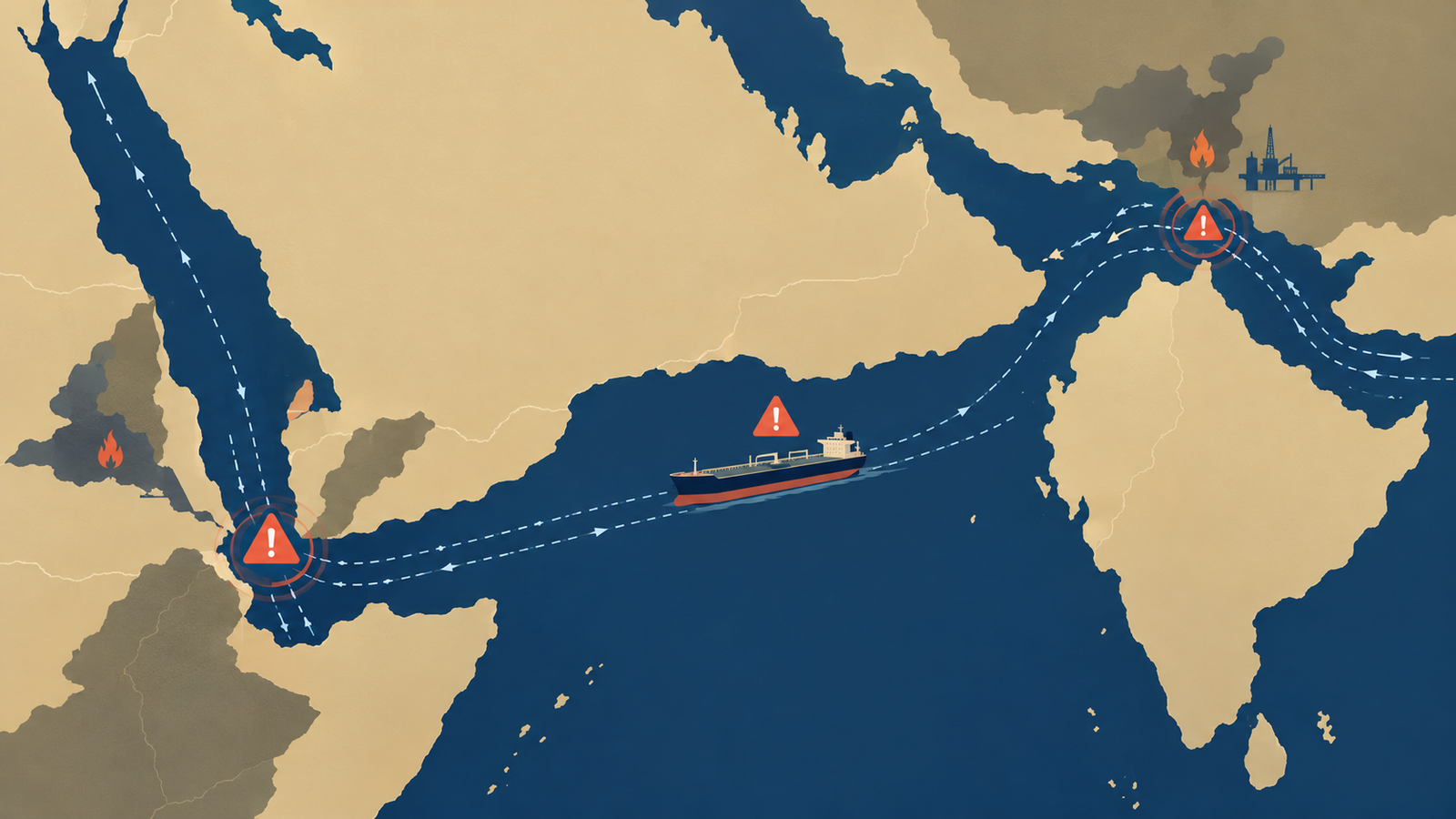
Why in the News
The two most critical straits of the Red Sea and the Persian Gulf are under pressure at the same time. On 15 November 2026, Saudi-backed Yemeni government forces vacated the area adjoining the Bab al-Mandab Strait - including Dhubab Airport - leaving the coast under the control of the Iran-backed Houthis. The very next day, 16 November, Britain's maritime monitoring agency UKMTO reported that a tanker was hit by an unknown projectile while exiting the Gulf through the Strait of Hormuz, causing a fire in its engine room; no injuries were reported. Meanwhile, at a UN Security Council session convened at Bahrain's request, Assistant Secretary-General Mohamed Khaled Khiari warned that as of 11 November the International Maritime Organization (IMO) had recorded 134 confirmed incidents in Hormuz and the wider region, in which 25 seafarers have died.
Sequence of Events: What Changed in Yemen
- September 2026: In a surprise offensive, the Houthis seized the Bab al-Mandab coast - including Perim Island at the mouth of the strait and the strategic port city of Mokha.
- Early October: Saudi-backed government forces claimed to have "secured" the strait.
- 15 November: The Southern Armed Forces said they were withdrawing troops from Dhubab Airport and the Bab al-Mandab area to defend the interim capital Aden; Houthi-run media confirmed the takeover. Saudi Arabia did not comment.
- Background: On 15 October, a Houthi attack on the presidential palace in Aden killed 5 and injured 16. According to UN Human Rights spokesperson Ravina Shamdasani, more than 60% of documented civilian casualties since the August escalation are women and children; roughly 330,000 people have been displaced in the fighting.
Why Bab el-Mandeb Matters
Bab el-Mandeb (the "Gate of Tears") connects the Red Sea to the Gulf of Aden and the Arabian Sea. At its narrowest it is roughly 29-32 km wide between Yemen and Djibouti-Eritrea; Perim Island divides it into two channels. It is the southern gateway of the Suez route - Asia-Europe maritime trade passes through it. According to the US Energy Information Administration (EIA), an average of 8.8 million barrels of oil per day transited it in the first half of 2023.
Hormuz: Already Effectively Closed
The Strait of Hormuz is about 39 km wide at its narrowest, and per the EIA about 20.9 million barrels of petroleum liquids - roughly 20% of global consumption - passed through it daily in 2023. Since the US-Israel war with Iran, this route has been effectively closed; Saudi Arabia had been relying on the Red Sea route for its oil exports - and Houthi control of Bab el-Mandeb has now made that alternative unsafe too. This is what has driven the surge in global oil prices. In the 16 November tanker incident, the UKMTO says the extent of damage and any environmental impact is still being assessed.
The Security Council Warning
At the session convened at Bahrain's request, Khiari said many ships and crews have been stranded in the Persian Gulf for months; restrictions on maritime transport raise energy, transport and insurance costs, fuelling inflation and threatening food security by constraining fertilizer shipments. He called on all parties to comply with international law and restore freedom of navigation, and urged that Iran-US negotiations be pursued in good faith.
Implications for India
- Energy security: India sources a large share of its crude oil and LNG imports from the Gulf region; the Hormuz closure has already raised supply pressure.
- Trade route: the principal sea route for Europe-bound exports runs through the Red Sea-Suez; rising insurance and freight rates raise costs for Indian exporters.
- Naval presence: the Indian Navy has already conducted conflict-era patrols and escort missions in the western Arabian Sea; the situation at both straits makes this even more important.
- Fertilizer and food: the cost and timeliness of fertilizer imports is tied to farm input costs.
Related (Hindi): Hormuz transit fee dispute; LPG imports and STS transfer amid the Hormuz crisis; Hormuz, Huda Shipping and energy security.
Prelims Practice Questions
Q1: With reference to the Bab el-Mandeb Strait, which of the statements are correct?
1. It connects the Red Sea to the Gulf of Aden.
2. Perim Island divides it into two channels.
3. It lies between Yemen and Oman.
(a) 1 and 2 only
(b) 2 and 3 only
(c) 1 and 3 only
(d) 1, 2 and 3
Answer and Explanation
Answer: (a) Bab el-Mandeb lies between Yemen and the Djibouti-Eritrea (African) coast, not Oman; it connects the Red Sea to the Gulf of Aden, and Perim Island splits it into two channels.
Q2: At the November 2026 UN Security Council session convened at Bahrain's request, how many confirmed maritime incidents (Hormuz and the wider region) did the IMO report as recorded?
(a) 84
(b) 104
(c) 134
(d) 164
Answer and Explanation
Answer: (c) Per Assistant Secretary-General Mohamed Khaled Khiari, the IMO had recorded 134 confirmed incidents as of 11 November 2026, in which 25 seafarers died.
Mains Practice Question
Question: "Simultaneous pressure on the Bab el-Mandeb and Hormuz straits creates a combined crisis for global energy and trade security." Analyse this statement in the light of current West Asian developments and suggest policy priorities for India. (250 words)
Outline: Introduction - geostrategic location of both straits; recent events - Houthi takeover, tanker attack, Security Council concerns; economic impact - oil prices, insurance, fertilizer; India-specific - energy import diversification, strategic reserves, naval patrols, diplomacy; conclusion - need for a multilateral navigation-security framework.
Frequently Asked Questions (FAQ)
Short answer: On 15 November 2026, the withdrawal of Saudi-backed Yemeni forces left the Bab al-Mandab coast under Houthi control; on 16 November a tanker was hit by an unknown projectile in Hormuz. The Security Council was told the IMO had recorded 134 maritime incidents as of 11 November, with 25 seafarers killed.
Q: Why is Houthi control of Bab el-Mandeb a major development?
Because Hormuz is already effectively closed and Saudi oil exports depended on the Red Sea route; Bab el-Mandeb passing to the Houthis makes the only major alternative for global oil supply unsafe as well, which has driven oil prices up.
Q: What happened in Hormuz on 16 November?
Per the UKMTO, a tanker exiting the Gulf was hit by an unknown projectile, causing an engine-room fire; there were no injuries, and the damage and environmental impact are being assessed.
Q: What are the UN's key concerns?
134 confirmed incidents and 25 seafarer deaths; ships and crews stranded for months; inflation from rising energy-insurance costs; threats to food security from constrained fertilizer shipments; and the demand that all parties restore international law and freedom of navigation.
Sources
- BBC (16 November 2026): Yemeni forces' retreat leaves Houthis in control of the Bab al-Mandab coast
- Arab News/Reuters (16 November 2026): UKMTO - tanker hit by projectile in Hormuz
- UN Security Council briefing (14 November 2026): ASG Khiari - IMO's 134 incidents / 25 deaths
- EIA: World Oil Transit Chokepoints - Hormuz and Bab el-Mandeb oil-flow data (official)
Download this article: PDF (English)