
Background and Context
A large part of Indian Railways' freight passes through only a few busy corridors, and the line capacity of these very corridors (how many trains can be run in a day) decides the speed of the supply chain. The Ballari-Hosapete region is one of the country's leading steel and cement clusters - heavy raw materials and products such as iron ore, dolomite, limestone, steel, coal, fertiliser and foodgrains move on this axis. When passenger and freight trains both run on the same axis, freight trains have to wait in loop lines while passenger services get priority, and transit time rises. To remove this basic constraint, the Railways takes two routes - building new Dedicated Freight Corridors (DFC), or adding capacity to existing busy sections by adding lines (multi-tracking).
Why in the News
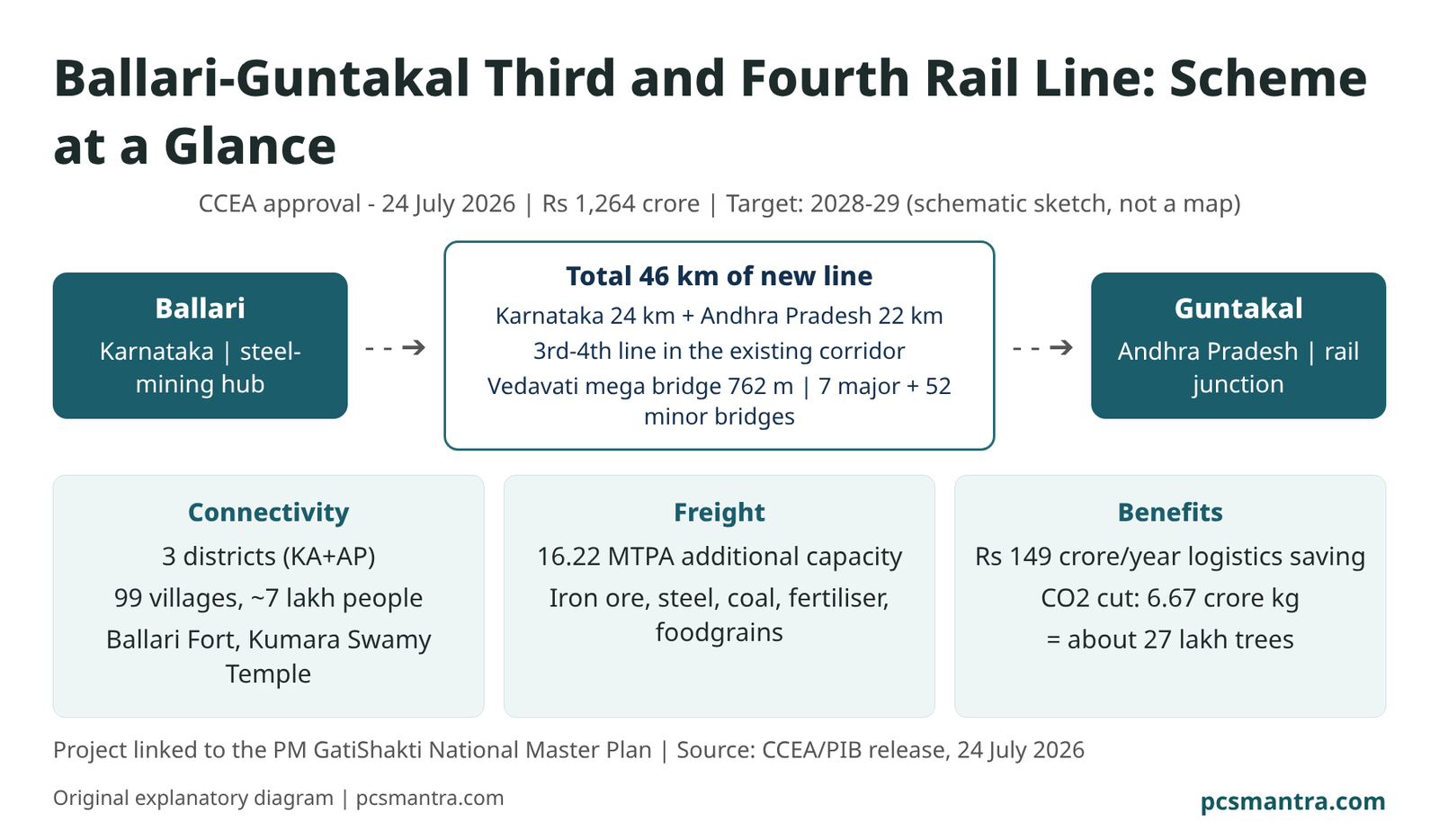
The Cabinet Committee on Economic Affairs (CCEA) on 24 July 2026 (Friday) approved the construction of the third and fourth lines on the Ballari-Guntakal rail section in Karnataka and Andhra Pradesh. The project, costing about Rs 1,264 crore, is spread across three districts of the two states and will add about 46 kilometres to the existing rail network; the target is completion by 2028-29. According to the Railway Ministry, the project will give better connectivity to about 99 villages - a total population of about seven lakh - and add 16.22 million tonnes per annum (MTPA) of freight capacity. According to the Cabinet briefing, the alignment is 24 kilometres in Karnataka and 22 kilometres in Andhra Pradesh; on the route, 7 large and 52 small bridges will be built, including a 762-metre mega bridge over the Vedavati river. The project is planned under the PM GatiShakti National Master Plan, and the estimated savings are stated as Rs 149 crore of annual logistics cost and a 6.67 crore kilogram CO2 reduction - equal to planting about 27 lakh trees.
Key Facts and Figures
| Approval and date | CCEA approval on 24 July 2026; completion target 2028-29 (Railway Ministry) |
|---|---|
| Cost and length | About Rs 1,264 crore; ~46 kilometres (Karnataka 24 km + Andhra Pradesh 22 km), 3 districts of the two states |
| Bridge structure | A 762-metre mega bridge over the Vedavati river; 7 large and 52 small bridges (Cabinet briefing) |
| Freight capacity | 16.22 million tonnes per annum of additional freight transport (Railway Ministry spokesperson) |
| Freight basket | Iron ore, dolomite, limestone, steel and steel products, coal, fertiliser and foodgrains |
| Benefit estimates | Rs 149 crore of annual logistics cost savings; 6.67 crore kg of annual CO2 reduction (Cabinet briefing estimate) |
| Public benefit | Better connectivity for about 99 villages, ~7 lakh population; access to places like Ballari Fort and the Shri Kumar Swamy temple |
| Planning framework | Multi-modal connectivity and integrated planning under the PM GatiShakti National Master Plan |
How Capacity Expansion Works - in Three Links
The arithmetic of paths: On a two-line section, a slow freight train running in one direction holds up the faster train behind it. The moment the third and fourth lines join, overtaking becomes possible and the available train paths per direction increase - that is why even a small 46-km section can change the flow of the whole axis, because a corridor's capacity is decided by its narrowest section.
Cluster-to-port economics: The Ballari-Hosapete steel-cement cluster takes raw material in and sends finished products out; with faster, reliable paths, inventory cost falls and the haul to the port (east coast) becomes time-bound. The Rs 149 crore of annual logistics savings in the Cabinet briefing is the monetary estimate of this time reliability.
The effect on passenger services: With freight paths separated, room for improvement in passenger train timings on the existing lines opens up; the Ministry claims that both operational efficiency and service reliability will rise and congestion will fall.
The Project's Significance
A small project, a strategic meaning: Among many large rail projects approved across the country, this 46-km section is an example of the principle that when network improvement is done at the real bottleneck, limited investment gives disproportionate benefit - this is the test of the GatiShakti approach.
The Railways' fight for freight share: Indian Railways has been trying continuously to win back share from road freight; the 16.22 MTPA of additional capacity is for heavy, bulk-earning loads like iron ore and cement, which matter for the Railways' revenue stability.
Regional balance: Connecting interior regions like Rayalaseema and north Karnataka to ports and markets can be considered the 'coastalisation of interior regions' - the Ministry has counted the estimated employment and self-employment opportunities on this reasoning.
Challenges and Question Marks
The speed of implementation: The three-year timeline includes the construction of 60 bridges, including the 762-metre mega bridge; in the Railways' older projects, land acquisition and bridge construction have been the main reasons for delay, so the timeline should be treated for now as a target only.
Estimate and reality: 16.22 MTPA and the savings of Rs 149 crore are administrative estimates; actual use will depend on whether the cluster's production and export demand grow as estimated - these figures are beyond independent verification.
The last-mile link: Main-line capacity is useful only when sidings, terminals and the connection with the cluster are well arranged; otherwise even new capacity can turn into queues.
Way Forward
Three tasks are clear going forward: (i) the project's monitoring should be milestone-based, including the bridge components, so that the 2028-29 timeline is not missed; (ii) siding and terminal planning should be coordinated with the industries of the Ballari-Hosapete cluster, so that the new capacity is used from the start; (iii) this section's coordination on the GatiShakti portal should be done with road projects and port connectivity, so that the benefit of multi-tracking is not divided into duplicate investment. In the medium term, reviewing proposals to connect this axis with the second phase of the Dedicated Freight Corridor would also be the logical next step.
Distinction Between Concepts
Keep three distinctions clear: (1) Multi-tracking versus DFC - the first adds lines to an existing mixed passenger-freight axis, the second builds a separate greenfield network for freight trains; (2) a new line versus capacity expansion (doubling/tripling) - a new line creates a new geographical connection, while doubling-tripling increases the volume of an existing connection; Ballari-Guntakal is in the second category; (3) GatiShakti planning versus traditional approval - in GatiShakti, a project is decided step by step by placing different ministries' plans on one portal; in the traditional method each ministry took approval separately.
Mains Perspective
GS-III: infrastructure, logistics efficiency, rail reform, regional development. In the answer, keep the facts (24 July 2026 CCEA; Rs 1,264 crore; 46 km; 16.22 MTPA - source-based) and present the benefit figures only as administrative estimates; do not add extra claims.
Answer Outline
Introduction: The bottleneck problem of Indian Railways and corridor economics.
Main Body: Concept: line capacity/train paths; argument: path arithmetic, cluster-port links, benefits for passenger services; limits: implementation risk, the nature of the estimate, the last mile; way: milestone monitoring, siding coordination, Gati Shakti integration.
Conclusion: To turn rail capacity into reliable logistics, suggest time-bound construction including bridges, siding-terminal coordination and Gati Shakti integration; write the additional freight, savings and emission reduction as government estimates, and 2028-29 as a target, not as achieved results.
Sources
- Press Information Bureau - CCEA: Ballari-Guntakal third and fourth lines (24 July 2026, PRID 2288860)
- The Hindu - Cabinet approves railway multi-tracking project across Karnataka, Andhra Pradesh at Rs 1,264 crore (press-based)
Key facts verified word-for-word from the Cabinet briefing document of 24 July 2026 and The Hindu's report; the PIB release page's link has been checked. The figures for the bridge structure, Rs 149 crore of logistics savings and CO2 reduction are estimates from the Cabinet briefing document - they have been recorded only as government estimates. The project's approval is an event of 24 July 2026; the completion target is 2028-29.
Remember: Keep three things in mind: the CCEA approval of 24 July 2026, the third and fourth lines of 46 km in Rs 1,264 crore, and 16.22 MTPA of additional freight capacity. The real lesson is that a network's capacity is decided by its narrowest section - even a small project can be strategic, provided it is completed on time.
Download This Article: PDF
