
Why in the news
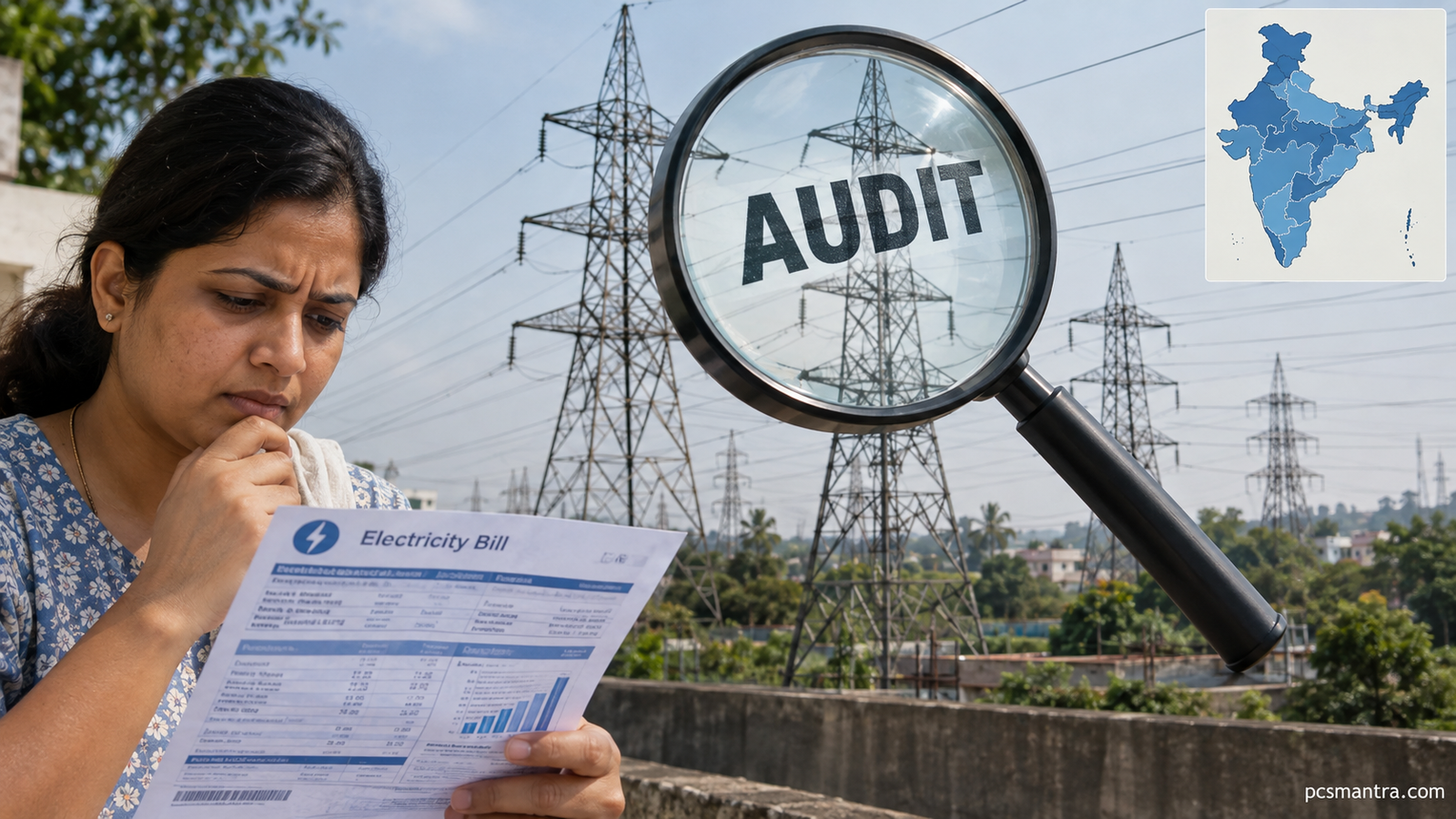
November 13, 2026: The Comptroller and Auditor General of India (CAG - the office is provided for in Article 148 of the Constitution) has begun a comprehensive, integrated audit of the country's power sector. It starts with the distribution companies (discoms - the companies that deliver electricity to the end consumer). Begun in July 2026, the audit report is expected to be finalised around the middle of the next financial year. It is being described as the first such nationwide consolidated audit exercise of the power sector, with consumer satisfaction, power trading and financial sustainability at its centre.
Scope and phases of the audit
Phase one - discoms: Thirty-nine public-sector discoms and five departmental undertakings across the country are within its ambit; their performance will be assessed for the period FY21 to FY26. Privately owned discoms will remain outside this audit.
Later phases: Transmission, generation, renewable energy and the Revamped Distribution Sector Scheme (RDSS, the discom-reform scheme launched in 2021) will follow in turn; the transmission segment's audit is planned from FY27. Each segment's operational and financial performance over the preceding five years will be assessed.
Integrated approach: The coal department will also be brought in, so that the entire chain from fuel supply to distribution can be assessed.
Consumer satisfaction: the audit's new direction
Moving beyond conventional financial and operational checks, the CAG has directed its auditors to engage directly with electricity consumers - the exercise will not remain limited to 'stakeholder consultation'. The experiences of around 10,000 consumers across industrial, agricultural and domestic categories will be recorded, with special emphasis on the reliability and quality of power supply. Placing consumer experience at the centre of an audit in this manner is its most distinctive feature.
Power purchase, trading and key indicators
The rising share of short-term purchase: The share of short-term procurement in states' overall power purchase basket has risen from about 7-8 per cent five years ago to nearly 14 per cent now, and power exchanges (electronic markets for electricity) account for more than 56 per cent of such transactions. Purchase cost directly affects the consumer's bill and the discom's financial health - which is what makes it a headline issue for the audit.
Technical and financial indicators: The audit covers aggregate technical and commercial (AT&C) losses - the loss from power wasted in transit, theft, and billing and collection gaps - along with billing and collection efficiency and the financial health and long-term viability of discoms. The backdrop is that the accumulated losses of discoms have run into lakhs of crores (about Rs 3.4 trillion by one estimate).
Where the report goes
Findings will be laid before the respective state legislatures through State Audit Reports. Common policy concerns and systemic deficiencies emerging from them will be consolidated and sent to the Union Ministry of Power for "consideration and appropriate policy interventions". The audit is thus designed not merely to check records but to serve as a basis for policy reform.
Way forward
The power sector's financial ailment is old - from the Ujwal Discom Assurance Yojana (UDAY, 2015) to RDSS (2021), several reform attempts have been made, yet discom losses and deficits have persisted. The true value of the CAG's sweeping audit will be proven only when its recommendations translate into timely policy action: transparency in purchase costs, a real cut in AT&C losses, speed in consumer-grievance redress, and a review of states' fiscally undisciplined subsidy practices. Making the consumer's voice the centre of an audit is a welcome change of direction - what remains to be seen is how far the system acts on that voice once the report arrives.
Prelims practice questions
Question 1. With reference to the Comptroller and Auditor General of India (CAG), consider the following statements:
1. The office of the CAG is provided for in Article 148 of the Constitution
2. The CAG presents reports only to Parliament, not to state legislatures
Which one of the following is correct in respect of the above statements?
(a) Statement 1 is correct, but Statement 2 is not correct
(b) Statement 1 is not correct, but Statement 2 is correct
(c) Both Statement 1 and Statement 2 are correct
(d) Neither Statement 1 nor Statement 2 is correct
Answer and explanation
Answer: (a)
Statement 1: Article 148 provides for the office of the Comptroller and Auditor General of India, so this statement is correct. Statement 2: CAG reports relating to states are also laid before the state legislature through the Governor, so this statement is not correct.
Question 2. In the power distribution sector, which of the following best describes 'AT&C losses' (Aggregate Technical and Commercial losses)?
Which one of the above is correct?
(a) Only the technical loss of electricity in transmission lines
(b) The total loss arising from technical loss, theft, and inefficiency in billing and collection
(c) Excess fuel consumption in power plants
(d) Fluctuation in electricity prices on power exchanges
Answer and explanation
Answer: (b)
AT&C losses include technical loss (in wires and equipment), commercial loss (theft, faulty metering) and gaps in billing and collection - all three. The other options describe only one aspect or an unrelated concept.
Mains practice question
"The CAG's comprehensive audit of the power sector is a significant step towards consumer-centric governance." Comment, and suggest measures to resolve the financial problems of Indian discoms. (250 words, 15 marks)
Answer outline:
In the introduction: The CAG's integrated power-sector audit - scope (39 discoms, FY21-FY26) and phases.
In the body: The significance of consumer centricity - the experience of 10,000 consumers; reliability-quality indicators. Key areas of scrutiny - short-term purchase up from 7-8 per cent to 14 per cent, AT&C losses, billing-collection, losses of Rs 3.4 trillion. Measures for discom reform - purchase transparency, smart metering, RDSS implementation, subsidy discipline, independence of state regulators.
In the conclusion: Reform only when the audit-legislature-ministry chain works.
Frequently Asked Questions (FAQ)
Summary answer: November 13, 2026: The Comptroller and Auditor General of India (CAG - the office is provided for in Article 148 of the Constitution) has begun a comprehensive, integrated audit of the country's power sector.
Question: What does the first phase of the CAG's power-sector audit cover?
39 public-sector discoms and five departmental undertakings, assessed for FY21 to FY26; the audit began in July 2026 and private discoms are outside it.
Question: What is the scope of the consumer survey?
Around 10,000 consumers across industrial, agricultural and domestic categories, with special emphasis on the reliability and quality of power supply.
Question: Through what route will the audit report travel?
Findings go to state legislatures through State Audit Reports; common policy deficiencies will be consolidated and sent to the Union Ministry of Power.
Sources
- [Press] https://www.thehindu.com/business/Industry/cag-widens-purview-of-power-sector-audit-starting-with-discoms-consumer-satisfaction-in-focus/article71694907.ece
- [Press] https://www.business-standard.com/industry/news/cag-begins-first-national-power-sector-audit-discom-losses-at-3-4-trn-126111201729_1.html
- [Press] https://indianexpress.com/article/business/cag-begins-nationwide-audit-of-39-power-discoms-10959589/
Download This Article: PDF