
Why in the News
Global targets for saving biodiversity are set, but where will the money, technology and local participation to bring them to the ground come from? This question was at the centre of India's national statement at the high-level segment of COP17 of the Convention on Biological Diversity in Yerevan, Armenia on 27 October 2026. Environment Minister Bhupender Yadav said that the implementation of the Kunming-Montreal Global Biodiversity Framework should be in line with national priorities, circumstances and law.
The Gap Between Promises and Implementation
According to the CBD Secretariat's press statement of 19 October on the opening, COP17 is to hold the first global review of collective progress in implementing the global framework. The conference runs from 19 to 30 October. This should not be read as the announcement of a final outcome: India's national statement and the conference's final decision are separate documents.
Based on its new global report, the Secretariat said that about 90 percent of parties have set national targets and more than 70 percent have submitted national reports, but less than half of the national targets assessed by parties are in the right direction. These are global, Secretariat-reported figures; they cannot be treated as a measure of India's achievement or failure.
India's Three Main Demands
- Means of implementation: adequate and predictable finance, capacity-building and technology transfer from developed countries. Along with setting targets, the institutional and economic capacity to fulfil them is also necessary.
- Benefit-sharing from digital information: support for a multilateral arrangement for benefit-sharing from digital sequence information (DSI) on genetic resources, which includes the Cali Fund. The statement is a support for benefit-sharing; it does not confirm any particular payment or any amount received by India.
- Balance of science and caution: a science-based, risk-proportionate and precautionary approach for synthetic biology and biosafety. This means not stopping innovation by itself, but increasing risk testing and safety capacity.
What Do 23 Targets and 142 Indicators Say?
According to the minister's statement published on PIB, India's updated National Biodiversity Strategy and Action Plan (NBSAP) converts the global framework into 23 national targets and 142 indicators. Targets show the direction; indicators provide the basis for measuring progress. The number of indicators is not in itself proof of conservation success. Regular, comparable and public data will be necessary for them.
The statement cited 1,134 protected areas, 103 Ramsar sites, 57 biodiversity heritage sites and 18 biosphere reserves in India, of which 13 are in UNESCO's Man and the Biosphere network. These are the figures given in the government statement of 27 October. The number of areas alone cannot measure habitat quality, the condition of species or the local benefits of conservation.
Why Is Local Participation Necessary?
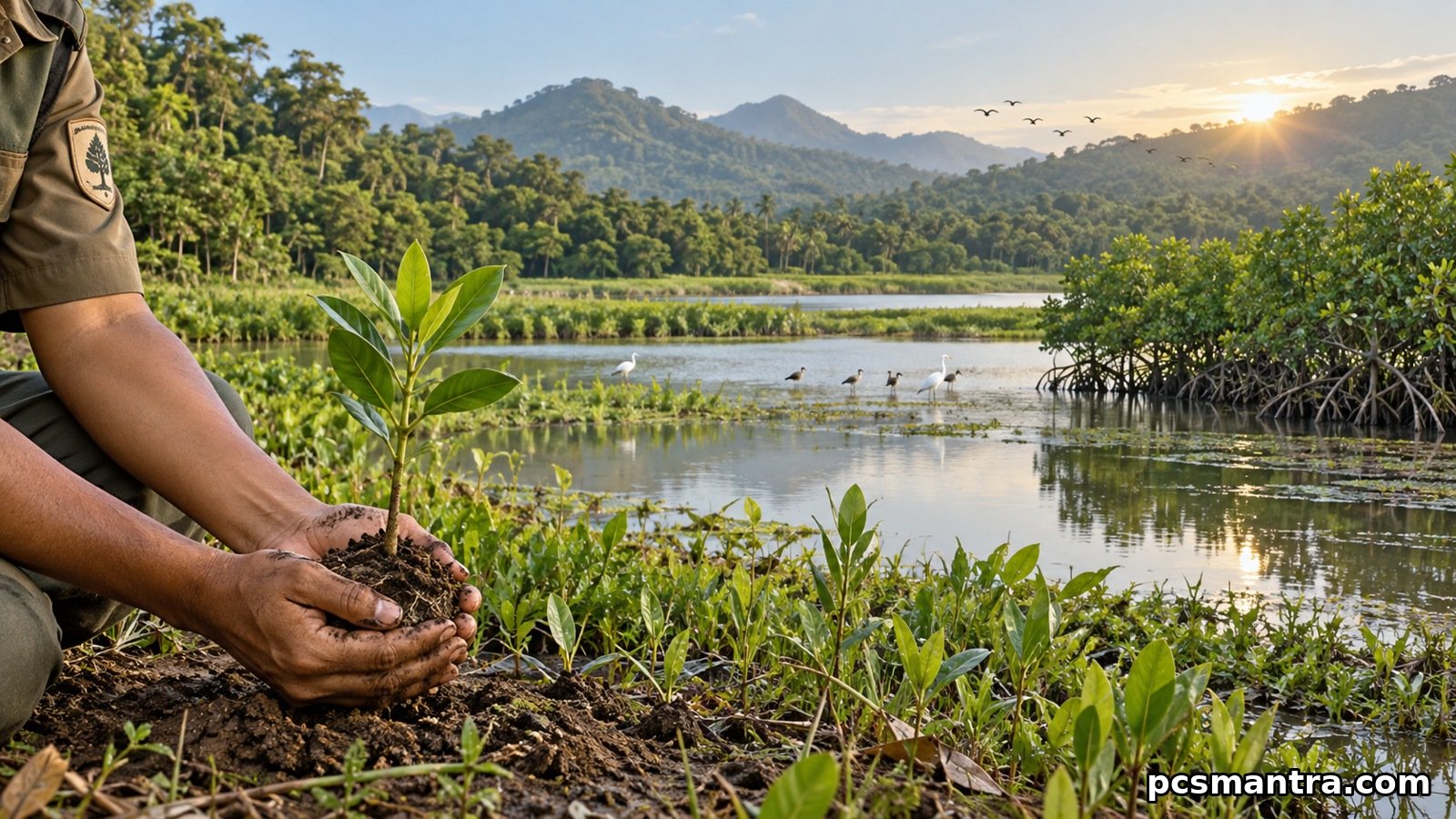
The minister mentioned decentralised access and benefit-sharing through village-level committees, MISHTI for mangrove restoration, Amrit Dharohar for wetland conservation and the Soil Health Card scheme. From an analytical point of view, it is useful to see these initiatives not as separate departmental schemes but as connected questions of water, soil, habitat and livelihood. Community participation will be meaningful only when conservation-related information, decisions and benefits reach them.
Direction of Analysis in the Mains
- Quality of finance: the promise of money, its timely receipt and actual spending on conservation are three separate stages.
- Quality of conservation: along with area and number, there should be an assessment of habitat condition, ecological connectivity and benefits to communities.
- Accountability: linking national indicators to budgets, responsible institutions and time-bound public review will help in checking implementation. This is an analytical suggestion, not an announced COP17 decision.
Mains Practice Question
Evaluate the role of finance, technology and local participation in the implementation of global biodiversity targets. Answer in the context of India's national action plan. (250 words)
Answer Outline
Introduction: Link the 23 targets and 142 indicators of India’s updated national biodiversity action plan to the national implementation of the global targets. Targets and indicators are not in themselves proof of conservation success.
Main Body: On finance, keep apart adequacy, predictability, timely availability and actual conservation spending. Explain the balance of science and caution in technology transfer, capacity building and biosafety. Make village-level committees, access and benefit-sharing, and local livelihoods the test of participation. Do not read support for DSI and the Cali Fund as confirmation of any definite payment. Suggest linking indicators to budgets, responsible institutions and public review.
Conclusion: Judge the success of India’s action plan not by the number of targets but by the availability of finance and technology and by whether decisions and benefits reach communities. Do not present the national statement as the conference’s final decision.
Sources and Limitations
PIB: India's national statement, 27 October 2026; CBD Secretariat: press statement on the opening of COP17, 19 October 2026. India-related conservation figures are given as stated in the minister's statement. The final COP17 decision is not the basis of this article; the conference is still in progress.