
Background and Context
Helium is a gas formed in the Earth's crust by the radioactive decay of uranium and thorium, found in natural gas reserves. It cannot be manufactured in a factory. According to The Hindu's explainer article, its boiling point is about -269 degrees Celsius, so it is used in work such as keeping MRI magnets and semiconductor wafers cold, building pressure on a rocket's fuel tanks and leak testing. When such a gas has only a few sources of supply, its export ban does not remain just one country's trade decision.
Why in the News
China's Ministry of Commerce (MOFCOM) and the General Administration of Customs imposed a temporary export ban on helium (customs commodity code 2804290010) by issuing joint announcement number 29 (2026) on 10 July 2026. According to the announcement's text, it applies from the date of issue and further changes will be announced separately. In the press briefing of 16 July 2026, MOFCOM said China is a big importer of helium, this step is to ensure domestic supply, and according to China it is in line with its foreign trade law and WTO rules. The announcement does not mention the ban's duration or reason. All statements of this article rest on the position of 10 and 16 July 2026. Until 17 October 2026 we found no announcement of the ban being lifted or changed in MOFCOM's sources, but this search is not complete, so it is not being said that the ban is still in force today.
Main Facts and Figures
| The announcement | MOFCOM and the General Administration of Customs, announcement number 29 (2026), 10 July 2026; commodity code 2804290010; effective from the date of issue; further changes by a separate announcement |
|---|---|
| China's statement (16 July 2026) | China is a big importer of helium; a temporary ban to ensure domestic supply; according to China, in line with the foreign trade law and WTO rules |
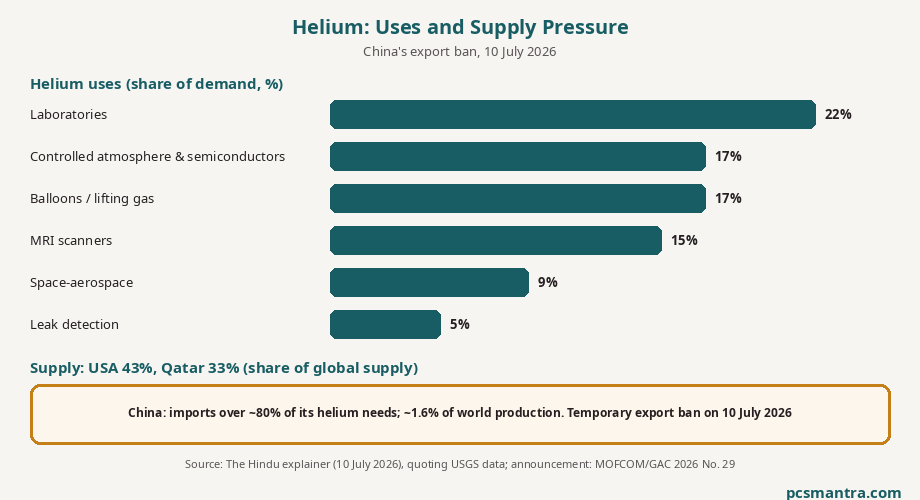
| China's position (The Hindu) | Imports more than 80% of its helium needs; produces about 1.6% of world production |
| World supply (The Hindu) | The US about 43%, Qatar about 33%; the rest Russia, Canada, Algeria; Russia's export restrictions and the tension in West Asia put pressure on supply |
| India (MP-IDSA, 21 May 2026) | No domestic helium production; Qatar supplies more than 50% of India's helium; in March 2026 spot prices in India rose 70-100% |
How the Ban's Effect Can Spread
Inside China: protecting the domestic stock: China imports a large share of its needs, so preserving domestic availability is its stated purpose. According to The Hindu, China's chipmakers and medical sector can benefit from it. This is the explainer article's assessment, not a MOFCOM statement.
The global market: already tight supply: according to The Hindu, in June 2026 the spot price of pure helium in North-East Asia had already become about double that of the end of 2025, and one major supplier had put an extra charge on its contracts. That is, the ban came into a market already under pressure.
India: import dependence: according to MP-IDSA's May 2026 brief, India has no domestic production and more than half its helium comes from Qatar. How much direct effect China's ban had on India cannot be determined from our sources, because we did not find China's share in India's imports.
Why This Event Matters
The supply chain of critical resources: the helium example shows that the effect of export control on a commodity with few sources, non-renewable and expensive to store travels far. These points about cost and storage are based on The Hindu's explainer.
The policy question for India: the MP-IDSA brief calls the lack of domestic supply a structural weakness and calls research support on alternative cooling technology and shared cryogenic infrastructure a near-term priority. These are the brief's suggestions, not government policy.
Points of Debate and Cautions
The ban's intent and duration: the announcement has no reason and no duration. The 16 July reason is China's own statement, which we have not independently tested, and being "in line with WTO rules" is also China's claim.
The source of the figures: China's import dependence, the shares of supply and the percentages of use are from The Hindu's explainer, which quotes USGS figures. We have not read the original USGS documents.
The effect on India: India's dependence on Qatar is a statement of the MP-IDSA brief. We have not read any official figure or response of the Government of India.
Way Forward
What to watch ahead: the position as of 17 October 2026 is not confirmed from our sources; when China announces the ban's duration and a change in it, how international helium prices stay, and how India expands the sources of supply for helium. On these we have no issuer-verified information after July 2026.
Distinctions Within the Concept
Keep three things separate: (1) the text of China's announcement, which states only the ban, the code and the effective date; (2) China's explanation of 16 July, which is its own side; and (3) the figures and assessments of The Hindu and MP-IDSA, which are secondary sources.
Mains Perspective
GS-II: international relations and trade; GS-III: science and technology, the economy and supply chains. In the answer write both the facts (10 July 2026; code 2804290010; import dependence) and the limits of the sources.
Answer Outline
Introduction: The ban and the characteristics of helium.
Main Body: The structure of supply and use; China's argument and its limit; India's dependence; policy options (diversifying sources, research support).
Conclusion: Given helium's uses and concentrated supply, examine the options of source diversification and research support. Keep China's stated argument, the news-based figures and the brief-based statement on India's dependence separate, and do not treat the current status of the ban as confirmed.
Sources
- MOFCOM and the General Administration of Customs, announcement 2026 number 29: the temporary export ban on helium (10 July 2026), Chinese text
- MOFCOM regular press briefing, 16 July 2026 (English text)
- The Hindu: China's temporary export ban on helium | Explained (10 July 2026)
- MP-IDSA Issue Brief: A Helium Shock to India's Quantum Technology Ambitions (21 May 2026), only the abstract and the opening paragraphs read
The MOFCOM announcement and the answer at the press briefing were read in full (the translation of the Chinese text is ours). The Hindu's explainer was read. Only the abstract and opening paragraphs of the MP-IDSA brief were read. No original source of the USGS, the Government of India or Indian import figures was read. The ban's current status could not be confirmed: the text of announcement number 29 was found the same on MOFCOM's site on 17 October 2026 and no amendment notice was seen in it, but a complete check of all of MOFCOM's later notices was not done. A third-party news site (Beijing Post, 17 October 2026) wrote about the ban continuing, but no quotation of the issuer was found in it, so it was not made a basis.
Remember: China imposed a temporary ban on helium exports on 10 July 2026 (the current status is not confirmed from our sources); India has no domestic production and, according to MP-IDSA, more than half the supply comes from Qatar.
Download This Article: PDF
