
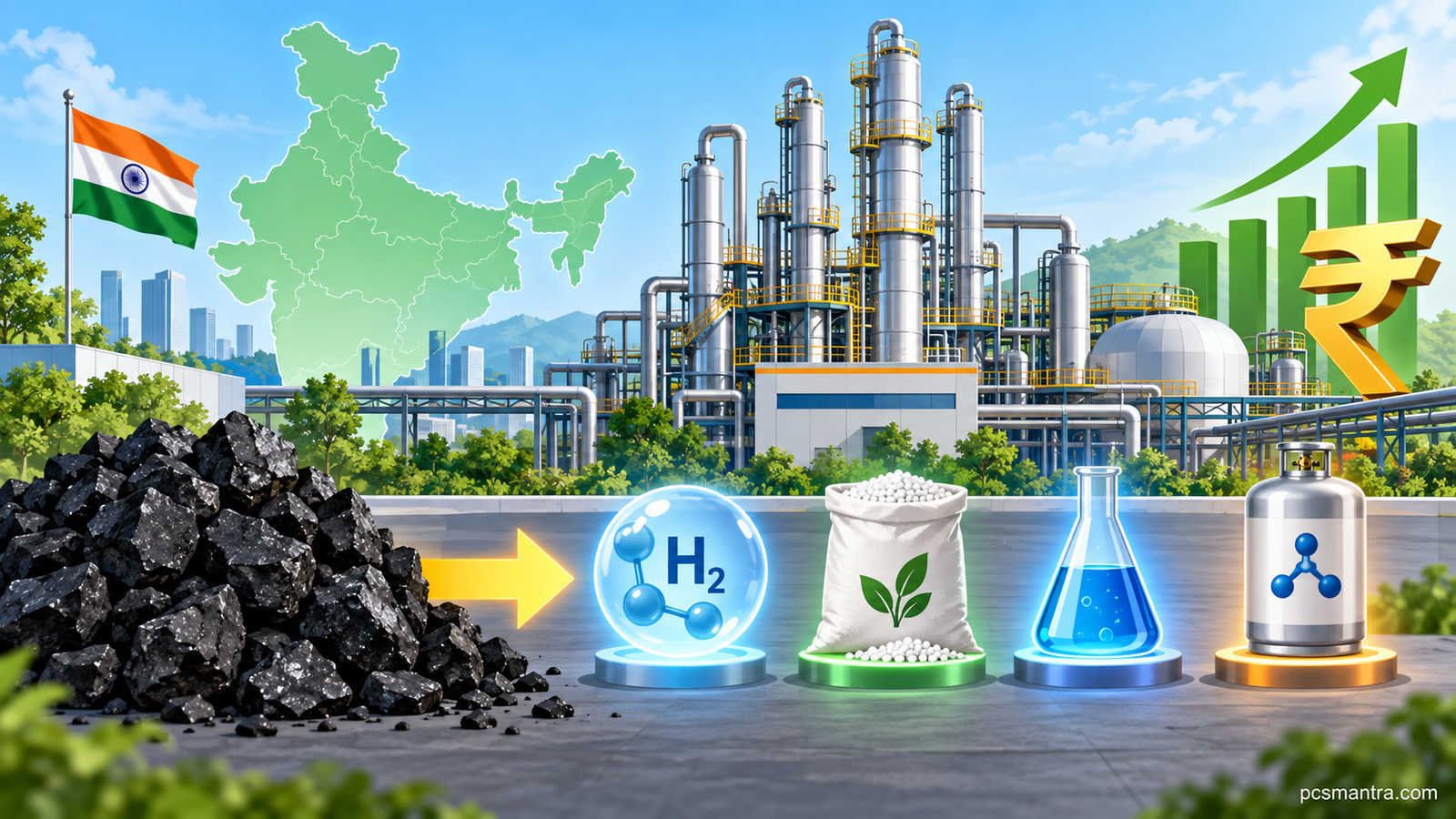
13 November 2026: The Centre for Domestic Economy Policy Research (C-DEP) and the Centre for WTO Studies (CWS) jointly released a report titled "Coal-to-Chemicals Policy in India: A Strategic Framework for Product Prioritisation under the National Coal Gasification Mission". The report evaluates 23 coal-derived products against eight economic, industrial and strategic criteria and places hydrogen at the top of the priority list. It comes as the government rolls out its Rs 37,500 crore coal gasification scheme, which aims to gasify an additional 75 million tonnes of coal and lignite every year.
Key findings of the report
- Priority order: hydrogen at the top, followed by synthetic natural gas (SNG), methanol, ammonia, dimethyl ether (DME), liquefied natural gas (LNG), liquefied petroleum gas (LPG), urea and diammonium phosphate (DAP).
- The import burden: in 2024 India spent nearly US$37 billion importing LPG, LNG, urea and DAP - over US$27 billion on LPG and LNG alone, and US$9.6 billion on urea and DAP.
- Import substitution: coal gasification can enable domestic production of these essential fuels, fertilisers and chemical feedstocks, offsetting part of the import bill.
Policy backdrop: the National Coal Gasification Mission
The government's Rs 37,500 crore scheme promotes surface coal and lignite gasification projects, with the goal of gasifying an additional 75 million tonnes of coal and lignite annually. The national target is 100 million tonnes of coal gasification capacity by 2030. The report says investments must concentrate on products offering the best economic returns, strategic advantage and import-substitution potential.
What was said
Petroleum and Natural Gas Regulatory Board (PNGRB) Chairperson Dr Anil Kumar Jain said coal gasification in India is at an early stage; which technologies are commercially viable for Indian coal must first be established. Industry should be allowed to test the technologies first; the government has provided policy and financial support, and commercially successful projects will shape a more targeted prioritisation framework.
C-DEP President Dr Jaijit Bhattacharya said that with Rs 37,500 crore committed, the priority is to identify where investments will deliver the greatest economic benefits; the report's framework directs investment towards products that cut imports, strengthen domestic supply chains and support industrial self-reliance.
Lessons from China
The report also studies China's coal-to-chemicals expansion. Integrated industrial clusters helped China scale up domestic production of fertilisers, methanol and other chemicals, but moving too fast left it with underused plants, heavy capital costs and water shortages. The study therefore advises India to invest in phases and build shared manufacturing hubs, where central gasification plants feed multiple downstream industries.
Analysis: the exam lens
- Energy security: a coal-based route to lower LPG-LNG import dependence is part of India's energy-security strategy; it also raises the question of balance with long-term energy-transition goals.
- Fertiliser self-reliance: domestic urea and DAP production is tied to both farm supply security and the subsidy burden.
- Industrial policy: the product-prioritisation framework shows that mission-mode schemes need a product-mix strategy, not just capacity targets.
Quiz: Test your knowledge
Q1: Consider the following about the C-DEP-CWS Coal-to-Chemicals report (November 2026): 1. It evaluates 23 coal-derived products across eight criteria. 2. It identifies hydrogen as the top-priority product. 3. It was jointly released by NITI Aayog and the Ministry of Coal. Which are correct?
(a) Only 1 and 2
(b) Only 2 and 3
(c) Only 1 and 3
(d) 1, 2 and 3
Answer and explanation: (a) Statements 1 and 2 are correct - the report evaluates 23 products on eight economic, industrial and strategic criteria and puts hydrogen at the top. Statement 3 is wrong - it is a joint report of the Centre for Domestic Economy Policy Research (C-DEP) and the Centre for WTO Studies (CWS), not of NITI Aayog or the Coal Ministry.
Q2: According to the report, roughly how much did India spend on LPG, LNG, urea and DAP imports in 2024?
(a) About US$10 billion
(b) About US$37 billion
(c) About US$75 billion
(d) About US$100 billion
Answer and explanation: (b) India's 2024 import bill for these four products was nearly US$37 billion - over US$27 billion on LPG and LNG, and US$9.6 billion on urea and DAP.
Mains practice question
India is adopting coal gasification as a strategy for energy and fertiliser import substitution. Analyse the product-prioritisation framework of the C-DEP-CWS report and discuss the lessons for India from China's experience. (Answer in 250 words - 15 marks)
Answer outline: Introduction: the nearly US$37 billion 2024 import bill for LPG, LNG, urea and DAP, and the backdrop of the Rs 37,500 crore National Coal Gasification Mission scheme. Main body: the framework - 23 products on eight criteria; high-priority products such as hydrogen, SNG, methanol, ammonia; balancing import substitution, economic returns and strategic security. China's lesson - success through integrated clusters, but over-expansion brought underused plants, capital burden and water stress; phased investment and shared manufacturing hubs for India. Challenges - technology viability for Indian coal, demonstrating commercial success, balance with energy-transition goals. Conclusion: only a product-prioritised, phased and evidence-based gasification strategy can deliver import substitution.
Frequently Asked Questions (FAQ)
In short: the C-DEP-CWS report says prioritising hydrogen, SNG, methanol and ammonia from coal gasification can cut India's imports of LPG, LNG, urea and DAP.
Question: Which product does the C-DEP-CWS report give top priority for coal gasification?
Hydrogen. It is followed by synthetic natural gas (SNG), methanol, ammonia, dimethyl ether (DME), LNG, LPG, urea and DAP.
Question: What is the government's target under the National Coal Gasification Mission?
The Rs 37,500 crore scheme aims to gasify an additional 75 million tonnes of coal and lignite every year, with a national target of 100 million tonnes of annual gasification capacity by 2030.
Question: What is the main lesson for India from China's coal-to-chemicals experience?
Integrated industrial clusters are useful, but over-rapid expansion must be avoided; phased investment and shared manufacturing hubs are recommended so that plants are not underused and capital costs and water stress do not grow.
Sources:
- Indian Chemical News: C-DEP-CWS report identifies priority chemicals for India's Rs 37,500 crore coal gasification push, 14 November 2026
- BusinessWorld: Study maps 23 coal-based products to cut India's fuel and fertiliser imports, 14 November 2026
Download this article: PDF