
Prelims | News context: 2026-11-17
Why in News
On the sidelines of the UN Climate Change Conference (COP31) in Antalya, Türkiye, the Ministry of Environment, Forest and Climate Change (MoEFCC) and the International Big Cat Alliance (IBCA) jointly organised the high-level ministerial side event 'BIG CATS: Drivers of Climate Change Mitigation' as reported by PIB on 17 November 2026. Union Minister Shri Bhupender Yadav said big cat conservation is an effective pathway for climate change mitigation and ecosystem resilience. Ministers and representatives of big cat range countries such as Nepal, Venezuela, Cambodia and Sri Lanka, and of international conventions like the Ramsar Convention and UNCCD, participated.
Introduction: IBCA and the big cat species
IBCA (International Big Cat Alliance): An international alliance envisioned by Prime Minister Narendra Modi for the conservation of the world's seven major big cat species - tiger, lion, leopard, snow leopard, puma, jaguar and cheetah - through knowledge sharing, capacity-building and international cooperation. Five of these species (all except the puma and jaguar) are found in India.
The umbrella species principle: Protecting an apex predator secures its entire habitat - forests, grasslands, wetlands and mountain ecosystems - benefiting thousands of other species and the communities dependent on them.
Main Body: highlights of the event
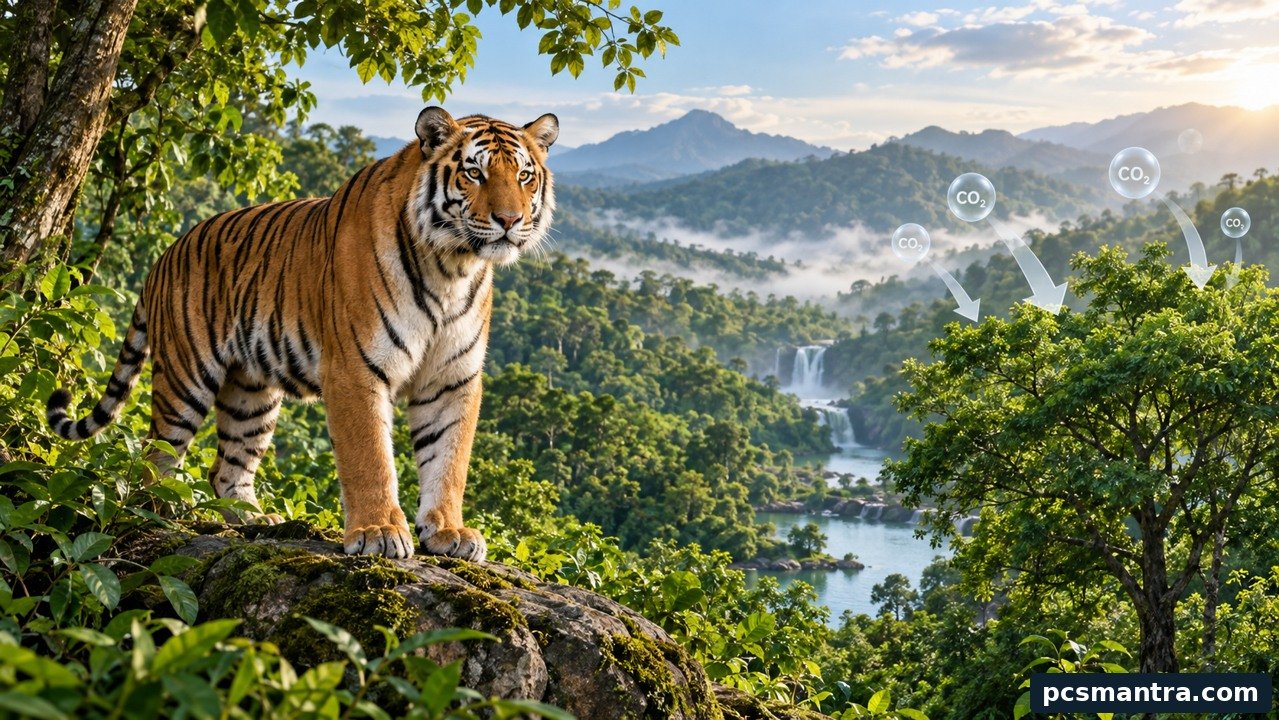
- Conservation as carbon security: Big cats do not sequester carbon directly, but their conservation protects forests, grasslands and wetlands that store carbon, prevents emissions from habitat degradation, and strengthens climate resilience.
- India's argument: Shri Yadav said India's tiger journey shows that political commitment, strong institutions, sustained investment and community participation can turn wildlife conservation into an instrument of ecological security, climate resilience and sustainable development. India's cheetah reintroduction was also appreciated.
- Presentation: IBCA Director General Shri S.P. Yadav presented on the alliance and the status of big cats in range countries.
India's tiger conservation model
- 58 tiger reserves: Spanning about 85,000 sq km, protecting extensive forest ecosystems and their carbon stocks; over 600 rivers originate or flow through these landscapes, making them critical watersheds.
- Tiger numbers: The 2022 census estimated 3,682 tigers in India - more than 70 per cent of the world's wild tigers.
- Legal-institutional framework: Project Tiger is supported by the Wildlife (Protection) Act, 1972 and the statutory National Tiger Conservation Authority (NTCA).
- Green employment: Project Tiger generates livelihood opportunities of about 6 million man-days annually, linking conservation to community livelihood security.
Exam relevance
For Prelims: IBCA's seven species, 58 tiger reserves/85,000 sq km, the 2022 census (3,682; 70%+), and the NTCA's parent law (Wildlife (Protection) Act, 1972) are direct question areas.
For Mains: Nature-based solutions, umbrella species and the conservation-climate convergence - rich material for GS-III.
Way Forward
Through the IBCA, India will share its conservation model with other range countries. Connecting big cat habitats with climate finance and mainstream nature-based action will be the goal of upcoming negotiations.
Prelims Practice Questions
Q1. With reference to tiger conservation in India, consider the following statements:
Statement 1: India has 58 tiger reserves spread over about 85,000 sq km
Statement 2: The 2022 census estimated 3,682 tigers in India
Statement 3: The NTCA is a statutory body constituted under the Environment (Protection) Act, 1986
Which of the statements given above is/are correct?
(a) 1 and 2 only
(b) 2 and 3 only
(c) 1 and 3 only
(d) 1, 2 and 3
Answer and Explanation
Correct answer: (a) 1 and 2 only
Explanation: Statement 1 is correct: 58 tiger reserves span about 85,000 sq km. Statement 2 is correct: 3,682 tigers in 2022 - over 70 per cent of the world's wild tigers. Statement 3 is incorrect: the NTCA is a statutory body under the Wildlife (Protection) Act, 1972.
Q2. Which two of the seven big cat species covered under the IBCA's vision are not found in India?
(a) Tiger and lion
(b) Leopard and snow leopard
(c) Puma and jaguar
(d) Cheetah and lion
Answer and Explanation
Correct answer: (c) Puma and jaguar
Explanation: The IBCA's seven species are tiger, lion, leopard, snow leopard, puma, jaguar and cheetah; the puma and jaguar are species of the Americas and are not found in India.
Mains Practice Question
'Conservation of big cat species can be an effective pathway for climate change mitigation.' Evaluate this statement in light of India's tiger conservation model. (GS-III; 250 words)
Answer Outline:
Introduction: Reference the MoEFCC-IBCA side event at COP31 and the statement; the umbrella species concept.
Main Body: How protecting carbon-rich habitats prevents emissions and builds resilience; 58 tiger reserves and the watersheds of 600+ rivers; factors behind the 3,682-tiger/70% success - law (WPA 1972), NTCA, budgets, technology-based monitoring and community participation; the conservation-livelihood link through 6 million man-days of employment; international cooperation through the IBCA.
Conclusion: Conclude that conservation and climate action are complementary; India's model is proof of nature-based solutions.
Frequently Asked Questions (FAQ)
Short answer: At COP31, the MoEFCC and IBCA held the side event 'BIG CATS: Drivers of Climate Change Mitigation', where India presented big cat conservation as a pathway for mitigation and resilience; India has 58 tiger reserves (~85,000 sq km) and 3,682 tigers (2022).
Q: What is the IBCA?
The International Big Cat Alliance - an international alliance for the conservation of seven major big cat species (tiger, lion, leopard, snow leopard, puma, jaguar, cheetah), envisioned by India.
Q: How many tigers are there in India?
3,682 as per the 2022 census - more than 70 per cent of the world's wild tigers.
Q: Under which law was the NTCA constituted?
The National Tiger Conservation Authority (NTCA) is a statutory body under the Wildlife (Protection) Act, 1972.
Sources
- PIB - Big Cat Conservation can be a Powerful Pathway for Climate Change Mitigation: Union Environment Minister at UNFCCC COP31, Antalya (17 November 2026): https://www.pib.gov.in/PressReleseDetailm.aspx?PRID=2337247&lang=1®=3
Related articles (internal links)
- 'Leave No One Behind': India's Just Transition Agenda at COP31
- Preparing the Chennai Coast for Olive Ridley Turtles: Conservation Drive Ahead of the Nesting Season
Download this article: PDF (English)