
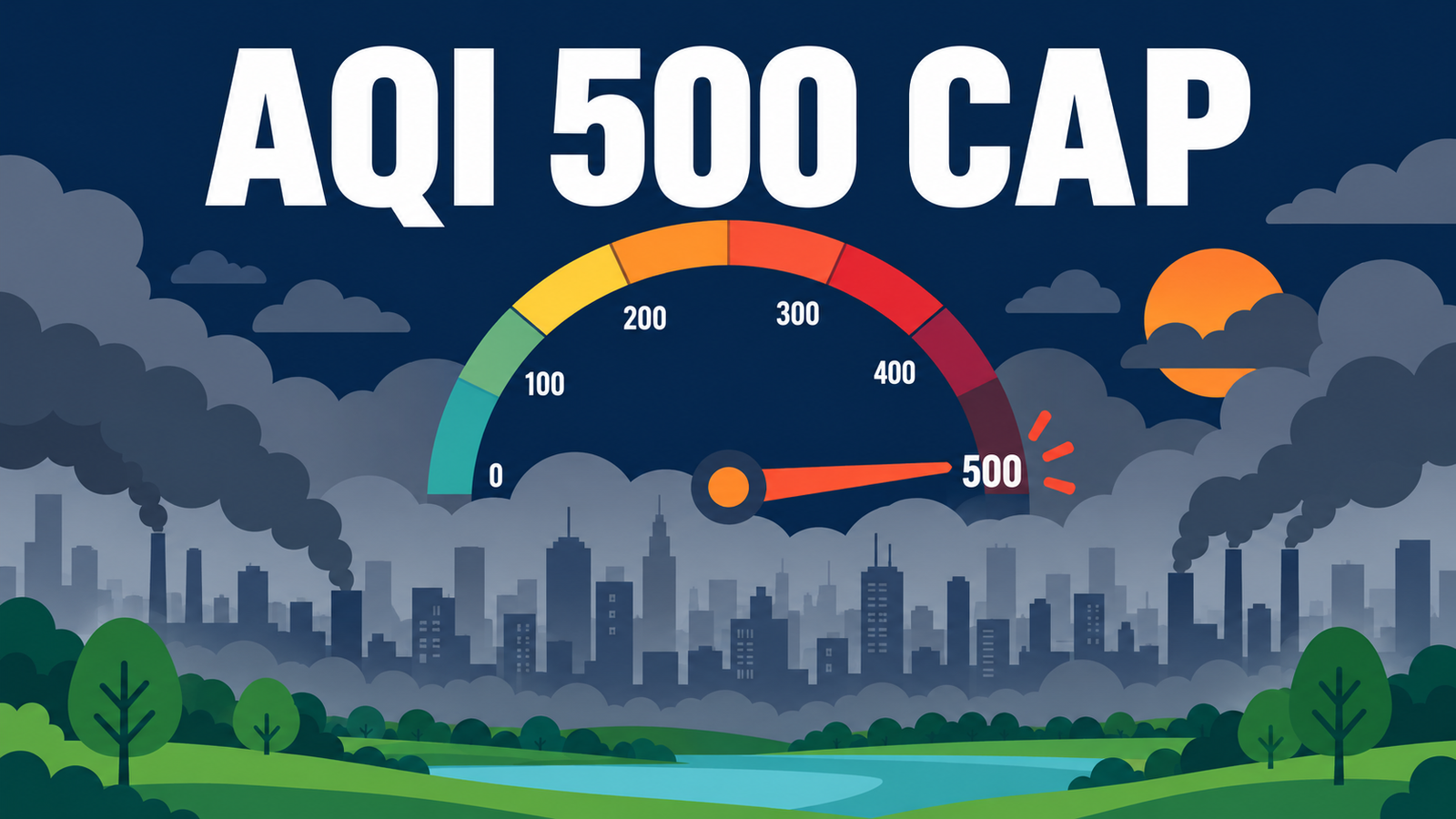
15 November 2026: As Delhi's average AQI moved from 'very poor' towards 'severe' (around 373), several private monitoring platforms began showing readings up to 1,000. The wide gap between government and private readings lies in how the index is calculated - India's official AQI stops at 500, while some international scales display values beyond it.
India's AQI: the structure
- Launch: in 2015 as part of the Swachh Bharat campaign; a colour-coded index converting measurements of eight major pollutants into a single number, category and colour.
- The eight pollutants: PM2.5, PM10, nitrogen dioxide, sulphur dioxide, ozone, carbon monoxide, ammonia and lead.
- Calculation: each pollutant's concentration is converted into a sub-index; the overall AQI is not an average but the highest sub-index.
- Six categories: Good (0-50), Satisfactory (51-100), Moderate (101-200), Poor (201-300), Very Poor (301-400) and Severe (401-500).
Why readings differ
- The 500 cap: India's official scale stops at 500; some private platforms use different breakpoints and display values above 500. On 9 November, the CPCB's 24-hour average was 370, while one private platform showed 955 on the US scale and 787 on its India-scale calculation.
- Other reasons: different monitoring locations, averaging periods and measurement methods also change readings.
- Criticism: atmospheric scientists such as Gufran Beig question the 500 cap - a reading of 500 does not reveal how much further pollution concentrations have risen.
GRAP: from AQI to action
- Stage-based response: the Graded Response Action Plan (GRAP), implemented by the CAQM in Delhi-NCR, has four stages tied to AQI ranges; stages can be invoked in advance on forecasts.
- Current status: Stage III has been in force since 6 November (AQI 382); Stage IV, with tighter curbs on truck entry and schools, can be invoked if AQI crosses 450.
For the exam
- Questions can be asked on the AQI launch (2015), the number of pollutants (8), the highest-sub-index method, the six category ranges, the 500 cap and the GRAP stages.
Quiz: Test your knowledge
Q1: Consider the following about India's national AQI: 1. It covers measurements of eight pollutants. 2. The overall AQI is the average of all pollutant sub-indices. 3. India's official scale is capped at 500. How many are correct?
(a) Only one
(b) Only two
(c) All three
(d) None
Answer and explanation: (b) Statements 1 and 3 are correct. Statement 2 is wrong - the overall AQI is the highest sub-index, not an average.
Q2: What is the range of the 'Severe' AQI category?
(a) 201-300
(b) 301-400
(c) 401-500
(d) 501-600
Answer and explanation: (c) 401-500 is 'severe'; India's index stops at 500, so no 501-600 category exists.
Mains Practice Question
The 500 cap on AQI and the differing readings of private platforms have raised questions about the credibility of pollution risk communication. Suggest measures for an integrated and transparent air-quality information system. (Answer in 250 words - 15 marks)
Answer outline:
Introduction: The context - CPCB's 370 versus private platforms' 900+.
Main body: The problem - different scales/breakpoints, the 500 cap hiding real severity, public confusion and the impact on GRAP decisions; measures - a standardised methodology, considering linear extension beyond 500, data transparency and third-party verification, simplifying citizen communication.
Conclusion: Accurate, uniform and understandable information is the first condition of pollution governance.
Frequently Asked Questions (FAQ)
In short: India's AQI, launched in 2015, is based on eight pollutants and capped at 500; private platforms using different scales can display values above 500, which is why readings differ.
Question: How many pollutants does the AQI include?
Eight - PM2.5, PM10, NO2, SO2, ozone, CO, ammonia and lead; the overall AQI is the highest sub-index.
Question: Why do government and private AQI readings differ?
India's scale stops at 500 while some platforms use different breakpoints to show 500+ values; monitoring location, averaging period and measurement method also differ.
Question: What is GRAP?
The Graded Response Action Plan - stage-wise curbs implemented by the CAQM in Delhi-NCR according to AQI levels; Stage IV, the strictest, kicks in when AQI crosses 450.
Sources:
- Indian Express Explained: Why Delhi's AQI readings differ - the 500 cap
- Firstpost Explainer: Why official monitors cap AQI at 500
Download this article: PDF