
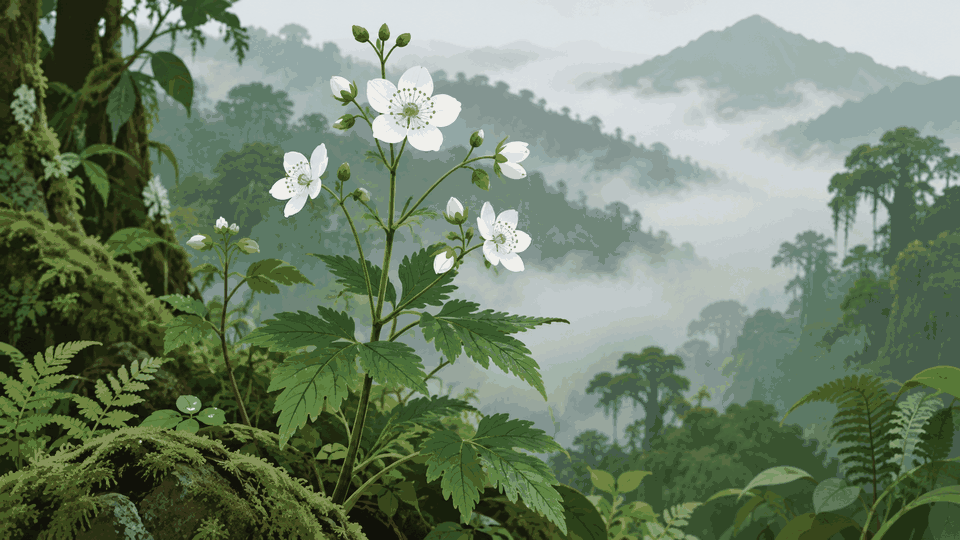
Why in the news
12 November 2026: Reports came of the discovery of a new flowering plant species - Disporopsis crispata - from the Vijoynagar area of Arunachal Pradesh's Changlang district. The discovery is significant in two ways: it is not only a new species but also the first recorded presence of the genus Disporopsis in India. The scientific description of the discovery has been published in the international plant-taxonomy journal Phytotaxa.
Details of the discovery
Location: The species was found around Vijoynagar in Changlang district at an elevation of about 2,500 metres - an area within the biodiversity-rich montane forests of the Eastern Himalaya.
Numbers: A cause for concern is that fewer than five individuals of the plant have been found so far - the need for conservation has surfaced alongside the discovery itself.
Publication: The formal description of the discovery appears in a research paper published in Phytotaxa (with Floden and Sahani among the leading authors).
Features of Disporopsis crispata
Classification: The plant belongs to the family Asparagaceae - the same family that includes plants like asparagus (shatavari).
Biogeography: The genus Disporopsis was thought to be mainly of the South-East Asia and China region; its first presence in India extends the known range of the genus.
Why a genus's first presence matters
In taxonomy, a genus being found in a region for the first time is more than the addition of one species - it throws new light on the evolutionary and geographic history of that region. It strengthens the understanding of floristic links between the Eastern Himalaya and South-East Asia. It also confirms that under-explored regions like Arunachal still hold unrecorded biodiversity.
The conservation concern
A species with fewer than five known individuals is naturally extremely fragile. Pressures like habitat loss, road construction and climate change can become immediate threats to such species. Along with the discovery, therefore, protection of the site, further surveys and ex-situ measures like seed or tissue conservation become essential.
Prelims practice questions
Question 1. With reference to Disporopsis crispata, consider the following statements:
1. This new flowering plant species has been discovered from Arunachal Pradesh's Changlang district
2. It belongs to the family Asparagaceae
3. This is the first recorded presence of the genus Disporopsis in India
How many of the above statements are correct?
(a) Only one
(b) Only two
(c) All three
(d) None
Answer and explanation
Answer: (c)
All three statements are correct. The species was found in the Vijoynagar area of Changlang district; it belongs to the family Asparagaceae; and it is the first recorded presence of the genus Disporopsis in India. The discovery has been described in Phytotaxa.
Question 2. With reference to new species discoveries, consider the following statements:
1. The first presence of a genus in a region improves the understanding of that region's evolutionary history
2. Fewer than five individuals of Disporopsis crispata have been recorded so far
Which one of the following is correct in respect of the above statements?
(a) Statement 1 is correct, but Statement 2 is not correct
(b) Statement 1 is not correct, but Statement 2 is correct
(c) Both Statement 1 and Statement 2 are correct
(d) Neither Statement 1 nor Statement 2 is correct
Answer and explanation
Answer: (c)
Both statements are correct. The first presence of a genus throws new light on a region's evolutionary and geographic history. Fewer than five known individuals of Disporopsis crispata make its conservation an immediate concern.
Mains practice question
Question: Why is the Eastern Himalaya significant as a biodiversity hotspot? In the light of recent new species discoveries, highlight the challenges of conservation there. (250 words, 15 marks)
Answer outline:
In the introduction: The discovery of Disporopsis crispata from Changlang, Arunachal - a new species and the genus's first presence in India; the Eastern Himalaya's extraordinary biodiversity.
In the body: Significance - species richness from altitudinal and climatic zonation; floristic links with South-East Asia; the likelihood of unrecorded biodiversity. Challenges - habitat loss, road construction, climate change; immediate threat to species with very small populations; shortage of survey expertise. Measures - site protection, regular surveys, ex-situ conservation, community participation.
In the conclusion: Every new discovery adds a responsibility of conservation; protecting the Eastern Himalaya is imperative both scientifically and ecologically.
Frequently Asked Questions (FAQ)
Short answer: A new flowering plant species, Disporopsis crispata, has been discovered from Arunachal Pradesh's Changlang district - the first recorded presence of the genus Disporopsis in India.
Question: Where was Disporopsis crispata found?
In the Vijoynagar area of Arunachal Pradesh's Changlang district, at an elevation of about 2,500 metres.
Question: Which family does it belong to?
The Asparagaceae family; the discovery has been described in the journal Phytotaxa.
Question: Why is its conservation status a concern?
Fewer than five individuals have been recorded so far, leaving the species in an extremely fragile state.
Sources
- https://phytotaxa.mapress.com/pt/article/view/phytotaxa.784.1.8
- https://www.indiatodayne.in/arunachal-pradesh/story/new-flowering-plant-species-discovered-in-arunachal-first-of-its-genus-in-india-1474524-2026-11-12
- https://nenow.in/north-east-news/arunachal-pradesh/arunachal-new-flowering-plant-species-discovered-in-changlang-district.html
