
Internal security and social issues | News context: NCORD's 10th apex-level meeting and the Vision Document on Drug Control 2026-2029, 26 June 2026 | Published: 18 October 2026
Background and Context
India's legal framework for dealing with narcotics is the Narcotic Drugs and Psychotropic Substances (NDPS) Act, 1985, and the Narcotics Control Bureau (NCB) coordinates at the Centre. The Narco Coordination Centre (NCORD) is the coordination forum among the Centre, states and agencies, with meetings at apex, state and district levels. Figures and claims on this subject easily create confusion, so this article gives the limits of the figures along with them.
Why in the News
Per PIB, Union Home and Cooperation Minister Amit Shah chaired the 10th apex-level NCORD meeting in New Delhi on 26 June 2026, released the "Vision Document on Drug Control (2026-2029)" and the "NCB Annual Report-2025", e-inaugurated NCB regional offices in Jammu and Guwahati and launched an "Online Drugs Disposal Pakhwada" to destroy 2,09,500 kg of narcotics.
Core Concept: Four Pillars and "Detect, Disrupt, Destroy"
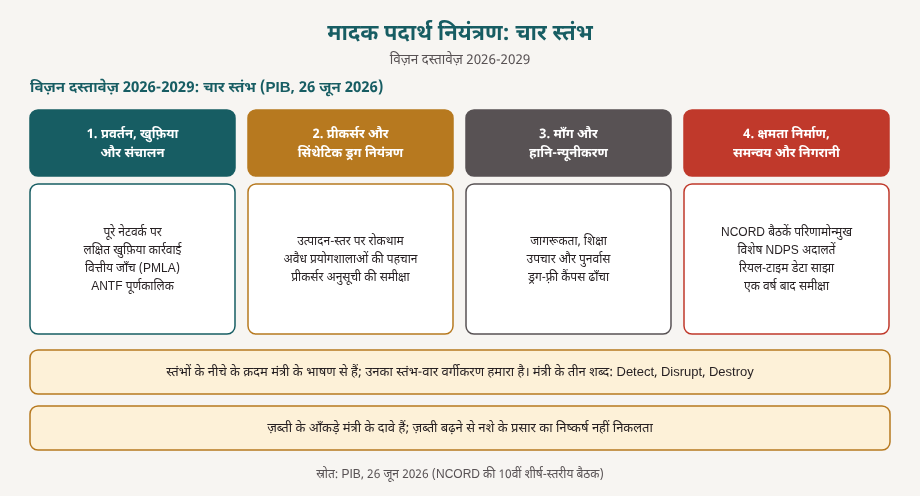
Per PIB the roadmap rests on four pillars: enforcement, intelligence and operations; precursor chemicals and synthetic drug control; demand and harm reduction; and capacity building, coordination and monitoring. The Home Minister put it in three words: Detect, Disrupt, Destroy. A stance of "tough on traffickers, compassionate towards victims" was also stated. Targets and timelines are said to be fixed for each sub-pillar.
Key Facts and Figures
| Occasion | NCORD's 10th apex-level meeting, New Delhi, 26 June 2026. Per PIB, 15,876 district-level, 266 state-level and 7 executive committee meetings have been held so far. |
|---|---|
| Documents released | Vision Document on Drug Control (2026-2029); NCB Annual Report-2025; NCB regional offices in Jammu and Guwahati. |
| Disposal fortnight | Target of destroying 2,09,500 kg of narcotics, value Rs 6,000 crore (PIB). The Home Minister cited "destroying narcotics worth Rs 6,000 crore in one day" as an achievement. |
| Directions to states (per the minister's speech) | Financial investigation mandatory in major NDPS cases; police chiefs expected to take personal interest; ANTFs to become full-time units; special public prosecutors; special NDPS courts from high courts; a nodal officer in every department; a "drug-free campus" framework in schools and higher education; real-time data sharing. |
| Expectations from central ministries | Review of schedules of precursor chemicals and psychotropic substances; monitoring of drug abuse and online pharmacies by the Health Ministry; expansion of the Nasha Mukt Bharat Abhiyaan, treatment and rehabilitation by the Social Justice Ministry. |
| Monitoring | Per the Home Minister the plan will be reviewed after one year and redefined if needed. |
| Figures given by the minister (quoted in PIB) | Seizures: Rs 40,000 crore (26 lakh kg) in 2004-2014; Rs 1,84,000 crore (1 crore 18 lakh kg) in 2014-2026. Destroyed: Rs 8,000 crore versus Rs 89,896 crore. Illegal opium cultivation destroyed: 10,000 acres in 2020, 42,282 acres in 2025. Cases and arrests: 1,73,000 and 1,95,000 versus 8,75,000 and 10,97,000. |
How to Read the Figures
Length of the periods: the comparison is of 2004-2014 (ten years) and 2014-2026 (twelve years). Our calculation: seized quantity on average from about 2.6 lakh kg per year to about 9.8 lakh kg per year. Still, not all the difference is from the periods' length, and PIB does not say whether the 2026 figures are for the full year or up to June.
Meaning of seizures: rising seizures can mean rising enforcement and also rising supply. So no direct conclusion about falling or rising prevalence of drug use follows from seizures. PIB's text too presents this as enforcement success; we have no figure of prevalence of use in this text.
Seized vs destroyed: PIB gives separate figures for seized and destroyed substances. The time gap between the two and the destruction process are not stated in PIB, so do not treat them as a direct ratio of each other.
Why This Subject Matters
Federal coordination: law and order is in the State List, while the NDPS Act is a parliamentary law. So the plan's success depends on states' police, ANTFs and courts. The minister's directions are expectations from states; PIB does not say states have accepted them. This is our reading.
A blend of security and health: the Home Minister described the issue as "not merely of law and order or public health" and tied it to internal security, narco-terror financing and the youth. In PIB, demand and harm reduction is a separate pillar; its concrete targets are not in PIB.
Points of Debate and Cautions
Announcement vs implementation: we read PIB's full text. We have not read the vision document's own text and its sub-pillar targets, so we say nothing about those targets. We have not read official information on the disposal fortnight's outcome; PIB notes based on July 2026 parliamentary answers are available, which we have not used.
The tone of the minister's speech: a large part of the PIB text is a summary of the minister's speech. The figures and adjectives (such as "ruthless approach") are the minister's words and we have not independently verified them.
Sources and limits: source read: the PIB release (full). The NCB Annual Report-2025 and the vision document we have not opened.
Mains View
GS-III: internal security, narco-trafficking, border management; GS-II: federal coordination, health policy. In answers separate the framework (four pillars, NDPS, NCORD) from the figures (seizure/destruction, with period caveats).
UPSC CSE Mains Style: Core Practice Question
India's drug-control roadmap combines enforcement with demand reduction. Discuss the institutional challenges of this two-track approach in a federal structure, with reference to the Vision Document 2026-2029.
(Answer in 150 words) | 10 marks
Outline of the Answer
Introduction: the 26 June 2026 NCORD meeting and the four pillars. Main body: enforcement track (ANTFs, financial investigation, special courts); demand/harm-reduction track (treatment, campuses); federal challenges (State List subject, capacity, data sharing); reading figures with care. Conclusion: targets with timelines and one-year review are the right design; implementation is the test.
Frequently Asked Questions (FAQ)
Short answer: per PIB, the vision document (2026-2029) released on 26 June 2026 rests on four pillars and expects several concrete steps from states. The seizure figures are the minister's claims; no conclusion about prevalence follows from them, and we have not read the document's targets.
Question: What are the four pillars of the Drug Control Vision Document?
Per PIB the roadmap rests on four pillars: enforcement, intelligence and operations; precursor chemicals and synthetic drug control; demand and harm reduction; and capacity building, coordination and monitoring. The Home Minister put it in three words: Detect, Disrupt, Destroy.
Question: What did the Home Minister ask states to do?
Per PIB: financial investigation mandatory in major NDPS cases; ANTFs to become full-time units; special public prosecutors and special NDPS courts; nodal officers in every department; a "drug-free campus" framework; and real-time data sharing.
Question: Do rising seizure figures show falling drug use?
No. Rising seizures can reflect stronger enforcement or greater supply. PIB's text presents them as enforcement success; it carries no figure on prevalence of use.
Download this article: PDF (English)