
Infrastructure / environment | News context: Cabinet approval for the Dwarka Expressway-Vasant Kunj tunnel, 1 July 2026 | Published: 18 October 2026
Background and Context
The biggest barriers to building new roads in cities are land and environment. A tunnel is one way through, because it takes little surface space. But tunnelling is expensive and technically difficult, and carries its own risks. Delhi's Ridge is among the city's remaining natural forest areas, so any project passing beneath the Ridge raises environmental questions.
Why in the News
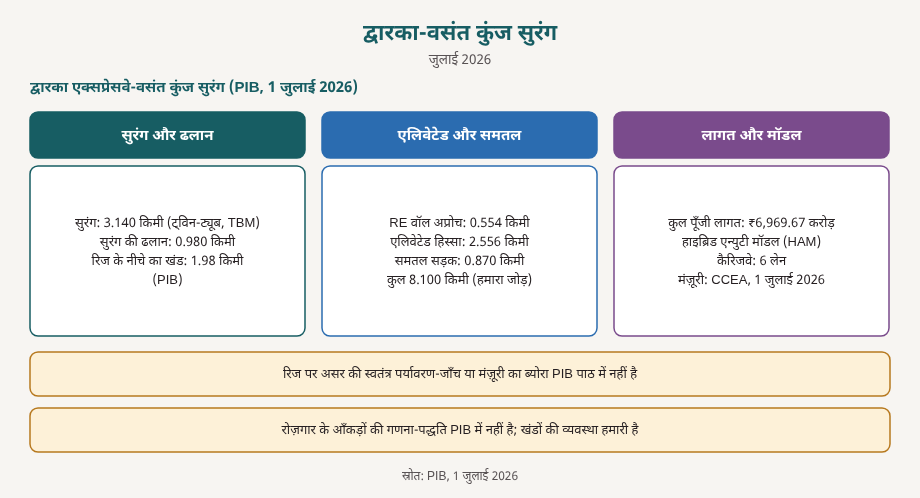
Per PIB, the Cabinet Committee on Economic Affairs (CCEA) on 1 July 2026 approved a 6-lane road tunnel on NH-148AE connecting the Dwarka Expressway (NH 248 BB) to Nelson Mandela Marg in Vasant Kunj, on the Hybrid Annuity Model (HAM). Total project length is stated as 8.1 km and total capital cost as Rs 6,969.67 crore.
Core Concept: Twin-Tube Tunnel and TBM
Per PIB the tunnel is "twin-tube" and will be built with a Tunnel Boring Machine (TBM): two separate tubes, bored underground by machine, causing less surface disruption. Per the release, a 1.98 km tunnel section passes under the Southern Ridge forest. The release carries no independent environmental assessment or clearance details regarding the Ridge's impact.
Key Facts and Figures
| Project form | Per PIB the total project length is 8.1 km, of which the main carriageway is 6.3 km. The remaining part connects with the proposed flyover and elevated U-turn besides the tunnel. The tunnel starts from the Shiv Murti interchange and ends before the Nelson Mandela Marg and Mehrauli-Chhatarpur Road junction. |
|---|---|
| Section-wise length | Per the release, of 8.100 km: 3.140 km tunnel, 0.980 km tunnel approach ramps, 0.554 km RE-wall approach, 2.556 km elevated portion and 0.870 km at-grade road. Our addition comes to 8.100 km. |
| Additional structures | A 1.8 km elevated road on Nelson Mandela Marg, an additional flyover near the existing Chhatarpur-to-Mehrauli flyover, and an elevated U-turn for traffic turning right towards Chhatarpur are proposed. |
| The government's case | Per PIB the project will give faster connectivity between west and south Delhi and benefit traffic from Gurugram, Dwarka, IGI airport and west Delhi towards south Delhi. This is the government's claim. |
| A further proposal | Per the release, NHAI is also proposing an elevated corridor between AIIMS and Mahipalpur that will connect this tunnel to the Barapullah elevated road. This is a proposal, not part of the approved project. |
| Employment estimate | Per PIB, national-highway development averages 264 person-days per day of direct and 55 indirect employment per lane-km, and the project is estimated to generate about 7.54 lakh direct and 9.80 lakh indirect person-days. We could not reproduce these totals directly from these rates (see below). |
How to Read the Project
The environment argument: the release says an underground twin-tube tunnel reduces surface disruption and preserves the Southern Ridge forest. Our reading: this is a construction-method argument. The release says nothing about the effects of under-Ridge excavation, groundwater, vibration and construction sites (shafts, spoil).
The HAM model: our general understanding: in HAM the government pays part of the construction cost during construction and the private developer bears the rest. The government's share ratio, toll arrangement or concession period is not given in PIB.
The employment figures: our calculation: if all 8.1 km is taken as 6 lanes (our simple assumption), lane-km is 8.1 x 6 = 48.6. Multiplying 264 per lane-km by that gives about 12,830, far below 7.54 lakh. Similarly 9.80 / 7.54 is about 1.30, while 55 / 264 is about 0.21. The release does not state the computation method (such as how many days were counted), so we made no correction of our own and kept these figures as government estimates.
Urban and Federal Aspects
Traffic in Delhi: the government's case is reducing west-south Delhi congestion. Our interpretation: new roads also raise the induced-demand question of attracting additional traffic. PIB has no traffic forecast or congestion-reduction figure.
The NH(O) scheme: per PIB the project is under the "NH (O)" scheme. We have not read this scheme's terms.
Challenges and What We Have Not Read
What we have not read: we read one PIB release (1 July 2026) in full. Environmental or forest clearance, the Ridge Management Board's role, tender documents and post-approval progress we have not read from the issuing institution's sources.
Estimate vs outcome: the claims on employment, travel convenience and Ridge preservation are government statements and estimates.
Duplication: the PIB page shows the text printed twice. We counted the facts once.
The Road Ahead
Read this article as the position of the 1 July 2026 PIB release. Conclusions may change as environmental clearance, tender and construction progress arrive.
Distinction of Concepts
Keep four things separate: (1) the official facts of approval and cost; (2) the government's estimates and claims; (3) our interpretations and calculations; and (4) what we have not verified.
Mains View
GS-III: infrastructure, environment, urban transport; GS-II: government policies. In answers, write both the tunnel's benefits and the risks in an environmentally sensitive area like the Ridge.
UPSC CSE Mains Style: Core Practice Question
Underground tunnels are being proposed to expand urban road capacity in Delhi. Discuss the trade-offs of routing such projects beneath the Ridge forests, with reference to the Dwarka Expressway-Vasant Kunj tunnel.
(Answer in 150 words) | 10 marks
Outline of the Answer
Introduction: the 1 July 2026 CCEA approval (8.1 km, Rs 6,969.67 crore, HAM). Main body: surface-space savings vs excavation, groundwater and vibration risks; the release's silence on environmental assessment; induced demand; employment-figure caveats. Conclusion: benefits and risks together, pending clearances.
Sources
- https://www.pib.gov.in/PressReleasePage.aspx?PRID=2279818&lang=1®=3 - PIB, approval of the Dwarka Expressway-Vasant Kunj 6-lane road tunnel (1 July 2026)
Download this article: PDF (English)