
Update of 16 November 2026: Relief for voters left out of the SIR - the ECI told the Supreme Court in a joint affidavit on 14 November (CEC Gyanesh Kumar, ECs Sukhbir Singh Sandhu and Vivek Joshi): (1) left-out ASDD (Absent, Shifted, Dead, Duplicate) voters can now submit enumeration forms for their current ordinary residence, under 6 November directions to state/UT CEOs (following the 28 October Delhi SIR hearing). (2) Same-residence electors file with Annexure-B; those relocated within a state file Annexure-C with address proof - no Form-8 needed; submissions in person to ERO/AERO/BLO or online with e-sign via ECINET. (3) Booth-wise lists of deleted electors will be displayed afresh with reasons; EROs will process under Rule 21(1) of the Registration of Electors Rules, 1960 and the original EPIC number will be re-assigned. (4) Form-6 clarification (3 November): those who already filed Form-6 during the SIR need no fresh form, and no prosecution will follow merely because a name appeared in an earlier roll, provided the person is not enrolled elsewhere.
Additional verified details: According to the same news report, electors at the same residence can also submit enumeration forms through family members. Electors relocated within a state may also use the "book a call with BLO" facility to get enrolled.
The report also says that, after a new Deputy Election Commissioner joined on 2 November, a 4 November work-allocation order assigned oversight of the IT/ICT division to a Senior DEC. The Commission said the division has always been supervised by a DEC, with the Director General (IT) routing its files through the Senior DEC before the Commission.
Source: https://indianexpress.com/article/legal-news/eci-tells-supreme-court-left-out-voters-sir-states-submit-enumeration-forms-10963864/ (news report - affidavit details as reported)
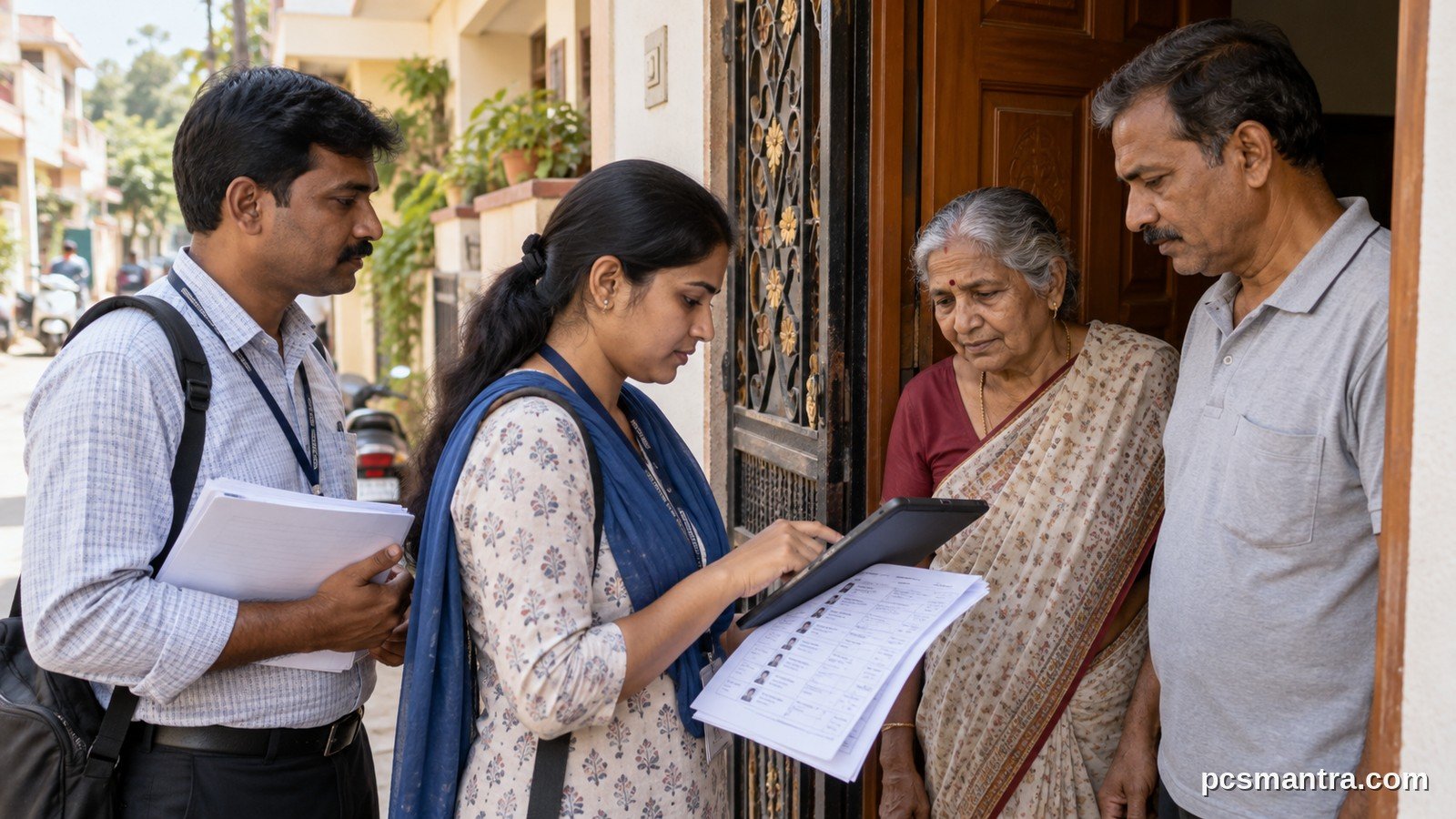
Original symbolic illustration: pcsmantra.com
Why in the news
According to an Indian Express report of 26 October 2026, the Election Commission of India (ECI) told the Supreme Court in an affidavit that the Special Intensive Revision (SIR) orders are legal and were issued with the unanimous decision of all three members of the Commission. The affidavit responds to petitioner Rakesh Kumar Singh's plea. Per The Tribune, the Supreme Court on 27 October gave petitioners 10 days to file a rejoinder to the Commission's affidavit. These are the Commission's claims, not findings of the court. The matter is pending.
What the Commission said in the affidavit
| Issue | Per the Commission's affidavit (as reported) |
|---|---|
| SIR orders | All three orders of 24.06.2025, 27.10.2025 and 14.05.2026 were issued per unanimous decisions of the Commission |
| Form 6 | Talk of amending Form 6 is 'misleading'; only the Central government can change it. Only the additional declaration attached to it gained the 'mapping' concept |
| Purpose of the declaration | To link the applicant's details to the previous SIR roll of 2002/2003, reducing the need for separate documents during the claims-objections period |
| Online applications | The Commission conceded the online display could have appeared as if Form 6 itself was changed; since 21 October 2026 the online process is split into two separate parts - Form 6 and the SIR declaration |
| ECINet | An entry in the electoral roll is added, deleted or modified only on the order of the Electoral Registration Officer (ERO) |
The Commission's stand on internal differences
Per the report, the Commission admitted that two Election Commissioners had separately written to the Cabinet Secretary about an internal work-allocation order and the conduct of a senior deputy election commissioner. Per the affidavit, that order was 'never implemented'. The Commission said suggestions, questions and notes by individual members are a normal part of decision-making and do not constitute the Commission's decisions. It also said law prefers institutional decisions to be unanimous, but on some occasions decisions may also be by majority.
Background of the original news and the road ahead
Per the report, this affidavit followed a 23 September Indian Express report that referred to file notings by two Election Commissioners on the SIR process. Per The Tribune, the Commission also argued the petition was not maintainable because it rested only on news reports. The court also sought the Commission's response on another petition alleging that Form 6 was changed during the Bihar SIR without the court's permission. Per The Tribune, the court had earlier said it had not ruled on the new Form 6 in the Bihar SIR matters. The petitioners' allegations have been called 'misleading' by the Commission, and the final decision rests with the court.
The 28 October hearing: oral remarks as reported
Per 28 October 2026 reports by LiveLaw, The Hindu and Supreme Court Observer, a bench of Chief Justice Surya Kant, Justice Joymalya Bagchi and Justice V. Mohana heard petitions related to the Delhi SIR. These reports cover oral courtroom remarks. All three clearly state the hearing date as 28 October (Wednesday). We could not obtain a written order of this hearing, so these oral remarks are not presented as written directions. The petitioners (Anjali Bhardwaj and Amrita Johri, per The Hindu) are reported as distinct from the 27 October affidavit case (Rakesh Kumar Singh); the reports do not treat the two hearings as the same matter.
| Issue | What was reportedly said |
| 'Logical Discrepancy' (LD) category | Justice Bagchi said the court has not finally decided the validity of this category. In West Bengal it was allowed as an 'interim arrangement'. The Bihar decision is no precedent on this, as the category was not used there. |
| Voters of the 2003 roll | The bench asked how a person on the 2003 roll could now be placed in the LD category, and whether pattern-based work of this kind involves the application of human discretion. This is a question, not a decision. |
| Form 6 and Form 8 | Per the reports, the bench asked why a voter already on the roll who has merely changed address should file Form 6. Per The Hindu, Justice Bagchi said Forms 6, 7 and 8 cannot be altered. Per Supreme Court Observer, the bench asked the Commission to publicly clarify that Forms 6 and 8 are available, and to publish the names and previous entries of voters who did not respond. |
| Parties' figures | Citing petitioners' counsel Prashant Bhushan: of roughly 1.45 crore voters in Delhi, about 47 lakh did not return enumeration forms (47,56,722 per The Hindu, including absent, shifted, dead and duplicate entries). Per Supreme Court Observer, 43 lakh of these are in the permanently shifted or absent category. About 19.34 lakh LD cases were cited (Supreme Court Observer). Citing Commission counsel D.S. Naidu, LiveLaw reported 95% of LD cases have been restored. These are the parties' claims; we have not independently verified them. |
| Next hearing | Per Supreme Court Observer, the matter is listed after two weeks. |
The 3 November development: the Commission's clarification on Form 6
Per Akashvani and The Hindu reports of 3 November 2026, the Election Commission clarified to the Chief Electoral Officers of states and Union Territories that if an existing voter's name is missing from the SIR draft roll, the person may submit Form 6 for inclusion. Merely on the basis of having been enrolled in a previous roll and now filing Form 6, the application should not be treated as a false declaration inviting action under Section 31 of the Representation of the People Act, 1950.
The conditions matter: the person must not already be enrolled in any other parliamentary or assembly constituency, and the declaration must otherwise be lawful. This is neither an exemption for all false declarations nor automatic approval of all applications. Per the Commission, applications will be examined under law.
Per Akashvani, the Commission also asked for wide publicity of this clarification in local languages. A signed copy of the original letter was not obtained for this update; the account is therefore expressly based on news reports. The Hindu report carries an inconsistent mention of the weekday and date; no definite day of issue is asserted here. The publication context of the news is 3 November.
The difference between Form 6, Form 7 and Form 8
- Form 6: application for inclusion of a name in the electoral roll. The current official form carries declarations of first-time inclusion and of not being enrolled in any other constituency. The recent clarification on re-application by existing voters relates to concerns about this declaration.
- Form 7: objection to a proposed inclusion, or application for deletion of a name from the existing roll. A name is not automatically removed the moment an objection is filed; the concerned officer must decide under the applicable procedure.
- Form 8: for shifting residence, correcting an existing entry, replacing the EPIC or marking disability status. It should not be described as a substitute for fresh inclusion in every situation.
Legal safeguards and liability
Sections 17-18 of the Representation of the People Act, 1950 bar registration in more than one constituency and more than once in the same constituency. Section 19 sets the conditions of age and ordinary residence; other statutory disqualifications also apply. Under Section 20, mere temporary absence does not end ordinary residence.
Section 22 concerns correction of entries, transposition and deletion of names, and requires due verification and an opportunity of hearing where applicable. Section 23 concerns inclusion of names. The administrative convenience of roll revision cannot be substituted for these statutory conditions.
Section 31: a written declaration connected to preparing, revising or correcting a roll, or to including or deleting a name, can be punishable if the person knows or believes it to be false or does not believe it to be true. The penalty is imprisonment up to one year, a fine, or both. A prior registration history and a deliberately false declaration are not the same thing.
Keep the court's word and the Commission's stand separate
In the 14 October 2026 order in Nilotpal Datta v. ECI, W.P.(C) 14955/2026 - read from a copy hosted on LiveLaw - the Delhi High Court found unfounded the apprehension of false declaration among petitioners whom the Commission's counsel had advised to file Form 6. Closing the proceedings, the court said they may file Form 6, which would be examined under law. This is neither automatic restoration of names nor a final ruling on every SIR question. The copy was not obtained from the court's own website, so its hosting source is stated separately.
By contrast, the questions raised in the 28 October Delhi SIR hearing on Form 6, Form 8, late enumeration forms and the 'logical discrepancy' category are reported above as news reports. An oral remark, a petitioner's claim, the Commission's affidavit, an administrative clarification and a signed judicial order are different levels of evidence. In this update, oral remarks have not been turned into final written orders.
Key points for the exam
- SIR is a Special Intensive Revision; a valid Form 6 application and the SIR's additional declaration can be separate documents. This stand of the Commission is no substitute for the court's final conclusion.
- The forms for inclusion, objection/deletion and address change are distinct.
- Absence of mapping to a previous roll, temporary absence and loss of eligibility are not automatically equivalent.
- The reported clarification on re-application by already-registered voters is conditional - not a broad immunity from penalty.
Quiz: Test your knowledge
Q1: Consider the following statements on voter-registration forms: Statement 1: Form 6 is the application for inclusion of a name in the electoral roll. Statement 2: Form 7 is for objection to a proposed inclusion or for deletion of a name from the existing roll. Statement 3: The sole purpose of Form 8 is to add a new voter's name. Which of the above are correct?
(a) 1 and 3 only
(b) 1 and 2 only
(c) 2 and 3 only
(d) 1, 2 and 3
Answer and explanation: (b) The official Form 8 is for shifting residence, correcting an entry, replacing the EPIC and marking disability status. The general application for fresh inclusion is Form 6.
Q2: Consider the following statements on the ECI clarification described in the 3 November reports: Statement 1: A re-application does not become a false declaration by itself merely because the person was on a previous roll and now files Form 6. Statement 2: This ends the application of Section 31 to all false declarations. Statement 3: The conditions of not being already enrolled in another constituency and of an otherwise lawful declaration apply. Which of the above are correct?
(a) 1 and 2 only
(b) 2 and 3 only
(c) 1 and 3 only
(d) 1, 2 and 3
Answer and explanation: (c) The clarification addresses the concern of conditional re-application. It does not repeal Section 31, gives no exemption for wilful false declarations, and is not an order for automatic inclusion.
Q3: Consider the following statements on the Representation of the People Act, 1950: Statement 1: Sections 17-18 bar registration in more than one constituency and more than once in the same constituency. Statement 2: Under Section 20, mere temporary absence does not end ordinary residence. Statement 3: Once a Form 7 is filed, the name is automatically deleted without inquiry by the Electoral Registration Officer. Which of the above are correct?
(a) 1 and 3 only
(b) 1 and 2 only
(c) 2 and 3 only
(d) 1, 2 and 3
Answer and explanation: (b) Sections 17-18 prevent double registration, and Section 20 separates temporary absence from ordinary residence. An objection is not a final order by itself; deletion requires the applicable legal process and the officer's decision.
Sources:
- https://newsonair.gov.in/eci-clarifies-previously-enrolled-voters-can-submit-form-6-if-names-missing-in-draft-electoral-rolls/ (Akashvani, 3 November 2026)
- https://www.thehindu.com/news/national/no-action-against-voters-seeking-re-enrolment-through-form-6-eci/article71661780.ece (The Hindu, 3 November 2026)
- https://voters.eci.gov.in/formspdf/Form_6_English.pdf (ECI official Form 6)
- https://voters.eci.gov.in/formspdf/Form_7_English.pdf (ECI official Form 7)
- https://voters.eci.gov.in/formspdf/Form_8_English.pdf (ECI official Form 8)
- https://upload.indiacode.nic.in/showfile?actid=AC_CEN_3_20_00016_195043_1517807321506&filename=a1950-43.pdf&type=actfile (India Code: Representation of the People Act, 1950)
- https://www.livelaw.in/pdf_upload/2026/10/16/3-706943.pdf (Delhi High Court order of 14 October 2026, copy hosted on LiveLaw)
- https://indianexpress.com/article/india/eci-supreme-court-affidavit-special-intensive-revision-sir-gyanesh-kumar-sukhbir-singh-sandhu-vivek-joshi-form-6-indian-express-report-10937935/ (The Indian Express)
- https://www.tribuneindia.com/news/india/sc-grants-10-days-to-petitioners-to-reply-to-election-commission-affidavit-defending-sir/ (The Tribune)
- https://www.livelaw.in/top-stories/logical-discrepancy-category-allowed-in-bengal-sir-as-interim-arrangement-its-legality-yet-to-be-decided-supreme-court-556338 (LiveLaw)
- https://www.thehindu.com/news/national/can-you-punish-laxity-by-forfeiting-the-right-to-vote-forever-supreme-court-asks-eci/article71636264.ece (The Hindu)
- https://www.scobserver.in/reports/delhi-sir-sc-says-legality-of-logical-discrepancy-remains-undecided/ (Supreme Court Observer)
- https://indianexpress.com/article/legal-news/eci-tells-supreme-court-left-out-voters-sir-states-submit-enumeration-forms-10963864/ (Indian Express, 15 November 2026 - 16 November update block)
The original affidavit, a signed order of the 28 October hearing and the original copy of the recent ECI letter were not obtained for this article. In those parts, the parties' claims and reported oral remarks are presented as such. The law and forms were checked from official sources. The 14 October order was read from a copy hosted on LiveLaw, not from the court's website. News position as of 3 November 2026; article updated 4 November 2026; further update 16 November 2026.
Download this article: PDF (English)