
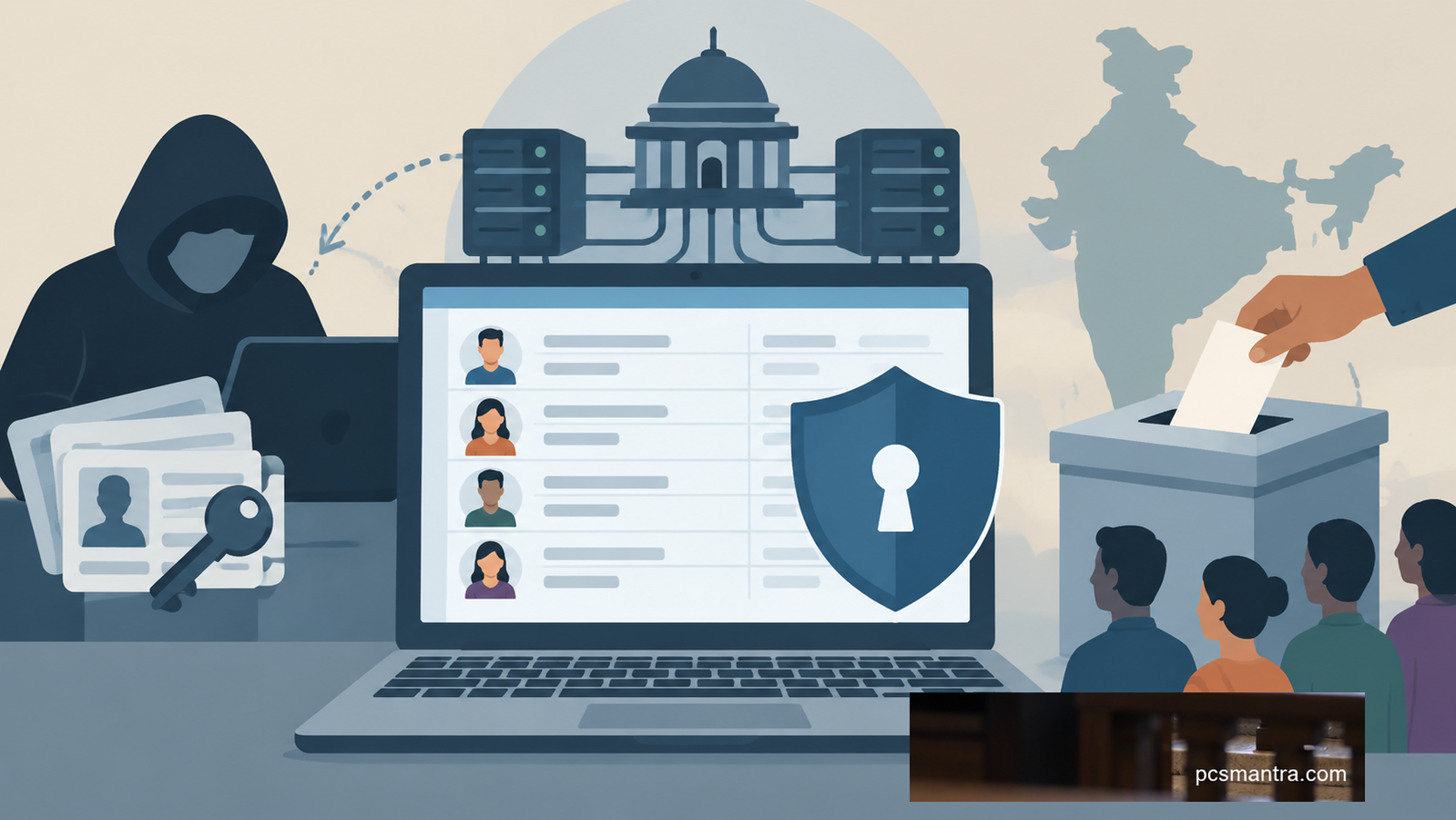
Original symbolic image: pcsmantra.com
Why in the News
Uttar Pradesh Chief Electoral Officer Navdeep Rinwa on 1 November 2026 ordered the statewide deactivation of some ECINET login IDs of data operators after complaints of alleged misuse of voter-registration credentials in Pilibhit. The inquiry found that a computer assistant had allegedly entered 13,779 Form-8 applications (changes in voter details), of which 10,470 were accepted and 3,309 rejected - and the related application forms or supporting documents were not found in the office. This action is one chapter of the larger continuing dispute over the security defences of ECINET - the Election Commission's integrated digital platform: security researchers had recorded the platform's flaws with CERT-In in July (made public in October); according to The Hindu's report, states' access to the platform can be switched on and off from the central level; and the Congress accused the Commission of "centralising" voter-list changes and cornered it over not sharing software details (25 October).
The new 4 November order: senior officer to oversee the IT Director General
Date: 4 November 2026 | Update published: 7 November 2026
In the work-allocation order of 4 November 2026, the Election Commission gave charge of IT/ICT to Senior Deputy Election Commissioner Pawan Kumar Sharma. According to the report, the related files of the IT Director General will now reach the Commission through him. This is a development that clarifies the reporting and supervision arrangement in IT administration.
There had earlier been a controversy over the July order. The Commission's position is that the 28 July order never came into effect after the 30 July decision, and the IT Director General has always worked through an officer of the rank of Deputy Election Commissioner. So it is more accurate to call this an explicit reaffirmation of oversight; according to the Commission, oversight was never removed.
Meaning for the exam: The trustworthiness of a digital election system does not depend only on software security. The authority to decide, the hierarchy, access to files and the responsibility for review must also be clear. This administrative order is not proof that all technical shortcomings of ECINet have been resolved or that any judicial dispute has been settled.
Sources for this update
Background
ECINET is an ECI platform that brings voter services into one app. The main points of the controversy: (1) security flaws recorded with CERT-In in July 2026; (2) the central switch over state access - the question of federal balance in the election process; (3) transparency - the allegation that the Commission is not giving software details; (4) the platform's parallel use alongside the SIR (Special Intensive Revision). Technically, the issue is one of access control, audit logs and credential management - the Pilibhit episode became a practical example of exactly this weakness.
Exam Perspective
Mains (GS-II): security versus access in election technology; institutional transparency; centralisation risks in digital infrastructure; CERT-In's role (Section 70B of the IT Act).
Prelims: ECINET, CERT-In, ECI's constitutional position (Article 324).
Mains Practice Question
"Digitisation of the election process increases efficiency, but centralised access control creates new vulnerabilities." Comment with reference to the ECINET controversy. (Answer in 250 words. 15 marks)
Answer Outline
Introduction: The essence of the Pilibhit action - statewide deactivation of IDs over credential misuse; the background of the ECINET controversy (CERT-In flaws, central switch, transparency).
Main Body: The efficiency side: service access through an integrated platform, a single source of truth, process speed. The vulnerability side: weak credential management (13,779 entries), the federal-balance question arising from the central on-off capability, and the lack of audit trails and transparency. The way: least-privilege access, tamper-proof audit logs, independent security audits (CERT-In's 70B role), limited sharing of software details and judicial/parliamentary scrutiny.
Conclusion: The legitimacy of a digital election framework rests on both technical security and institutional transparency; reactive deactivation alone is not enough.
Prelims Practice Questions
Question 1. With reference to the Election Commission of India, consider the following statements:
Statement-I: Article 324 vests the superintendence, direction and control of elections in the Election Commission.
Statement-II: CERT-In is the national incident-response agency designated under Section 70B of the Information Technology Act.
Which of the above statements is/are correct?
(a) Both Statement-I and Statement-II are correct
(b) Statement-I is correct, but Statement-II is not correct
(c) Statement-I is not correct, but Statement-II is correct
(d) Neither Statement-I nor Statement-II is correct
Answer and explanation
Answer: (a) - Article 324 gives the ECI superintendence/direction/control of elections; CERT-In is the national cyber incident-response agency designated under Section 70B of the IT Act.
Question 2. With reference to the Pilibhit-related action of 1 November 2026, which statement is correct?
(a) The UP CEO ordered the deactivation of some ECINET login IDs across the state
(b) The Election Commission shut down the ECINET platform completely
(c) The inquiry found no evidence of credential misuse
(d) The action remained confined within a single district
Answer and explanation
Answer: (a) - UP CEO Navdeep Rinwa ordered the statewide deactivation of some ECINET IDs of data operators after complaints in Pilibhit; the inquiry revealed 13,779 Form-8 entries (10,470 accepted) by a computer assistant.
Sources
- Economic Times (PTI): UP CEO's order to deactivate ECINET IDs (1 November 2026)
- NDTV: ECINET flaws recorded with CERT-In earlier (8 October 2026)
- The Hindu: central switch over state access on ECINET (20 October 2026)
- The Hindu: Congress allegations on ECINET software details (25 October 2026)
Note: The allegations in the Pilibhit inquiry are still at the investigation stage; allegations have been kept separate from established facts.
