
Economy, labour and social security | News context: 21 July 2026 | Published: 17 October 2026
The Employees' Provident Fund Organisation (EPFO), in its 3.0 reform phase, is preparing a universal contributory pension scheme - with a proposal to reach unorganised, gig and platform workers. According to major reports of July 2026 and follow-up reporting of September 2026, the Labour Ministry has prepared a concept note; the detailed framework is still being built.
Why in the News
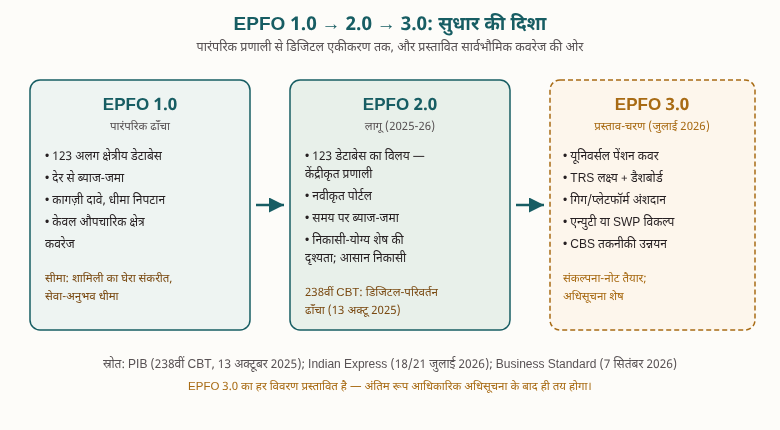
The Indian Express (18 July 2026), citing senior officials, revealed that the government is building a new contributory pension scheme under the EPFO for both unorganised and formal sector workers, whose core will be a "Target Retirement Sum" (TRS). According to the 21 July analysis, EPFO 3.0 has three pillars: pension cover for all workers (with an annuity or systematic withdrawal option), first-time social-security contribution for unorganised/gig/platform workers, and a technical upgrade based on a Core Banking Solution (CBS). According to Business Standard (7 September 2026), the Labour Ministry has prepared the concept note and work on the detailed framework is on. Note: as checked on 17 October 2026, no official notification/document of this scheme was found in available sources - this is a proposal-stage scheme, not an implemented one.
TRS: What Is the 'Target Retirement Sum'?
The Target Retirement Sum (TRS) is a retirement-goal system: the member will set a target corpus based on age, retirement age and desired pension, and the system will show an estimate of the contribution required to reach that target - progress will also show on a dashboard. At age 60 the accumulated corpus could be converted into a pension at the annuity/interest rates of that time, or kept with the EPFO and drawn through systematic withdrawal. The accumulation phase will be like the existing EPFO model: annual interest and similar tax treatment; contribution frequency flexible (a fixed amount every month not mandatory).
Key Facts
- Goal of universal coverage: over 60 crore workers, more than three-fourths of them in the unorganised sector - including existing EPFO members as well as those left out of EPS; first-time contribution-based coverage for gig/platform workers.
- Multi-source contribution: not only the worker - employer, government co-contribution for low-income groups, gig/platform aggregators, CSR programmes, NGOs and other third parties could also contribute to the account; a voluntary contribution option is also under consideration.
- Defined contribution (DC) framework: unlike EPS's defined-benefit system (pensionable salary + service period) - this would be a defined-contribution model: deposits + interest = corpus, then annuity or systematic withdrawal at 60.
- Flexible withdrawal: the proposal includes the facility to reduce or increase pension after retirement: more withdrawal in early years, less later - the remaining corpus keeps earning interest.
- EPFO 2.0's foundation ready: in the past year EPFO 2.0 merged 123 regional databases into a centralised system - timely interest credit and visibility of withdrawable balance; 3.0's CBS upgrade will stand on this.
- Official foundation: the 238th CBT: the 13 October 2025 Central Board of Trustees meeting (PIB) approved the member-centric digital transformation framework under 'EPFO 3.0'; 13 partial-withdrawal provisions merged into one rule, 100% eligible-balance withdrawal, minimum service 12 months; the 'Vishwas scheme' (reducing penalty-damages litigation) and EPFO-IPPB doorstep life certificates too.
Why This Proposal Matters
- The biggest gap in social security: three-fourths of India's 60 crore+ workers are unorganised - outside old-age income security. A universal contributory framework would be the first major institutional attempt to fill this structural gap.
- Formalisation of the gig economy: the aggregator-contribution proposal includes platform work in social-security responsibility - giving the spirit of the labour codes (Code on Social Security 2020) a fund-based mechanism.
- Learning from the NPS experience: the defined-contribution debate has run with the NPS; TRS + flexible withdrawal + EPFO-interest model is a hybrid path of "government-backed accumulation" - an attempt to balance market risk and the demand for guarantees.
- Technical capacity a precondition: the merger of 123 databases (EPFO 2.0) shows scale preparation began with technology - running 60 crore accounts on CBS will be among India's biggest financial-technology challenges.
Analysis and the Road Ahead
Three open questions. First, financial viability: the size and source of government co-contribution for low-income workers is undecided - without adequate co-contribution, regular contribution from an unorganised worker's irregular income is hard; the question of linkage and overlap with the Atal Pension Yojana's experience too. Second, annuity risk: conversion at 60 depends on the annuity rates of that time - in a long period of low rates, pension adequacy will remain in crisis; flexible withdrawal also brings longevity risk. Third, administrative load: for aggregator contribution, the platform economy's registration chain, linkage with the e-Shram database and payment rails will have to be built. Monitoring indicators: progress from concept note to notification, budgetary provision for co-contribution, pilot-coverage numbers, decisions of the next CBT meeting.
Distinction of Concepts
Proposal stage vs implemented scheme: the July-September 2026 reports describe a design-stage scheme - as checked on 17 October 2026 no notification/official scheme document was found in available sources; for the final position treat only the Labour Ministry/EPFO's official announcement as evidence. EPS vs the proposed scheme: EPS is defined-benefit (salary+service-based monthly pension); the proposal is defined-contribution (annuity/SWP from the TRS corpus) - the benefit arithmetic and risk of the two differ. EPFO 3.0 pension proposal vs the Rs 25,000 wage-ceiling notification (September 2026): the wage ceiling is an expansion of existing EPF/EPS coverage (implemented); the universal pension is a new structure (proposed) - two separate events.
Mains View
GS-II: social security, the welfare state, unorganised-sector policy. GS-III: labour reform, the gig economy, financial inclusion, pension reform, digital public infrastructure. GS-IV: social justice, the ethics of old-age security. Essay: from work to dignity - the right to security.
UPSC CSE Mains Style: Core Practice Question
EPFO 3.0's proposed universal pension framework is based on 'defined contribution' and 'multi-source funding'. Evaluate its potential to bring unorganised and gig workers within old-age income security, along with the design challenges.
(Answer in 150 words) | 10 marks
Outline of the Answer
Introduction: the coverage gap and the EPFO 3.0 proposal (concept-note stage). Main body: potential - universal coverage, aggregator contribution, TRS transparency, CBS foundation; challenges - co-contribution financing, irregular incomes, annuity/longevity risk, administrative chain, overlap with APY/NPS. Conclusion: notification, pilot and financing decisions will decide; a proposal is not a scheme.
Frequently Asked Questions (FAQ)
Short answer: EPFO 3.0's universal pension idea is a contributory pension proposal. The article describes it as a proposal-stage arrangement, not an implemented scheme.
Question: Has EPFO's universal pension scheme been implemented?
According to the article it is a proposal-stage scheme, not an implemented one. The concept note is ready and work on the detailed framework is on.
Question: Which workers does the proposed pension scheme seek to reach?
Its proposal is for workers of both the formal and unorganised sectors. Reaching gig and platform workers is also included.
Question: What technical and pension options are stated for EPFO 3.0?
The pension cover mentions an annuity or systematic withdrawal option. The technical upgrade is stated to be based on a Core Banking Solution.
Also read: EPFO's Raised Wage Ceiling: Expanding Social Security.
Download this article: PDF (English)