
News context: 2026-11-17 | Publication: 17 November 2026 Mains: GS-III: Space technology; GS-II: Institutional coordination Prelims: concepts and statement-based practice
Why in the News
An explainer on 17 November 2026 has focused attention on astronaut selection and training for Gaganyaan. Human spaceflight needs more than a rocket and capsule: physical fitness, psychological stability and readiness to make decisions in emergencies also matter. This is not an announcement of a new launch or test completed today.
Why select test pilots?
ISRO says trainees for Gaganyaan's first crewed mission were selected from a pool of test pilots. ISRO and the Indian Air Force jointly defined the criteria, including flying experience, fitness, psychological assessment and aeromedical evaluation.
Aeromedical evaluation considers health and physical suitability for flight conditions. It includes body measurements, or anthropometric parameters. General good health or academic qualifications alone do not replace the complete selection process.
Test pilots evaluate the behaviour of new and experimental aircraft. The 17 November explainer highlights the relevance of decision-making under pressure and useful feedback to engineers. This does not mean that only military pilots can participate in every future space mission.
Training goes beyond classroom teaching
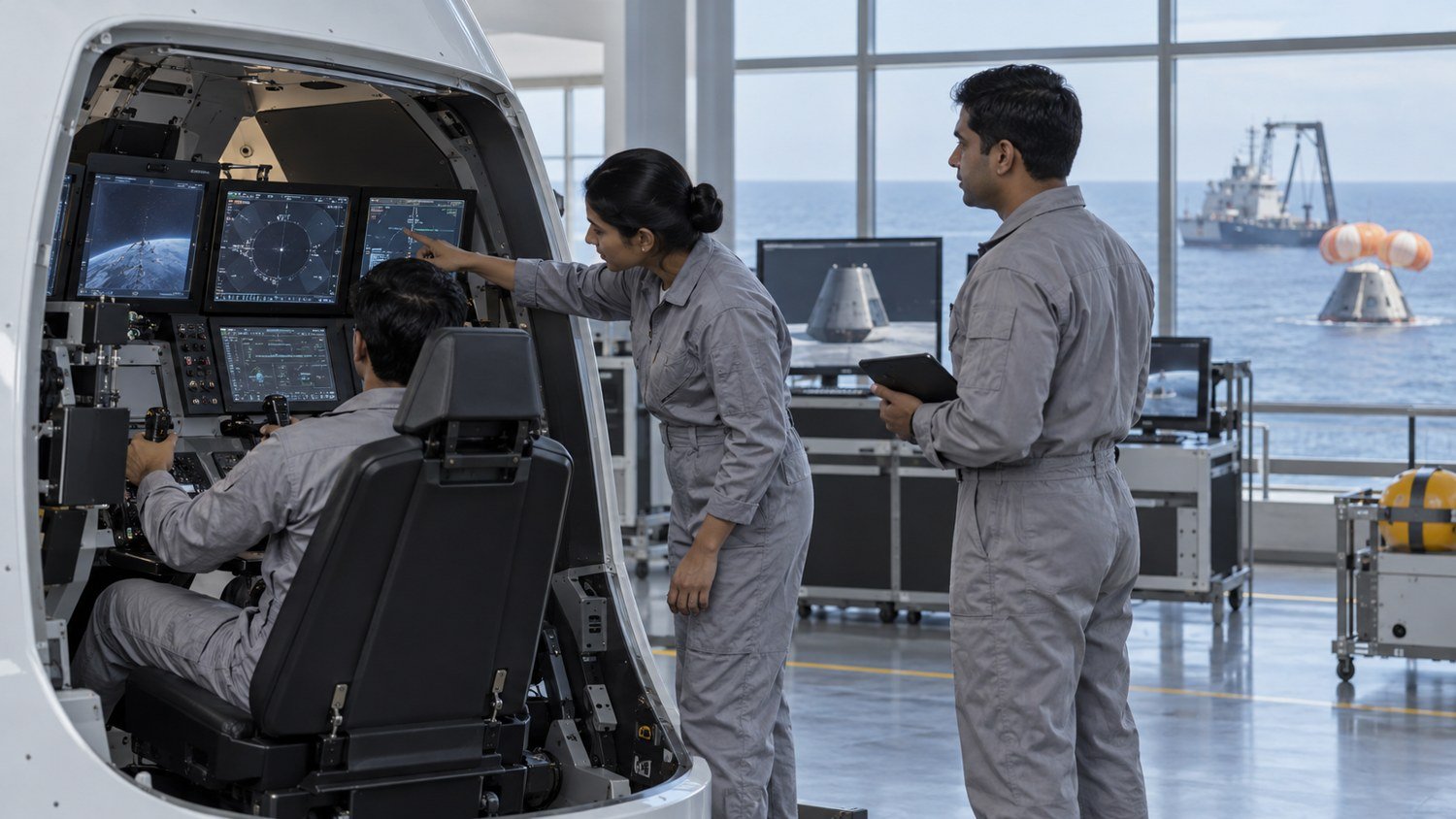
ISRO's published mission-specific curriculum covers the human-rated launch vehicle, orbital-module systems, space medicine, launch-complex procedures, microgravity familiarisation, recovery and survival training. An inter-agency team involving DRDO, the Air Force and ISRO developed the curriculum requirements.
Normal operations: Crews need to understand the spacecraft and its operating sequence.
Off-nominal situations: They must rehearse prescribed responses to warnings, unexpected system behaviour and emergencies.
Simulators: Virtual reality and static mock-ups allow practice without creating the actual hazard. Simulator proficiency does not eliminate every risk of real flight.
International experience and domestic training
Training abroad offers learning opportunities, but different spacecraft do not have identical procedures. ISRO's release of 28 November 2024 describes the initial US training of Shubhanshu Shukla and Prasanth Balakrishnan Nair for Axiom-4. It included familiarisation with Dragon and ISS systems, communications and medical emergencies. This is a historical training record, not proof of Gaganyaan's flight readiness today.
Safe recovery from the sea is part of the mission
ISRO and the Indian Navy's 2023 recovery-training plan covered specialist forces, parajumpers, medical experts and technical personnel. It envisaged phased training in harbour and open-sea conditions. Astronaut preparation is therefore linked to the readiness of the teams that recover them.
The way forward: human-centred capability
Bioastronautics studies the biological, behavioural and medical aspects of humans living and working in space. Research on selection, training, human-compatible design and mission experience can build long-term Indian capability. Success should be assessed through safe procedures, institutional learning and tested readiness, not merely the number of people trained.
Prelims Practice Questions
Question 1. Consider the following statements about crew preparation for Gaganyaan:
Statement 1: ISRO says selection of trainees for the first crewed mission includes flying experience and psychological evaluation.
Statement 2: Mission-specific training covers normal operations only, not off-nominal situations.
Statement 3: Separate teams also require training for sea recovery of the crew.
Which of the statements given above are correct?
Answer and Explanation
Correct answer: (b)
Statement 1 is correct. ISRO-Air Force criteria include flying experience, psychological assessment and aeromedical evaluation.
Statement 2 is incorrect. ISRO's curriculum covers nominal and off-nominal conditions and emergency escape preparation.
Statement 3 is correct. The Navy-ISRO plan identifies recovery-team roles and phased training.
Mains Practice Question
Crew readiness in Gaganyaan is an institutional capability, not merely an astronaut's personal quality. Examine this statement with reference to selection, training and sea recovery. (150 words) (10 marks)
Answer Outline
Introduction: Explain combined human and technical safety
Main Body: cover test-pilot selection and multi-stage assessment; discuss mission-specific training, simulators and recovery; examine inter-agency and academic coordination
Conclusion: conclude with bioastronautics and institutional learning.
Frequently Asked Questions (FAQ)
Selection involves flying experience, fitness, psychological assessment and aeromedical evaluation. Training combines spacecraft operations, emergencies and safe recovery.
From which group were trainees for the first crewed mission selected?
ISRO says they were selected from test pilots using criteria jointly defined by ISRO and the Air Force.
What is the purpose of a simulator?
It reproduces spacecraft environments and situations for rehearsing normal and emergency procedures. It does not eliminate every risk of real flight.
Why does recovery training involve the Navy?
Safe recovery of the crew module and astronauts from the sea needs coordinated maritime, medical and technical preparation.
Sources
Download this article: PDF