
14 November 2026 update: Rahul Gandhi joins rally; 'Gig Workers Social Security and Welfare Scheme' launched
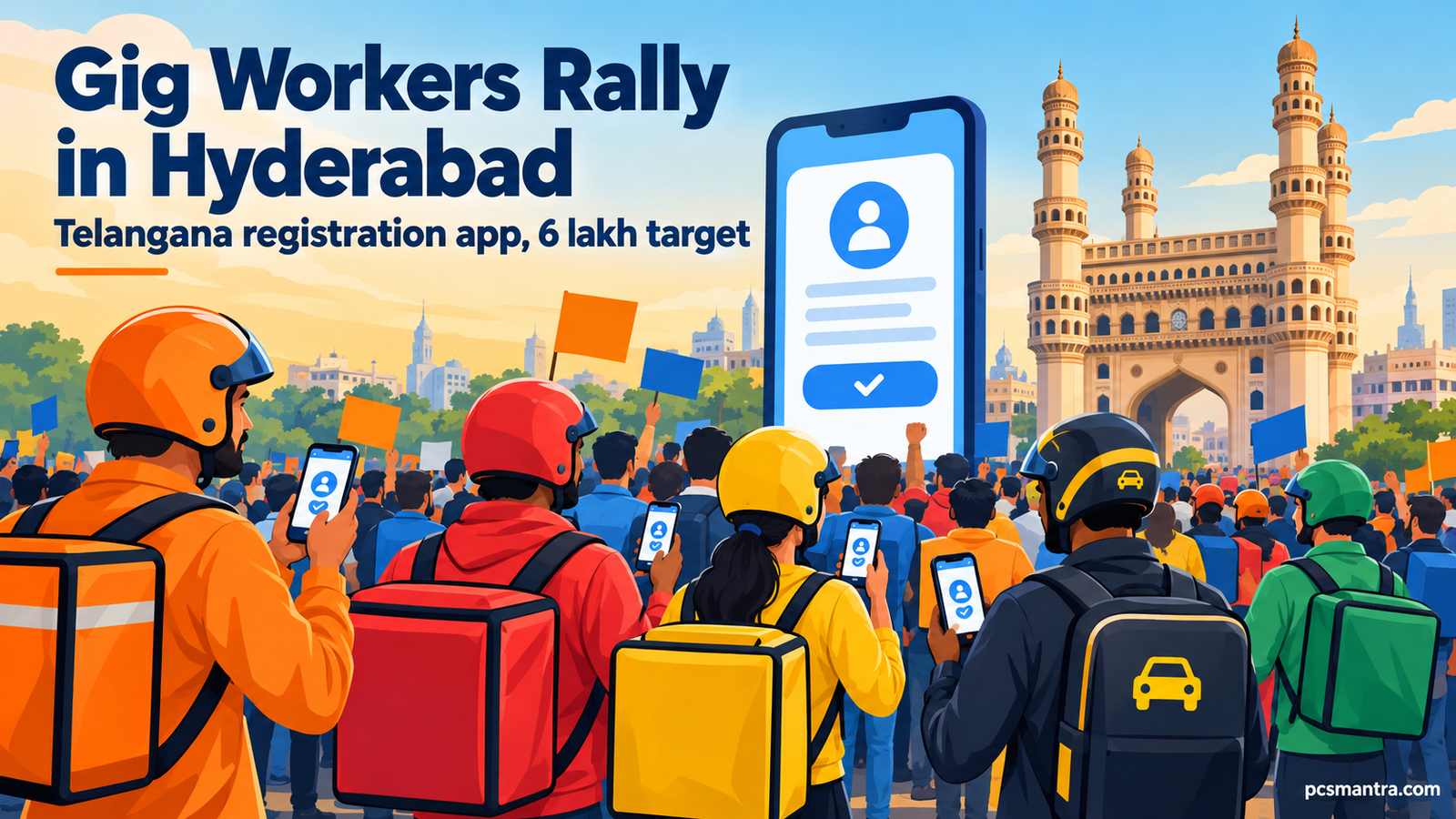
Leader of Opposition in the Lok Sabha Rahul Gandhi and Chief Minister A. Revanth Reddy joined the rally held in Hyderabad on 14 November. During the bike rally, Gandhi was seen riding pillion on a scooter driven by a female gig worker, and Reddy also rode pillion behind another worker. The event saw the launch of the Telangana Gig Workers Social Security and Welfare Scheme, under the Telangana Platform Based Gig Workers (Registration, Social Security and Welfare) Act, 2026, passed in March 2026.
Key announcements: every gig worker to get Rs 5 lakh accident insurance and Rs 10 lakh health insurance; Wi-Fi-enabled rest zones across Hyderabad and all cities of the state; and the right to access complete data on one's work, completed rides and payments on mobile phones. Under the Act, an aggregator can remove a worker only for valid reasons, in writing and with at least seven days' notice; timely payments and a safe working environment are also mandatory.
Gandhi said the BJP-RSS want gig workers to work round the clock to benefit billionaires, while the Congress wants to treat them as 'partners, not labourers'. He said the promise made to gig workers by the Congress and the Chief Minister was being fulfilled today.
Source: Dainik Bhaskar (English): Rahul joins bike rally in Hyderabad (14 November 2026)
Why in the news
November 13, 2026: The Telangana Gig and Platform Workers Union (TGPWU) has announced a major rally and strike in Hyderabad on 14 November. The demands are: social security, labour rights and welfare measures. Union office-bearer Shaik Salauddin said that the Leader of the Opposition in the Lok Sabha, Rahul Gandhi, has been invited to join the rally, and welfare-related announcements are possible on the occasion.
The background of the rally is the Telangana Gig and Platform Workers Act, 2026, whose rules are ready and for whose implementation the process of forming a welfare board and a registration app is under way. The state government's target is to register about 6 lakh gig workers.
Who is a gig worker
A gig worker is a person who works outside the traditional employer-employee relationship, in temporary or task-based work - such as app-based delivery, cab driving or freelance services. When the work comes through a digital platform (an app), it is called platform work.
The hallmark of this category is flexibility, and the problem is insecurity: neither a fixed wage nor facilities like the pension and insurance of traditional employees. This very insecurity is the root reason for these workers organising and for laws being made.
Telangana's law and new initiative
The Telangana Gig and Platform Workers Act, 2026 provides a legal framework for labour rights, at the centre of which are:
Mandatory registration: Registration of every gig worker, for which the state government is bringing a dedicated app; the target is about 6 lakh registrations.
Social security benefits: Provision of security schemes for registered workers.
Dedicated welfare board: A board is being formed to monitor workers' interests and implement the schemes.
Grievance redressal mechanism: An arrangement for effective resolution of workers' complaints, in which the app will also play a role.
The law's rules are ready, meaning the implementation stage has begun; the rally is being held to push forward the demands connected with it.
National framework: the Code on Social Security, 2020
At the national level, the Code on Social Security, 2020 recognised gig workers and platform workers in law for the first time. The Code provides for social security schemes for these workers, to which contributions can also be taken from platform companies (aggregators).
The social security board working at the national level is grappling with several practical challenges: tracking the total earnings and work duration of a worker who works on different platforms, calculating contributions, and portable benefits - that is, benefits that stay with the worker even when they move from one platform or city to another.
Challenges
Identification and data: The same worker works on several apps; accurate data is needed for both registration and contribution calculation.
Financing: Fixing the balance of contributions from the state, platforms and workers in the welfare fund is difficult.
Pace of implementation: Despite the law being made and the rules ready, reaching board formation, the app and actual benefits takes time - the rally is also pressure against this delay.
The way ahead
The focus will be on the 14 November rally and the announcements possible there. After that, progress on the formation of the welfare board in Telangana, the launch of the registration app and the target of 6 lakh registrations will need watching. At the national level, solutions for portable benefits and contribution calculation can take direction from Telangana's experience.
Mains practice question
The gig economy has expanded employment opportunities, but it has also brought the problem of workers' social security to the fore. Evaluate the efforts being made at the Centre and state levels in India. (250 words, 15 marks)
Answer outline:
In the introduction: Give the context of the definition of a gig worker and their rising numbers; place the Hyderabad rally as the recent point.
In the body: Explain the insecurity of gig work; place the Code on Social Security 2020's recognition and contribution provision; show Telangana's Act (mandatory registration, welfare board, grievance redressal, the target of 6 lakh registrations and the app) as an example of a state-level effort; state the challenges of portable benefits and data tracking.
In the conclusion: Conclude that for a balance of flexibility and security, timely implementation, platform-independent benefits and workers' participation are essential.
Prelims practice questions
Question 1. Consider the following statements regarding gig workers:
1. Gig workers do task-based work outside the traditional employer-employee relationship
2. In India, gig and platform workers were recognised for the first time in the Code on Social Security, 2020
Which of the above statements is/are correct?
(a) Only 1
(b) Only 2
(c) Both 1 and 2
(d) Neither 1 nor 2
Answer and explanation
Answer: (c)
Statement 1 is correct: Gig workers do temporary, task-based work, such as app-based delivery or cab services.
Statement 2 is correct: The Code on Social Security, 2020 defined gig and platform workers for the first time and opened the way for schemes for them.
Question 2. Consider the following statements regarding the Telangana Gig and Platform Workers Act, 2026:
Statement-I: It provides for mandatory registration of gig workers and a dedicated welfare board
Statement-II: This law has no arrangement for grievance redressal
Choose the correct option with reference to the above statements:
(a) Statement I is correct, but Statement II is wrong
(b) Statement I is wrong, but Statement II is correct
(c) Both Statement I and Statement II are correct
(d) Both Statement I and Statement II are wrong
Answer and explanation
Answer: (a)
Statement-I is correct: The law is centred on mandatory registration, social security benefits and a dedicated welfare board.
Statement-II is wrong: The law also provides for an effective grievance redressal mechanism, for which the registration app will be used.
Question 3. Consider the following statements regarding portable benefits:
1. These are benefits that stay with the worker even when they change platforms or locations
2. Implementing them for gig workers is easy, because a worker works on many platforms
Which of the above statements is/are correct?
(a) Only 1
(b) Only 2
(c) Both 1 and 2
(d) Neither 1 nor 2
Answer and explanation
Answer: (a)
Statement 1 is correct: Portable benefits mean platform-independent benefits that move with the worker.
Statement 2 is wrong: Working on many platforms makes tracking earnings and contributions difficult, so implementation is challenging.
Frequently Asked Questions (FAQ)
Summary answer: Gig and platform workers have called a rally in Hyderabad on 14 November. The background is the Telangana Gig and Platform Workers Act, 2026, for whose implementation a welfare board, a registration app and a target of about 6 lakh registrations have been set.
Question: Who has called the Hyderabad rally and when is it?
The Telangana Gig and Platform Workers Union (TGPWU), for 14 November; Rahul Gandhi has been invited.
Question: What is the Telangana government's registration target?
Registration of about 6 lakh gig workers through a dedicated app.
Question: Which law first recognised gig workers at the national level?
The Code on Social Security, 2020.
Sources
- [Press] The Hindu - Rally announcement and the framework of the Act
- [Press] Times of India - Registration app and the 6 lakh target
- [Press] Business Standard - National board and the challenges of portable benefits
Download this article: PDF
