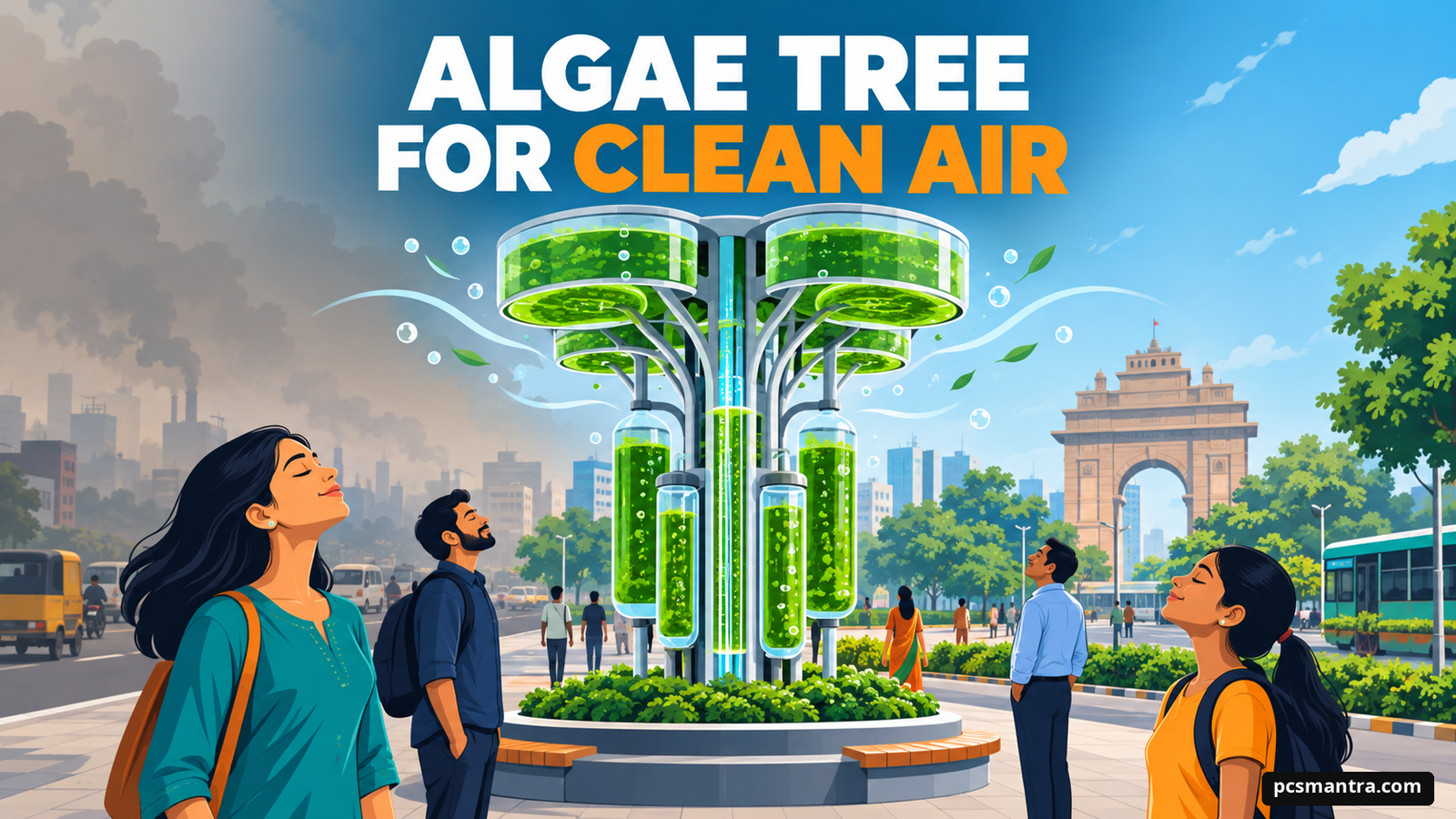
9 November 2026: In a first-of-its-kind initiative in Andhra Pradesh, the Guntur Municipal Corporation (GMC) has installed an 'Algae Tree' at Gandhi Park. The artificial 'tree' draws in polluted air, absorbs carbon dioxide and releases oxygen through natural photosynthesis. A single Algae Tree is considered to match the carbon absorption capacity of roughly 20-25 mature trees.
What the Algae Tree is
- Technology: Not a natural tree but a 600-litre water tank in which microalgae are grown; the algae take in CO2 from the air and release oxygen through photosynthesis.
- Cost and support: The pilot project was installed under the 'Nava Guntur' programme with CSR support from Lalitha Group of Hospitals at a cost of about Rs 5 lakh. Municipal Commissioner K Mayur Ashok shared the details.
- Capacity: Officials say one unit can release oxygen equivalent to about 25 large trees - a supplementary tool for improving urban air quality.
Algae and photosynthesis: for the exam
- Algae: Eukaryotic, photosynthetic organisms found mainly in aquatic environments; green, brown and red algae are the major groups. They are primary producers in ecosystems.
- Photosynthesis: Green plants, algae and some bacteria convert CO2 and water into glucose using sunlight and release oxygen - the very process the Algae Tree runs on.
- Limits: Such devices help locally, but the core solution to air pollution remains control of emission sources - vehicles, industry and dust.
Quiz: Test your knowledge
Q1: Where has Andhra Pradesh's first Algae Tree been installed?
(a) Visakhapatnam
(b) Gandhi Park, Guntur
(c) Vijayawada
(d) Tirupati
Answer and explanation: (b) Gandhi Park, Guntur - a Guntur Municipal Corporation pilot under the Nava Guntur programme with CSR support.
Q2: The Algae Tree's oxygen production is based on which process?
(a) Chemical decomposition
(b) Photosynthesis
(c) Respiration
(d) Fermentation
Answer and explanation: (b) Microalgae in a 600-litre water tank absorb CO2 and release oxygen through photosynthesis; one unit matches roughly 20-25 mature trees.
Mains Practice Question
How effective can technology-based initiatives like the algae tree be in solving urban air pollution? Discuss along with the importance of emission control. (Answer in 250 words - 15 marks)
Answer outline:
Introduction: Reference Guntur's algae tree; the challenge of urban air pollution.
Main body: The technology's working principle and limited capacity; a complementary device versus a core solution. Controlling emission sources (vehicles, industry, construction dust, stubble), public transport, green cover. Frameworks like NCAP and GRAP. An assessment of cost-effectiveness.
Conclusion: Innovative experiments bring awareness and local improvement, but the long-term solution lies in source control and policy commitment.
Frequently Asked Questions (FAQ)
In short: Guntur Municipal Corporation has installed Andhra Pradesh's first 'Algae Tree' at Gandhi Park - microalgae in a 600-litre tank absorb CO2 and release oxygen through photosynthesis; one unit equals about 20-25 trees.
Question: Where has the Algae Tree been installed?
At Gandhi Park in Guntur, Andhra Pradesh - the state's first such initiative.
Question: How does it work?
Microalgae grown in a 600-litre water tank absorb CO2 and release oxygen through photosynthesis.
Question: What did it cost, and who supported it?
About Rs 5 lakh, under the Nava Guntur programme with CSR support from Lalitha Group of Hospitals.
Sources:
- https://www.thehindu.com/news/national/andhra-pradesh/algae-based-artificial-tree-to-help-check-air-pollution-in-guntur/article71697256.ece
- https://timesofindia.indiatimes.com/city/vijayawada/guntur-installs-aps-first-algae-tree-to-combat-air-pollution/articleshow/135688510.cms
Download this article: PDF