
New developments: the symbolic event of 31 October; the rally of 1 November
Analysis context: 2-3 November 2026
Original publication: 1 November 2026
Article updated: 4 November 2026
Subject: Polity and Rights; Mains GS-II
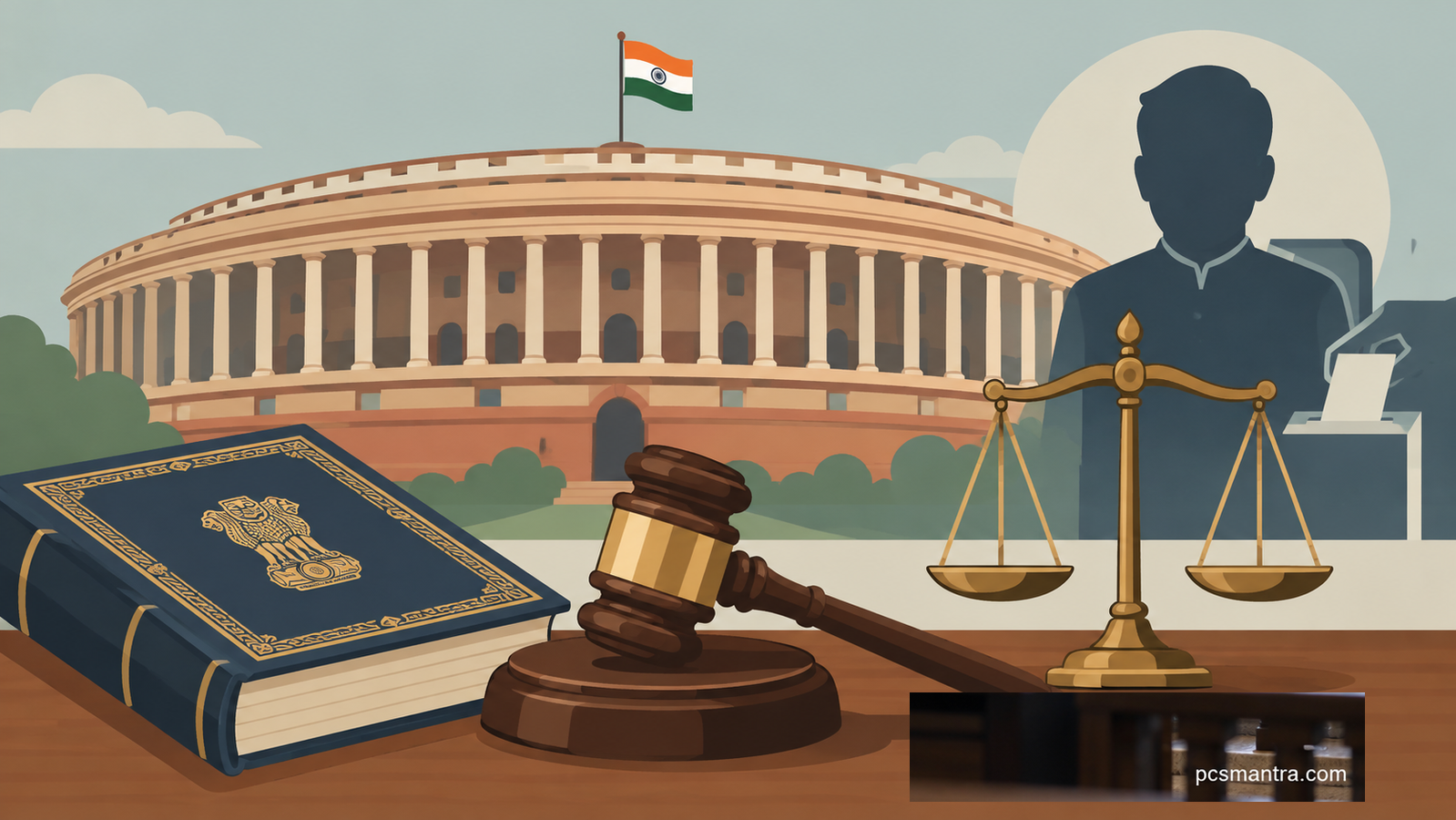
Original symbolic image: pcsmantra.com
Why in the News
Amid opposition to the SIR and the demand for removal of Chief Election Commissioner (CEC) Gyanesh Kumar, the Opposition held a symbolic 'people's impeachment' event in Delhi on Saturday, 31 October 2026. A rally followed at the Ramlila Maidan on Sunday, 1 November. According to reports in The Hindu and The Indian Express, the Opposition alleged irregularities in the electoral rolls. These are political allegations, not findings established by a court. The BJP criticised the symbolic parliamentary proceeding and defended the SIR.
The key distinction: a resolution passed at a public meeting, a 'mock Parliament' or a people's impeachment cannot by itself remove the CEC from office. Protest, demanding a resignation, and removal under the Constitution are different processes.
Keep facts, allegations and opinion separate
- Event: on 31 October a symbolic event was held at Mallikarjun Kharge's Delhi residence; former Lok Sabha Speaker Meira Kumar presided. The 1 November Ramlila Maidan rally was the next stage of the political protest.
- Controversy: the Opposition raised questions about the electoral rolls, the forms and the impartiality of the Commission. The allegations should be tested through the relevant records, statutory processes and judicial review. Repeating an allegation from a stage is not legal proof of it.
- Editorial opinion: The Indian Express editorial of 3 November asked the Opposition to focus on evidence and a clear political alternative. This is the newspaper's assessment.
- Author's opinion: Yogendra Yadav's article, published on 2 November and updated on 3 November, argued for keeping the movement centred on free and fair elections and democratic freedoms. This is his viewpoint, not a judicial order or a unanimous finding.
Crowd numbers and the disputed figures on voter deletions have not been treated as verified facts in this article. It is not necessary to accept any party's entire charge sheet in order to understand the constitutional process.
The constitutional process for removing the CEC
Article 324(5) says the CEC can be removed in the same manner and on the same grounds as a judge of the Supreme Court. This connects with Article 124(4). The ground for removal is proved misbehaviour or incapacity, not merely political disagreement or electoral defeat.
- In each House of Parliament, the address for removal must be supported by a majority of the total membership of that House and by at least two-thirds of the members present and voting. Both conditions apply together.
- The addresses of both Houses must be presented to the President in the same session.
- Removal then takes place by order of the President. A resolution of a gathering, or a vote in one House alone, does not complete the process.
This is the parliamentary-constitutional removal process. The word 'impeachment' is common in public discussion, but the precise text of Article 324(5) speaks of a judge-like procedure and grounds. Whether any formal motion has been filed, admitted or any charge proved must be checked against a separate official record; this article makes no such claim.
The difference between the CEC, other Commissioners and resignation
- CEC: the first proviso of Article 324(5) gives the protection of judge-like removal. After appointment, the CEC's conditions of service cannot be varied to his or her disadvantage.
- Other Election Commissioners and Regional Commissioners: under the second proviso of Article 324(5), they cannot be removed except on the recommendation of the CEC. This provision should not be read as 'the CEC alone can remove them'.
- Resignation: under Section 11(1) of the Chief Election Commissioner and Other Election Commissioners (Appointment, Conditions of Service and Term of Office) Act, 2023, the CEC or another Election Commissioner may resign by writing under his or her hand addressed to the President. Demanding a resignation and a resignation actually happening are different things.
- Repetition in the statute: the same Act repeats, in Section 11(2), the judge-like removal protection for the CEC and, in Section 11(3), the requirement of the CEC's recommendation for other Election Commissioners.
Appointment and removal are not one process
Article 324(2) ties appointment to the President, subject to any law made by Parliament. Section 7 of the 2023 Act places the Prime Minister, the Leader of the Opposition in the Lok Sabha and a Union Cabinet Minister nominated by the Prime Minister on the selection committee. Under Section 9 the term is six years or up to the age of 65, whichever is earlier. The conclusion that the committee that makes the appointment thereby acquires the power to remove the CEC by simple majority is wrong.
It is also not correct to say that the text of Article 324(5) on the constitutional protection of the CEC's conditions of service is identical for all Commissioners. The proviso to Section 10(1) of the 2023 Act gives a separate transitional protection for the salary, allowances and conditions of service of the CEC and other Commissioners in office immediately before the Act came into force. The scope of the two provisions is different.
The balance of independence and accountability
The difficult removal process gives the Commission institutional protection from immediate political pressure. That does not place the Commission's decisions beyond scrutiny. Reasoned orders, the statutory claims-and-objections process for electoral rolls, available judicial review, reliable information and public debate are important means of accountability.
In the exam, instead of repeating a party's slogan, ask three questions: what is the proof of the allegation; what is the statutory route of investigation and correction; and how will the affected voter get an effective remedy while institutional independence is preserved? The right of political protest and a lawful finding against an office-holder operate at different levels.
Mains Practice Question
'Security of tenure is necessary for the independence of the Election Commission, but it must come with credible accountability.' Discuss with reference to the constitutional process for removing the CEC and the recent symbolic people's impeachment. (250 words, 15 marks)
Answer Outline
Introduction: state the Commission's importance in free and fair elections and the difference between political protest and constitutional removal.
Main Body: mention Article 324(5), Article 124(4), the dual majority condition in each House, the addresses in the same session and the President's order. Write about the CEC's recommendation for other Commissioners and the separate process of resignation. Explain the independence rationale of a difficult removal process and the accountability that comes from reasoned decisions, transparent records, statutory remedies and judicial review. Do not treat political allegations as proved misbehaviour.
Conclusion: do not treat the protection of the institution and the protection of the citizen's right as opposing goals; connect evidence-based inquiry with a fair process.
Prelims Practice Questions
Question 1. Consider the following statements about removing the CEC:
Statement 1: Article 324(5) speaks of removing the CEC in the same manner and on the same grounds as a judge of the Supreme Court.
Statement 2: A majority of the total membership of each House and the support of at least two-thirds of those present and voting are required.
Statement 3: The CEC stands removed automatically on a simple majority of one House.
Which of the above are correct?
(a) 1 and 3 only
(b) 1 and 2 only
(c) 2 and 3 only
(d) 1, 2 and 3
Answer and Explanation
Answer: (b). Article 124(4)'s dual majority condition applies in each House; the addresses are presented to the President in the same session and removal takes place by the President's order.
Question 2. Consider the following statements about Election Commissioners:
Statement 1: Another Election Commissioner cannot be removed except on the recommendation of the CEC.
Statement 2: A symbolic impeachment by a public gathering can take the place of the President's order of removal.
Statement 3: Under Section 11(1), an Election Commissioner may resign by writing under his or her hand addressed to the President.
Which of the above are correct?
(a) 1 and 2 only
(b) 2 and 3 only
(c) 1 and 3 only
(d) 1, 2 and 3
Answer and Explanation
Answer: (c). The CEC's recommendation is a necessary condition for removing another Commissioner. Resignation is a separate process. A symbolic public resolution is no substitute for constitutional removal.
Question 3. Consider the following statements about the Election Commissioners appointment law of 2023:
Statement 1: The Section 7 selection committee includes the Prime Minister, the Leader of the Opposition in the Lok Sabha and a Union Cabinet Minister nominated by the Prime Minister.
Statement 2: Section 9 provides for a term of six years or up to the age of 65, whichever is earlier.
Statement 3: The selection committee that makes the appointment can also remove the CEC by simple majority.
Which of the above are correct?
(a) 1 and 3 only
(b) 1 and 2 only
(c) 2 and 3 only
(d) 1, 2 and 3
Answer and Explanation
Answer: (b). The appointment and removal processes are different. Section 11 and Article 324(5) give the CEC judge-like removal protection; the selection committee has not been given the power to remove by simple majority.
Sources and factual limits
- Legislative Department: the Constitution of India, Articles 124(4) and 324(5)
- India Code: original text of the 2023 Act, Sections 7, 9, 10 and 11
- The Hindu, 31 October 2026: report of the symbolic people's impeachment
- The Indian Express, 1 November 2026: report of the Ramlila Maidan rally
- The Indian Express, 3 November 2026: editorial opinion
- Yogendra Yadav, published 2 November / updated 3 November: personal opinion
The news events are of 31 October and 1 November 2026; the new analytical material is of 2-3 November. The article keeps political allegations, editorial opinion and the law separate. Original publication 1 November 2026; article updated 4 November 2026.
Download This Article: PDF
