
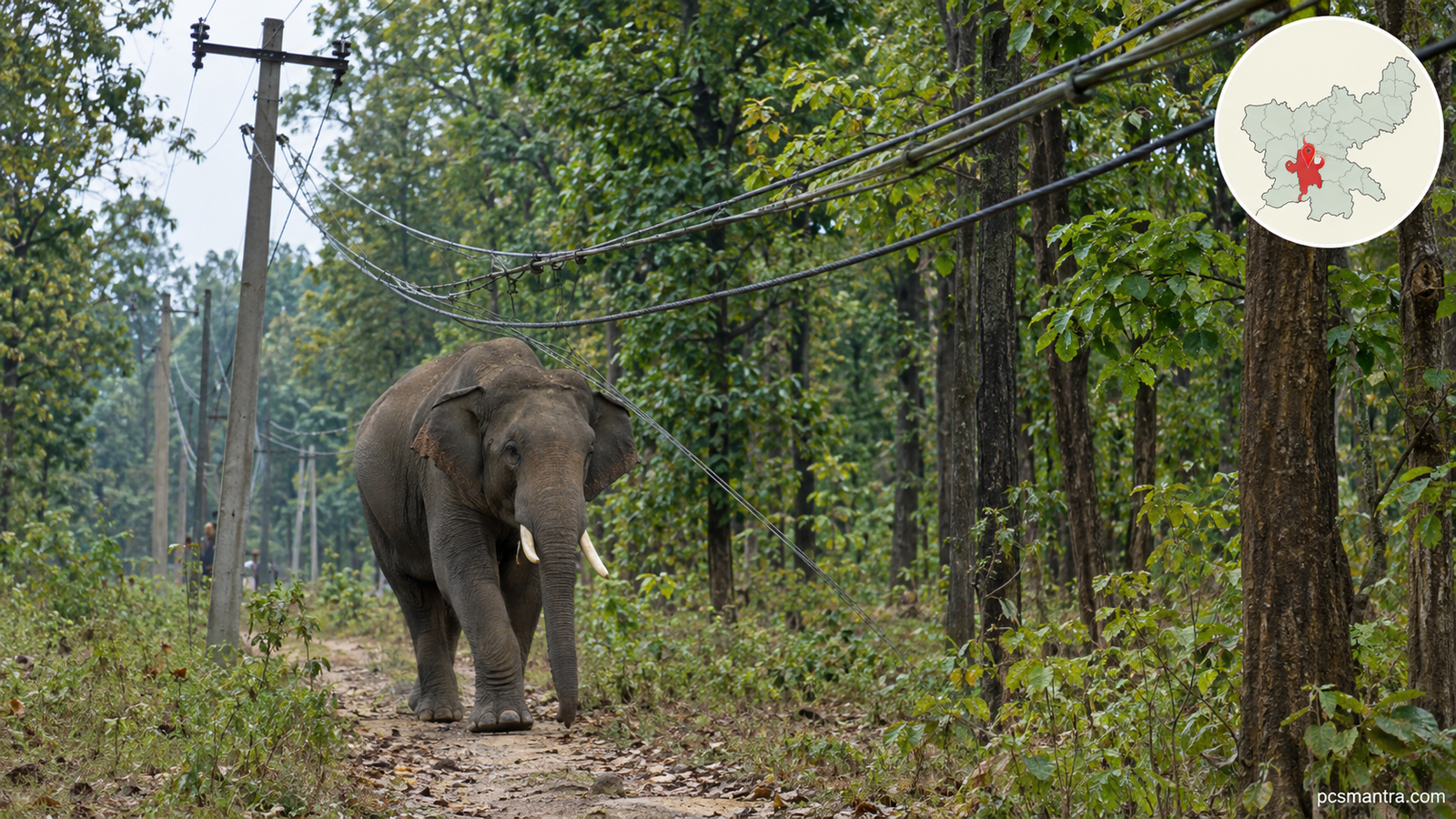
Why in the news
November 13, 2026: On 12 November 2026, an adult tusker about 25 years old, crossing the Koel river near Tetari village in the Rania area of Jharkhand's Khunti district, died of electrocution after coming into contact with a sagging 11,000-volt overhead power line. According to forest officials the line hung barely 7-8 feet above the ground and was hardly visible among bushes - close to a road leading to a school and used regularly by villagers and vehicles. Villagers allege that the electricity department took no action despite complaints. After the incident, the forest department ordered a survey of low-hanging lines in elephant corridors across Rania, Tapkara and other vulnerable areas.
Key facts of the incident
- Place and time: On the Rania-Sode main road near Tetari village; the preliminary examination put the time of death between 4 am and 6 am.
- Preliminary findings: Three distinct wire marks on the body; prima facie death by electrocution - the post-mortem report is awaited.
- Departmental response: Khunti's divisional forest officer said the electricity department had been informed earlier about sagging wires in elephant corridors; it will now be inspected whether corrective measures were taken.
- A pending plan: According to the electricity department's executive engineer, a detailed project report (DPR) on raising the wires in the elephant corridor was sent to the higher authorities over a year ago and is pending approval; in certain areas the maximum wire height is 14-15 feet, which sags between poles and can touch a large elephant raising its trunk.
The national picture: elephants dying by current
- The numbers: According to data of the Ministry of Environment, Forest and Climate Change (MoEFCC) and replies under the Right to Information, 741 elephants died of electrocution between 2009 and 2020; of the 510 conflict-related elephant deaths between 2014-15 and 2018-19, 333 (nearly two-thirds) were caused by electrocution.
- Two kinds of threat: One, illegal electric fencing - live wires put up in fields to protect crops; two, sagging or broken transmission and distribution lines. As per an affidavit before the Karnataka High Court, of 13 electrocution deaths in 2023-24, 10 were due to illegal fencing and 3 to sagging lines, while of 12 deaths in 2024-25, 6 were due to sagging lines - both threats remain active.
- Roots of the conflict: Habitat fragmentation, encroachment into corridors, and elephants reaching settlements in search of food and water - amid all this, electrical infrastructure has been laid without safety standards.
The legal-administrative framework and court directions
- Protected status: The elephant is listed in Schedule I of the Wildlife (Protection) Act, 1972, giving it the highest legal protection; 'Project Elephant' (1992) is the central scheme for the conservation of the elephant, its habitats and corridors.
- MoEFCC guidelines (24 October 2016): Guidelines were issued preferring aerial bunched cables (ABC - a bunch of insulated conductors twisted together) or underground cables for distribution lines passing through forest areas.
- Karnataka High Court (2025): Issued directions including e-surveillance and underground cabling; monitoring of the implementation of the 2016 guidelines, joint inspection of sagging lines by the forest and energy departments with maintenance of adequate height, and adherence to the minimum-height norms fixed by the National Board for Wildlife (NBWL) for hilly terrain.
- Public interest litigation in the Supreme Court (2022): Notice was issued on elephant deaths by electrocution; the petition had sought insulation of high-voltage lines passing through protected areas and elephant corridors, and implementation of the recommendations of the 'Gajah' report (2010).
Routes to a solution
- Technical: Insulated or underground cables in elephant-bearing areas; strict adherence to minimum-height standards and regular checks for sag; action against illegal electric fencing and promotion of safe solar fencing.
- Institutional: Time-bound information exchange and joint inspection between the forest and electricity departments; faster approval of plans like DPRs; verification of elephant corridors and built-in safety conditions in power projects from the start.
- Monitoring: E-surveillance, patrolling and a rapid-response mechanism for villagers' complaints - the Khunti incident shows how fatal delay can be even after a complaint is recorded.
Way forward
The Khunti incident is no exception but the latest chapter of a pattern: pending DPRs, unheard complaints and lines sagging below standards. The solution to human-elephant conflict cannot be left to the forest department alone - the energy department, state governments and regulators must all be brought to one table. Ordering a survey is the first step; the real test is repairing the lines, approving the pending projects and fixing accountability. A line that can kill an adult elephant is just as lethal to any villager - adherence to safety standards is now a duty, not an option.
Prelims practice questions
Question 1. With reference to the conservation of the Indian elephant, consider the following statements: Statement 1: The elephant is listed in Schedule I of the Wildlife (Protection) Act, 1972 Statement 2: 'Project Elephant' is a central scheme launched in 1992 Statement 3: MoEFCC guidelines of 2016 preferred aerial bunched cables or underground cables for distribution lines in forest areas How many of the above statements are correct?
(a) Only one
(b) Only two
(c) All three
(d) None
Answer and explanation
Answer: (c)
Statement 1: The elephant is in Schedule I of the Wildlife (Protection) Act, 1972, which gives it the highest protection, so this statement is correct. Statement 2: Project Elephant was launched in 1992, so this statement is correct. Statement 3: The guidelines of 24 October 2016 preferred ABC or underground cables in forest areas, so this statement is also correct.
Question 2. In the context of human-elephant conflict, which of the following best describes an 'elephant corridor'?
Which one of the above is correct?
(a) A narrow strip of land that connects two habitat patches of elephants and through which they regularly move
(b) A safari track built for tourists inside a national park
(c) An area where elephants are held captive and trained
(d) A line of artificial waterholes created by the forest department
Answer and explanation
Answer: (a)
An elephant corridor is a narrow strip of land connecting fragmented habitats, allowing elephants to move for food, water and breeding; securing them is the key to reducing conflict. The other options do not define a corridor.
Mains practice question
"Sagging power lines and illegal electric fences are the silent but lethal dimensions of human-elephant conflict." Discuss the statement with reference to the Khunti incident and suggest long-term solutions. (250 words, 15 marks)
Answer outline:
In the introduction: The Khunti incident (12 November 2026) - a sagging 11,000-volt line, death of a 25-year-old tusker.
In the body: Extent of the problem - 741 electrocution deaths in 2009-2020; two-thirds of conflict deaths; illegal fencing versus sagging lines. Causes - habitat fragmentation, pending DPRs, inter-departmental disconnect, neglect of standards. Legal framework - WPA 1972 (Schedule I), MoEFCC guidelines 2016, Karnataka High Court 2025, NBWL height norms. Solutions - insulated/underground cables, minimum height and regular inspection, e-surveillance, joint departmental mechanism, corridor verification.
In the conclusion: Fixing accountability and time-bound implementation is the real solution.
Frequently Asked Questions (FAQ)
Summary answer: November 13, 2026: On 12 November 2026, an adult tusker about 25 years old, crossing the Koel river near Tetari village in the Rania area of Jharkhand's Khunti district, died of electrocution after coming into contact with a sagging 11,000-volt overhead power line.
Question: How low was the power line in the Khunti incident?
Barely 7-8 feet above the ground; the 11,000-volt line was hardly visible among bushes and lay close to a road leading to a school.
Question: What do the MoEFCC guidelines of 2016 say?
The guidelines of 24 October 2016 preferred aerial bunched cables (ABC) or underground cables for distribution lines passing through forest areas.
Question: What legal status does the elephant have?
It is listed in Schedule I of the Wildlife (Protection) Act, 1972 - the highest protection; Project Elephant has run as a conservation scheme since 1992.
Sources
- [Press] https://timesofindia.indiatimes.com/city/ranchi/tusker-electrocuted-by-sagging-power-line-in-khunti-forest-department-orders-survey/articleshow/135772900.cms
- [Press] https://www.newindianexpress.com/india/2026/Nov/12/wild-tusker-electrocuted-to-death-in-jharkhands-khunti
- [Press] https://www.livelaw.in/high-court/karnataka-high-court/karnataka-high-court-order-elephants-electrocution-deaths-karnataka-government-291390
- [Press] https://www.livelaw.in/top-stories/elephant-deaths-due-to-electrocution-supreme-court-issues-notice-on-pil-188795
- [Press] https://www.livemint.com/Politics/owyjGRSyV4cRhMpPuMUmMO/New-rules-for-building-power-lines-in-forests-to-save-animal.html
Download This Article: PDF